

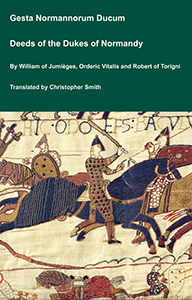
The Deeds of the Dukes of Normandy
The Gesta Normannorum Ducum [The Deeds of the Dukes of Normandy] is a landmark medieval chronicle tracing the rise and fall of the Norman dynasty from its early roots through the pivotal events surrounding the Norman Conquest of England. Originally penned in Latin by the monk William of Jumièges shortly before 1060 and later expanded at the behest of William the Conqueror, the work chronicles the deeds, politics, battles, and leadership of the Norman dukes, especially William’s own claim to the English throne. The narrative combines earlier historical sources with firsthand information and oral testimony to present an authoritative account of Normandy’s transformation from a Viking settlement into one of medieval Europe’s most powerful realms. William’s history emphasizes the legitimacy, military prowess, and governance of the Norman line, framing their expansion, including the conquest of England, as both divinely sanctioned and noble in purpose. Later chroniclers such as Orderic Vitalis and Robert of Torigni continued the history, extending the coverage into the 12th century, providing broader context on ducal rule and its impact. Today this classic work remains a foundational source for understanding Norman identity, medieval statesmanship, and the historical forces that reshaped England and Western Europe between 800AD and 1100AD.
Available at Amazon in eBook and Paperback format.
Stonor Letters is in Letters.
The Stonor letters and papers, 1290-1483; ed. for the Royal historical society, from the original documents in the Public record office, by Charles Lethbridge Kingsford.
6th March 1478. Elizabeth Croke [aged 38] to William Stonor [aged 28].
Ryght reverent and worschypffull and interely best belovyde husbonde, I recomaunde me unto you in the most harteyste wyse hever more desyryng to here off your goode wellfare, the wyche I pray God longe to contune unto your hartys desyr. Syr, I resayved a tokyn ffrom you by Tawbose, my lorde Lovellys [aged 22] sarvant. And Syr, I have sent my lorde Lovell a tokyn and my ladys, as ye comaunde me to do, schuche as schalle plese them. Syr, ye schalle understonde that þe beschope off Bathe [aged 58] ys browthe in to the Towre [Map] syne you departyd. Allso Syr, ye schalle understonde that þe wolle hooys departe, as to morw is, ffor as I understonde: I pray Jhesu by thayr goode spede: and Goodard. [Goddard Oxbryge.] departys allso: and I pray you that ye wylle sende me som off your sarvantys and myne to wayte upone me, ffor now I ame ryght bare off sarvantys, and þat ye know well. Syr, I sent you halffe a honder welkys by Gardenar, and I wollde have sent you som hoder desys, but truly I cowde not get none: but and I cane get hony to morow, syr Wylliam salle bryng hyt with hym. Syr, I pray you that I may be recomaundehyde unto my masterys your moder, and unto all goode ffrendys. No more unto you at thys tym, but þe blesyde Trenyte have you in hys kepyng now and hever. Amen. At London þe vj day off Marche.
Cossen, I was crasyd þat the makyng off thys letter, but I thanke God I am ryght well amendyd, blesyd by Jhesu.
By your owen wyff Elysabeth Stonore.
To my ryght reverent and worschypffull Cosyn, syr Wyllm. Stonor, knyght.