

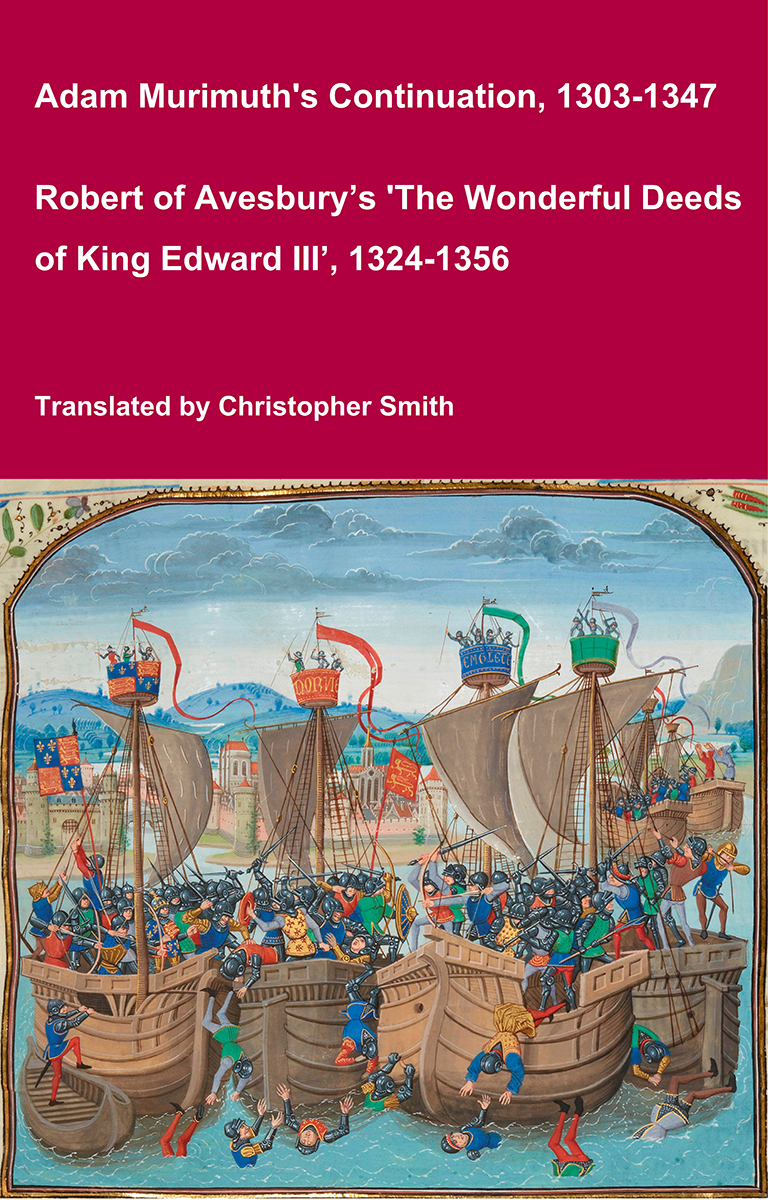
Adam Murimuth's Continuation and Robert of Avesbury’s 'The Wonderful Deeds of King Edward III'
This volume brings together two of the most important contemporary chronicles for the reign of Edward III and the opening phases of the Hundred Years’ War. Written in Latin by English clerical observers, these texts provide a vivid and authoritative window into the political, diplomatic, and military history of fourteenth-century England and its continental ambitions. Adam Murimuth Continuatio's Chronicarum continues an earlier chronicle into the mid-fourteenth century, offering concise but valuable notices on royal policy, foreign relations, and ecclesiastical affairs. Its annalistic structure makes it especially useful for establishing chronology and tracing the development of events year by year. Complementing it, Robert of Avesbury’s De gestis mirabilibus regis Edwardi tertii is a rich documentary chronicle preserving letters, treaties, and official records alongside narrative passages. It is an indispensable source for understanding Edward III’s claim to the French crown, the conduct of war, and the mechanisms of medieval diplomacy. Together, these works offer scholars, students, and enthusiasts a reliable and unembellished account of a transformative period in English and European history. Essential for anyone interested in medieval chronicles, the Hundred Years’ War, or the reign of Edward III.
Available at Amazon in eBook and Paperback format.
Surtees is in Surtees.
Whitehorse Hill.
Oct. 3, 1758. My daughter [Anna] Fairchild having been in Barkshire, gave me an account of Whitehorse-hill, and the places thereabouts; the remains of a round temple23 of the Druids called Wayland Smith [Map]. Here the country people have a notion of an invisible smith living there; and if a traveller's horse happens to lose a shoe, leave him there, and a penny, and your horse shall be well shooed. I have often taken notice of these magic notions affixed to Druid temples. The figure of the horse24 on the side of the hill is poorly dravi'n, though of an immense bulk: but, she says, very much in the scheme of the Brittish horses on the reverse of their coins. They found a quantity of gold Brittish coins near there lately, hollow, and like of Cunobeline. Near the white horse, upon the hill, is a large tumulus, which they call pendragon. I believe this hill was one of their places of horse and chariot races at the midsummer sacrifice in the times of the Brittish kings, like that of black Hameldon in Yorkshire, it being a fine down. — Diary, vol. xviii., 12.
Note 23. A chambered round barrow, with formerly a ring of stones at the base of the mound. The chamber is cruciform in plan.
Note 24. Near Uffington Castle, a rude figure of a horse, formed by cutting away the turf upon the side of the chalk hill, of great antiquity; supposed by some to have been a work of the Britons, and by others to be a memorial of Alfred's victory over the Danes. Just under whitehorse-hill is a round hill called dragon-hill, but whether artificial or not. is held to be doubtful. The ancient figure of the horse gives its name to the adjoining vale. — Lysons' Magn. Brit, vol. i.. 215,301.