

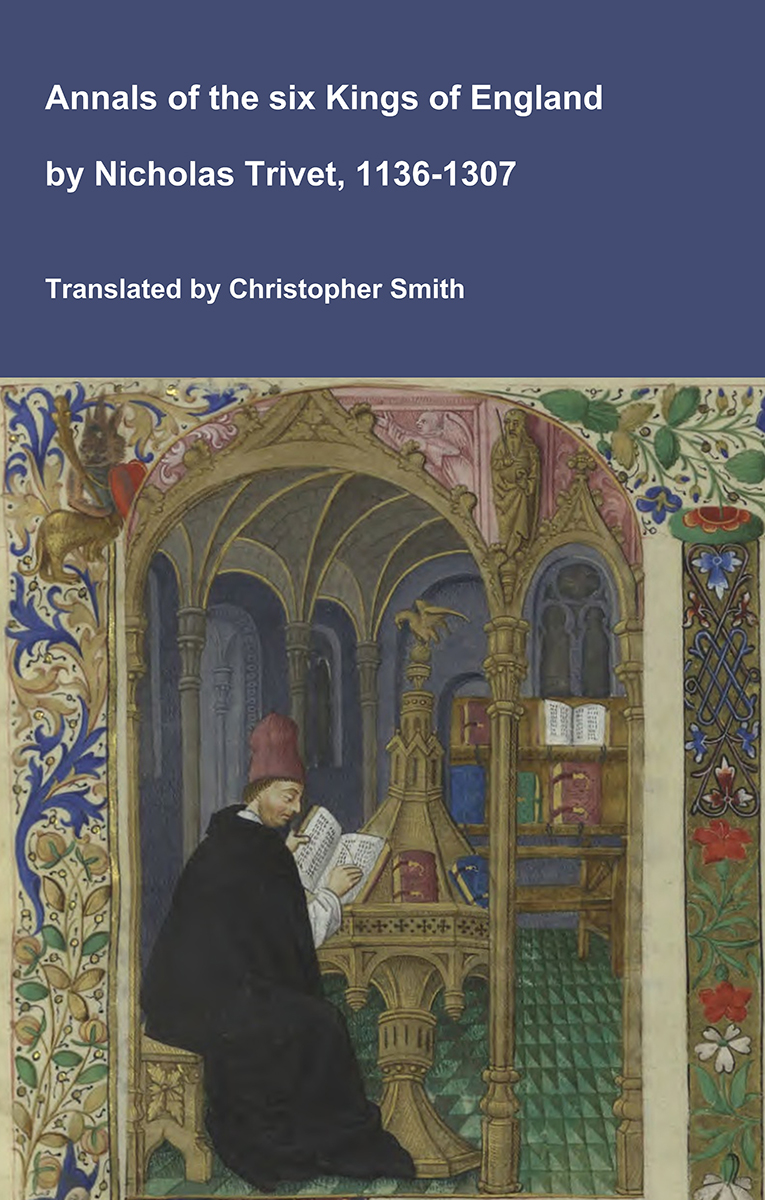
Annals of the six Kings of England by Nicholas Trivet
Translation of the Annals of the Six Kings of England by that traces the rise and rule of the Angevin aka Plantagenet dynasty from the mid-12th to early 14th century. Written by the Dominican scholar Nicholas Trivet, the work offers a vivid account of English history from the reign of King Stephen through to the death of King Edward I, blending political narrative with moral reflection. Covering the reigns of six monarchs—from Stephen to Edward I—the chronicle explores royal authority, rebellion, war, and the shifting balance between crown, church, and nobility. Trivet provides detailed insight into defining moments such as baronial conflicts, Anglo-French rivalry, and the consolidation of royal power under Edward I, whose reign he describes with particular immediacy. The Annals combines careful year-by-year reporting with thoughtful interpretation, presenting history not merely as a sequence of events but as a moral and political lesson. Ideal for readers interested in medieval history, kingship, and the origins of the English state, this chronicle remains a valuable and accessible window into the turbulent world of the Plantagenet kings.
Available at Amazon in eBook and Paperback format.
The Edinburgh Medical and Surgical Journal is in Victorian Books.
78th Regiment. The 78th and 86th Regiments arrived from England in August 1842. The first was sent to Poona for twelve months, and then to Kurrachee. There, in the quarter ending December 1843, it lost forty-three men, chiefly from fever and dysentery. In the third quarter of 1844, the regiment, divided betwixt Sukkiir and Hydrabad, on the Indus, lost 231 men, — 141 from remittent fever, the remainder from bowel complaints chiefly. In the last quarter of 1845, the 78th had been removed to Bombay, and lost 276 men, the predominant cause being, not fever, as in the third quarter, but acute and chronic dysentery, to which 244 of the deaths were referred, and six more to diarrmhea, leaving only sixteen for all other diseases. The regiment has been stationed at Belgaum since December 1847, and has there enjoyed excellent health.