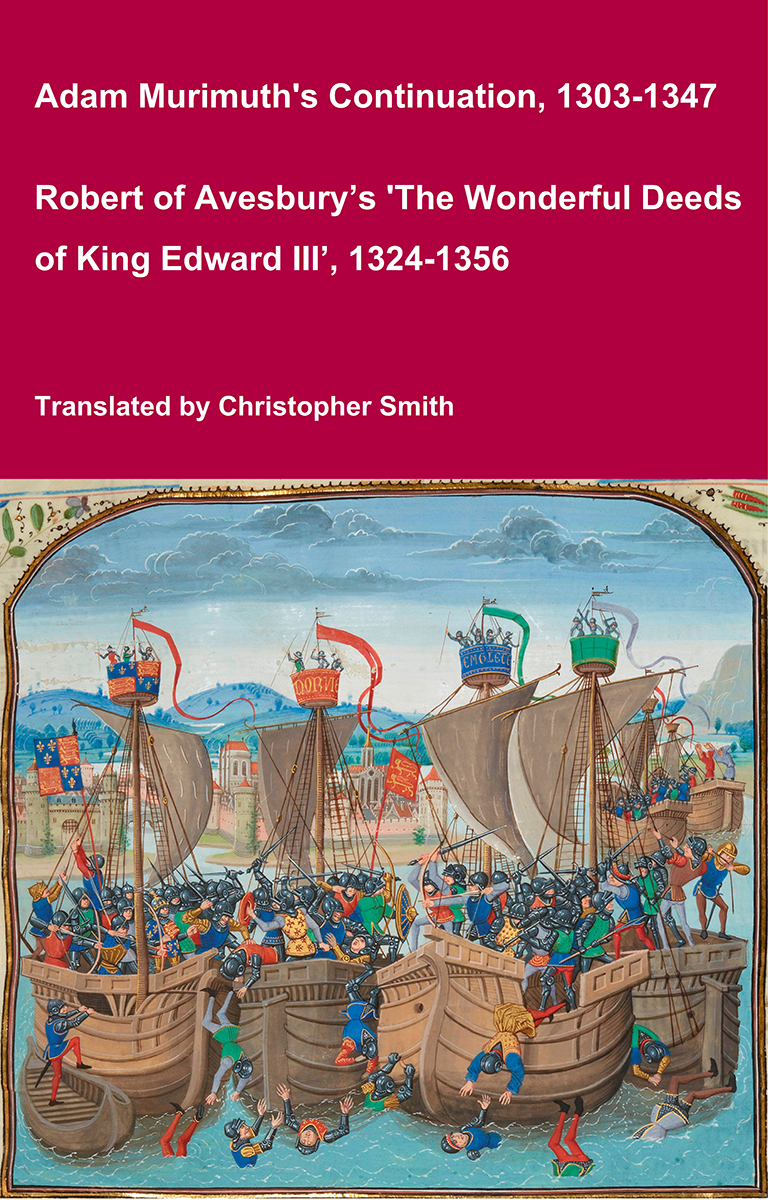
Adam Murimuth's Continuation and Robert of Avesbury’s 'The Wonderful Deeds of King Edward III'
This volume brings together two of the most important contemporary chronicles for the reign of Edward III and the opening phases of the Hundred Years’ War. Written in Latin by English clerical observers, these texts provide a vivid and authoritative window into the political, diplomatic, and military history of fourteenth-century England and its continental ambitions. Adam Murimuth Continuatio's Chronicarum continues an earlier chronicle into the mid-fourteenth century, offering concise but valuable notices on royal policy, foreign relations, and ecclesiastical affairs. Its annalistic structure makes it especially useful for establishing chronology and tracing the development of events year by year. Complementing it, Robert of Avesbury’s De gestis mirabilibus regis Edwardi tertii is a rich documentary chronicle preserving letters, treaties, and official records alongside narrative passages. It is an indispensable source for understanding Edward III’s claim to the French crown, the conduct of war, and the mechanisms of medieval diplomacy. Together, these works offer scholars, students, and enthusiasts a reliable and unembellished account of a transformative period in English and European history. Essential for anyone interested in medieval chronicles, the Hundred Years’ War, or the reign of Edward III.
Available at Amazon in eBook and Paperback format.
The London Gazette 35000-39999 is in The London Gazette.
War Office, 20th December, 1940. The King has been pleased to approve of the undermentioned awards in recognition of gallant conduct in action with the enemy:-
THE DISTINGUISHED SERVICE ORDER.
Lieutenant (Temp. Major) PHILIP HARKER NEWMAN, F.R.C.S., Royal Army Medical Corps.
THE MILITARY CROSS.
Captain (Temp. Major) Antony Henry Head (age 34), The Life Guards.
Whitehall, February 4, 1941. The King has been pleased, by Letters Patent under the Great Seal of the Realm, bearing date the 25th ultimo, to confer the dignity of a Barony of the United Kingdom upon the Right Honourable Hugh Richard Heathcote Gascoyne-Cecil (age 71) (commonly called Lord Hugh Richard Heathcote Gascoyne Cecil), and the heirs male of his body lawfully begotten, by the name, style and title of Baron Quickswood, Of Clothall In The County Of Hertford.

Central Chancery Of The Orders Of Knighthood.
St. James's Palace, S.W.1. 18th July, 1941.
The King has been gracidusly pleased to award the GEORGE CROSS to:-
Charles Henry George Howard, Earl of Suffolk and Berkshire (deceased), Chief Field Research and Experimental Officer, Directorate of Scientific Research, Ministry of Supply.
For conspicuous bravery in connection with bomb disposal.
Whitehall, August 19, 1941. The King has been pleased by Letters Patent under the Great Seal of the Realm, bearing date the 14th instant, to confer the dignity of a Barony of the United Kingdom upon Sir Hugh Michael Seely (age 42), Bt., arid the heirs male of his body lawfully begotten, by the name, style and title of Baron Sherwood, of Calverton in the county of Nottingham.
Flg. Offs. to be Flt. Lts. (war subs.): 3rd Sept. 1941.
W. R. L. BEAUMONT (72979).
N. BICKNELL, D.F.C. (73041).
R. C. CHOPPING (70126).
The Hon. D. A. COKE (age 25) (73042).
E. J. MARTIN (73004).
Supplement to the The London Gazette 36679. 31st August 1944.
The Distinguished Service Order
Major (temporary Lieutenant-Colonel) Robin Hood William Stewart Hastings, M.C. (70912), The Rifle Brigade (Prince Consort's Own) (attd. The Green Howards (Alexandra, Princess of 'Wales's Own Yorkshire Regiment)) (Moreton-in-Marsh)
Whitehall, July 6, 1945.
The King has been pleased, by Letters Patent under the Great Seal of the Realm, bearing date the 2nd instant, to confer the dignity of a Viscounty of .the United Kingdom upon the Right Honourable Christopher, Baron Addison (age 77), and the heirs male of his body lawfully begotten, by the name, style and title of Viscount Addison, of Stallingborough in the County of Lincoln. [Dorothy Low Viscountess Addison by marriage Viscountess Addison of Stallingborough in Lincolnshire]
Whitehall, October 19, 1945. The King has been pleased, by Letters Patent under the Great Seal of the Realm, bearing date the 19th ultimo, to confer the dignity of a Barony of the United Kingdom upon Field-Marshal Sir Alan Francls Brooke (age 62), G.C.B., D.S.O., and the heirs male of his body lawfully begotten, by the name, style and title of Baron Alanbrooke, of Brookeborough in the County of Fermanagh.
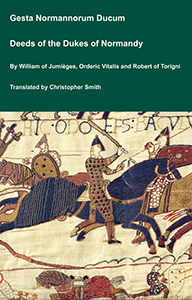
The Deeds of the Dukes of Normandy
The Gesta Normannorum Ducum [The Deeds of the Dukes of Normandy] is a landmark medieval chronicle tracing the rise and fall of the Norman dynasty from its early roots through the pivotal events surrounding the Norman Conquest of England. Originally penned in Latin by the monk William of Jumièges shortly before 1060 and later expanded at the behest of William the Conqueror, the work chronicles the deeds, politics, battles, and leadership of the Norman dukes, especially William’s own claim to the English throne. The narrative combines earlier historical sources with firsthand information and oral testimony to present an authoritative account of Normandy’s transformation from a Viking settlement into one of medieval Europe’s most powerful realms. William’s history emphasizes the legitimacy, military prowess, and governance of the Norman line, framing their expansion, including the conquest of England, as both divinely sanctioned and noble in purpose. Later chroniclers such as Orderic Vitalis and Robert of Torigni continued the history, extending the coverage into the 12th century, providing broader context on ducal rule and its impact. Today this classic work remains a foundational source for understanding Norman identity, medieval statesmanship, and the historical forces that reshaped England and Western Europe between 800AD and 1100AD.
Available at Amazon in eBook and Paperback format.
Admiralty. Whitehall, 13th November, 1945. The King has been graciously pleased to approve the award of the VICTORIA CROSS for valour to: —
the late Temporary Lieutenant Robert Hampton Gray, R.C.N.V.R., for great valour in leading an attack on a Japanese destroyer in Onagawa Wan on 9th 2August, 1945. In the face of fire from shore batteries and a heavy concentration of fire from some five warships Lieutenant Gray pressed home his attack, flying very low in order to ensure success, and, although he was hit and his aircraft was in flames, he obtained at least one direct hit, sinKing the destroyer. Lieutenant Gray has consistently shown a brilliant fighting spirit and most in spiring leadership
Lieutenant Ian Edward FRASER, D.S.C., R.N.R. Lieutenant Fraser commanded His Majesty's Midget Submarine XE-3 in a successful attack on a Japanese heavy cruiser of the Atago class at her moorings in Johore Strait, Singapore, on 3ist July, 1945- Bur ing the long approach up the Singapore Straits XE-3 deliberately left the believed safe channel and entered mined waters to avoid suspected hydrophone posts. The target was aground, or nearly aground, both fore and aft, and only under the midship portion was there just sufficient water for XE-3 to place herself under the cruiser. For forty minutes XE-3 pushed her way along the seabed until finally Lieutenant Fraser managed to force her right under the centre of the cruiser. Here he placed the limpets and dropped his main side charge. Great difficulty was ex perienced in extricating the craft after the attack had been completed, but finally XE-3 was clear, and commenced her long return journey out to sea. The courage and deter mination of Lieutenant Fraser are beyond all praise. Any man not possessed of his re lentless determination to achieve his object in full, regardless of all consequences, would have dropped his side charge along side the target instead of persisting until he had forced his submarine right under the cruiser. The approach and withdrawal en tailed a passage of 80 miles through water which had been mined by both the enemy and ourselves, past hydrophone positions, over loops and controlled minefields, and through an anti-submarine boom.
[13th November 1945]. Temporary Acting Leading Seaman James Joseph Magennis (age 26), D/JX. 144907. Leading Seaman Magennis served as Diver in His Majesty's Midget Submarine XE-3 for her attack on 31st July, 1945, on a Japanese cruiser of the Atago class. Owing to the fact that XE-3 was tightly jammed under the target the diver's hatch could not be fully opened, and Magennis had to squeeze himself through the narrow space available. He experienced great difficulty in placing his limpets on the bottom of the cruiser owing both to the foul state of the bottom and to the pronounced slope upon which the limpets would not hold. Before a limpet could be placed therefore Magennis had thoroughly to scrape the area clear of barnacles, and in order to secure the limpets he had to tie them in pah's by a line passing under the cruiser keel. This was very tiring work for a diver, and he was moreover handicapped by a steady leakage of oxygen which was ascending in bubbles to the surface. A lesser man would have been content to place a few limpets and then to return to the craft. .Magennis, however, persisted until he had placed his full outfit before returning to the craft in an exhausted condition. Shortly after withdrawing Lieutenant Fraser endeav oured to jettison his limpet carriers, but one of these would not release itself and fall clear of the craft. Despite his exhaustion, his oxygen leak and the fact that there was every probability of his being sighted, Magennis at once volunteered to leave the craft and free the carrier rather than allow a less experi enced diver to undertake the job. After seven minutes of nerve-racKing work he succeeded in releasing the carrier. Magennis displayed very great courage and devotion to duty and complete disregard for his own safety.
CENTRAL CHANCERY OF THE ORDERS OF KNIGHTHOOD.
St. James's Palace, S.W.1. 1st January, 1946.
The King has been graciously pleased to signify His Majesty's intention of conferring Peerages of the United Kingdom on the following military war leaders: —
To be Viscounts:
Field-Marshal the Right Honourable Alan Francis, BARON ALANBROOKE (age 62) [Viscount Alanbrook], G.C.B., D.S.O., Aide-de-Camp General to the King.
Field-Marshal the Honourable Sir Harold Rupert Leofric George ALEXANDER, G.C.B., C.S.I., D.S.O., M.C., Aide-de-Camp General to the King.
Admiral of the Fleet the Right Honourable Andrew Browne, BARON CUNNINGHAM OF HYNDHOPE, K.T., G.C.B., D.S.O.
Field-Marshal Sir Bernard Law MONTGOMERY (age 58) [Viscount Montgomery of El Alamein], G.C.B., D.S.O.
Marshal of the Royal Air Force the Right Honourable Charles Frederick . Algernon, BARON PORTAL OF HUNGERFORD, G.C.B., D.S.O., M.C.
To be Barons:
Admiral Sir Bruce Austin FRASER, G.C.B., K.B.E.
Marshal of the Royal Air Force Sir Arthur William TEDDER, G. C. B.
Admiral of the Fleet Sir John Cronyn TOVEY, G.C.B., K.B.E., D.S.O., First and Principal Naval Aide-de-Camp to the King.
Field-Marshal Sir Henry Maitland WILSON, G.C.B., G.B.E., D.S.O., Aide-de-Camp General to the King.
War Office, 7th February, 1946.
The King has been graciously pleased to approve the posthumous award of the VICTORIA CROSS to:—
Lieutenant The Honourable Christopher FURNESS (53422), Welsh Guards.
Lieutenant the Honourable C Furness was in command of the Carrier Platoon, Welsh Guards, during the period 17th-24th May, 1940, when his Battalion formed part of the garnson of Arras. During this time his Platoon was constantly patrolling in advance of or between the widely dispersed parts of the perimeter, and fought many local actions with the enemy Lieutenant Furness displayed the highest qualities of leadership and dash on all these occasions and imbued his command with a magnificent offensive spirit.
During the evening of 23rd May, Lieutenant Furness was wounded when on patrol but he refused to be evacuated By this time the enemy, considerably reinforced, had encircled the town on three sides and withdrawal to Douai was ordered during the night of 23rd-24th May. Lieutenant Furness's Platoon, together with a small force of light tanks, were ordered to cover the withdrawal of the transport consisting of over 40 vehicles.
About 02 30 hours, 24th May, the enemy attacked on both sides of the town At one point the enemy advanced to the road along which the transport columns were withdrawing, bringing them under very heavy small arms and anti-tank gun fire. Thus the whole column was blocked and placed in serious jeopardy Immediately Lieutenant Furness, appreciating the seriousness of the situation, and in spite of his wounds, decided to attack the enemy, who were located in a strongly entrenched position behind wire.
Lieutenant Furness advanced with three Carriers, supported by the light tanks. At once the enemy opened up with very heavy fire from small arms and anti-tank guns The light tanks were put out of action, but Lieutenant Furness continued to advance He reached the enemy position and circled it several times at close range, inflicting heavy losses. All three Carriers were hit and most of their crews killed or wounded. Hts own Carrier was disabled and the driver and Bren gunner killed. He then engaged the enemy in personal hand-to-hand combat until he was killed His magnificent act of self sacrifice against hopeless odds, and when already wounded, made the enemy withdraw for the time being and enabled the large column of vehicles to get clear unmolested and covered the evacuation of some of the wounded of his own Carrier Platoon and the light tanks.
Whitehall, January 31, 1950. The King has been pleased, by Letters Patent under the Great Seal of the Realm, bearing date the 31st instant, to confer the dignitiy of a Barony of the United Kingdom upon Sir Alexander Steven Bilsland (age 57), Baronet, M.C., and the heirs male of his body lawfully begotten, by the name, style and title of Baron Bilsland of Kinrara in the County of Inverness.
Whitehall, July 8, 1952
The Queen has been pleased by Letters Patent under the Great Seal of the Realm, bearing date the 5th instant, to confer the dignity of a Viscount of the United Kingdom upon the Right Honourable Sir Alfred Duff Cooper (age 62), GCMG, DSO, and the heirs male of his body lawfully begotten, by the name, style and title of VISCOUNT NORWICH, of Aldwick in the County of Sussex. [Diana Manners Viscountess Norwich (age 60) by marriage Viscountess Norwich of Aldwick in Sussex.]