

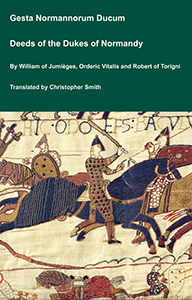
The Deeds of the Dukes of Normandy
The Gesta Normannorum Ducum [The Deeds of the Dukes of Normandy] is a landmark medieval chronicle tracing the rise and fall of the Norman dynasty from its early roots through the pivotal events surrounding the Norman Conquest of England. Originally penned in Latin by the monk William of Jumièges shortly before 1060 and later expanded at the behest of William the Conqueror, the work chronicles the deeds, politics, battles, and leadership of the Norman dukes, especially William’s own claim to the English throne. The narrative combines earlier historical sources with firsthand information and oral testimony to present an authoritative account of Normandy’s transformation from a Viking settlement into one of medieval Europe’s most powerful realms. William’s history emphasizes the legitimacy, military prowess, and governance of the Norman line, framing their expansion, including the conquest of England, as both divinely sanctioned and noble in purpose. Later chroniclers such as Orderic Vitalis and Robert of Torigni continued the history, extending the coverage into the 12th century, providing broader context on ducal rule and its impact. Today this classic work remains a foundational source for understanding Norman identity, medieval statesmanship, and the historical forces that reshaped England and Western Europe between 800AD and 1100AD.
Available at Amazon in eBook and Paperback format.
Tudor Books is in Books.
The Chronicles of London. Edited with Introduction and Notes by Charles Lethbridge Kingsford, M.A. St. John's College, Oxford. Oxford at the Clarendon Press 1905.
Table of the Governor-General of the Netherlands, at the beginning of the sixteenth century.
History of Mary Queen of Scots by Adam Blackwood
History of Mary Queen of Scots by Adam Blackwood, translated from the Original French, 1834.
Manuscripts of J Eliot Hodgkin
14th August 1514. Sir Thomas Boleyn [aged 37] to Margaret of Austria [aged 34], Governor of the Netherlands. Greenwich.
Perambulation of Kent by William Lambarde
A Perambulation of Kent containing the Description, History and Customs of that Shire. Written in the year 1570, by William Lambarde, of Lincoln's Inn, Gent: First published in the Year 1576.
The History of England under Henry VIII
The History of England under Henry VIII. By Edward Herbert 1st Baron Herbert Chirbury [aged 65]. 1870.
The Life and Reign of King Edward VI
At this time the seditious lived by rapine and ruine of all the country, omitting nothing of that which savages enraged in the height of their unruly behaviour doe commit, but the Citizens driven to great distresse for want of vicuales, bread they made of coursest branne moulded in cloathes, for that otherwise it would not cleave together. Their finest flesh was of their owne horses, especially for 12 daies they endured most extreame famine. During this time they were much encouraged by an aged cittizen, who brought forth all his provisions and said, that as hee did communicate unto them his store, so would he participate of their wants. And that for his part he would feed on the one arme and fight with the other before he would consent to put the citty into the seditious hands. Herewith the Lord privy Seale [John Russell 1st Earl Bedford [aged 64]] for want of power to performe any services, was about to rise and returne to London. But in good time the Lord Gray [aged 40] came to him with supply of forces most Almane horsemen, and with him came Spinola with his band of Italians consisting of 300 shot, purposed for Scotland, also 200 men were sent unto him from Reading, so being in all not much above 1000 strong, he made head against the seditious [2nd July 1549].
The Martyrdom of the King of Scotland
Martyrdom of the King of Scotland, by Adam Blackwood, 1587.