

The Deeds of the Dukes of Normandy
The Gesta Normannorum Ducum [The Deeds of the Dukes of Normandy] is a landmark medieval chronicle tracing the rise and fall of the Norman dynasty from its early roots through the pivotal events surrounding the Norman Conquest of England. Originally penned in Latin by the monk William of Jumièges shortly before 1060 and later expanded at the behest of William the Conqueror, the work chronicles the deeds, politics, battles, and leadership of the Norman dukes, especially William’s own claim to the English throne. The narrative combines earlier historical sources with firsthand information and oral testimony to present an authoritative account of Normandy’s transformation from a Viking settlement into one of medieval Europe’s most powerful realms. William’s history emphasizes the legitimacy, military prowess, and governance of the Norman line, framing their expansion, including the conquest of England, as both divinely sanctioned and noble in purpose. Later chroniclers such as Orderic Vitalis and Robert of Torigni continued the history, extending the coverage into the 12th century, providing broader context on ducal rule and its impact. Today this classic work remains a foundational source for understanding Norman identity, medieval statesmanship, and the historical forces that reshaped England and Western Europe between 800AD and 1100AD.
Available at Amazon in eBook and Paperback format.
William Morris' Funeral is in Modern Era.
1966. William Morris' Funeral by William E. Fredeman.
Tuesday, October 6, 1896, was a storm day throughout England, and in the region of Lechlade, in the Thames valley, the winds and rain were unseasonably violent. For at least two observers1, the storm, confirming Ruskin's principle of the pathetic fallacy, was nature's boisterous and saga-like accompaniment to William Morris' departure from this 'Earthly Paradise'.
As we never associated William Morris with fine weather, rather taking him to be a pilot poet lent by the Vikings to steer us from the Doldrums in which we now lie all becalmed in smoke to some ValhaUa of his own creation beyond the world's end, it seemed appropriate thac on his burial-day the rain descended and the wind blew half a gale from the north-west. (p. 389)2
Note 1. R. B. Cunninghame-Graham. 'With the North-West Wind', Saturday Review, LXXXII, No. 2137 (10 October 1896), 389-90- the other articles are by G. B. Shaw on 'Morris as Actor and Dramatist', and by Arthur Symons on 'Morris as Poet'; J. W. Mackail, The Life of Wi/liam Morris (London: Longmans, 1899), Vol. lI, 347-349. Quotations from these two sources are documented internally.
Note 2. It is an amusing inconsistency that Mackail, describing the storm, says that it 'raged with great violence over the whole country, with furious south-westerly gales ...'


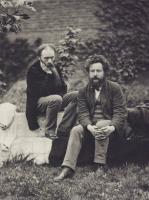


Morris died, after several months of 'general organic degenera tion', at Kelmscott House, Hammersmith, on Saturday, October 3, 1896· He died, MackaiJ says, 'quietly and without visible suffer ing' (II, 335)' Three days later, his body, accompanied by sundry mourners, was taken by train to Lechlade and interred in the churchyard at Kelmscott in a shon and simple ceremony, wholly devoid of the 'pomp of organized mourning' (II, 348). Considering the distance from London, the inconvenience of travel, and the weather, the funeral, for all its simplicity, was well attended:
Artists and authors, archaeologists, with men of letters, Academicians, the pulpit, stage, the Press, the statesmen. craftsmen, and artificers, whether of books, or of pictures, or idlers, all otherwise engaged ... The Guilds were absent, with the Trades-Unions and the craftsmen, the hammermen, the weavers, matchmakers, and those for whom he worked and thought. (p. 389)