


Text this colour links to Pages. Text this colour links to Family Trees. Text this colour are links that disabled for Guests.
Place the mouse over images to see a larger image. Click on paintings to see the painter's Biography Page.
Mouse over links for a preview. Move the mouse off the painting or link to close the popup.
Henrici Quinti, Angliæ Regis, Gesta, is a first-hand account of the Agincourt Campaign, and subsequent events to his death in 1422. The author of the first part was a Chaplain in King Henry's retinue who was present from King Henry's departure at Southampton in 1415, at the siege of Harfleur, the battle of Agincourt, and the celebrations on King Henry's return to London. The second part, by another writer, relates the events that took place including the negotiations at Troye, Henry's marriage and his death in 1422.
Available at Amazon in eBook and Paperback format.
Wiltshire Archaeological Magazine 1859 V6 Pages 73-74 is in Wiltshire Archaeological Magazine 1859 V6.
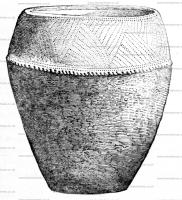
Account of a Barrow on Oldbury Hill [Map], Wilts. Opened by Mr Cunnington, F.G.S, February 1853.
Funereal Urn, found in a barrow on Oldbury Hill, Wilts. In the Museum of the Wilts Archaeological and Natural History Society, from a photograph by Marshman.
In the early part of the present year, a man engaged in digging flints on this hill suddenly struck his pickaxe into a hollow space, which proved to be the interior of a large urn. It was slightly mutilated by the blow, but was carefully lifted out and taken charge of by Mr. Clarke of Bourton, who kindly presented it to me. I have since restored the broken part with Portland cement, (a material admirably adapted to the purpose,) and the urn now forms part of the collection of the Wilts Archaeological and Natural History Society. I subsequently visited the spot where it was found, and had the barrow re-opened. More than half of it had been turned over by the workmen in search of flints, but the following details were obtained. It is a large low circular barrow of 50 feet diameter, and about 2 feet high; situated on sloping ground on the eastern side of Oldbury Camp, about twenty yards from the exterior of the camp, and due east from Lord Lansdowne's obelisk. The interment, which consisted of burnt bones, was in a cist 18 inches deep, and 18 inches wide, and a few feet from the centre of the barrow. That it was eccentric is probably owing to the materials of the barrow having gradually sunk on the sloping ground. The bones were those of an adult, but no weapon or implement was found. The urn was inverted over the ashes. It is of rude early British make, is 16 inches high, and 14 inches broad in the widest part. Like many others of this date, it is rudely ornamented round the upper portion, with zig-zag rows of indented dots, the interspaces of the angles being filled up with diagonal lines of similar dots, alternately sloping to the right and left, except in some instances where the workman has made some sad blunders in his design, and has filled up several consecutive angles with lines in the same direction. It was not turned in a lathe, and is formed of coarse clay, containing minute fragments of flint. The bottom of the urn was so near the surface, that a horse treading on the spot would certainly have put his foot into it. Ashes of wood, and fragments of bones of the domestic animals, were found throughout the barrow.
 Become a Member via our Buy Me a Coffee page to read more.
