

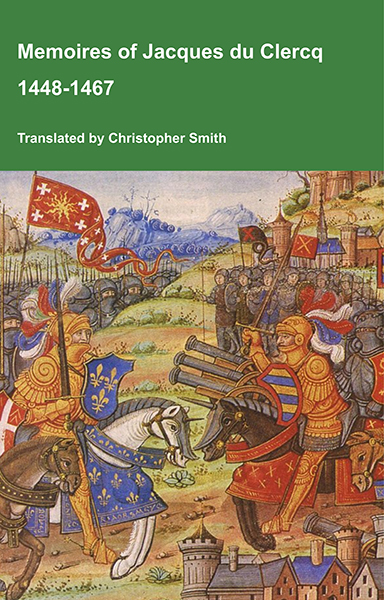
This is a translation of the 'Memoires of Jacques du Clercq', published in 1823 in two volumes, edited by Frederic, Baron de Reissenberg. In his introduction Reissenberg writes: 'Jacques du Clercq tells us that he was born in 1424, and that he was a licentiate in law and a counsellor to Philip the Good, Duke of Burgundy, in the castellany of Douai, Lille, and Orchies. It appears that he established his residence at Arras. In 1446, he married the daughter of Baldwin de la Lacherie, a gentleman who lived in Lille. We read in the fifth book of his Memoirs that his father, also named Jacques du Clercq, had married a lady of the Le Camelin family, from Compiègne. His ancestors, always attached to the counts of Flanders, had constantly served them, whether in their councils or in their armies.' The Memoires cover a period of nineteen years beginning in in 1448, ending in in 1467. It appears that the author had intended to extend the Memoirs beyond that date; no doubt illness or death prevented him from carrying out this plan. As Reissenberg writes the 'merit of this work lies in the simplicity of its narrative, in its tone of good faith, and in a certain air of frankness which naturally wins the reader’s confidence.' Du Clercq ranges from events of national and international importance, including events of the Wars of the Roses in England, to simple, everyday local events such as marriages, robberies, murders, trials and deaths, including that of his own father in Book 5; one of his last entries.
Available at Amazon in eBook and Paperback format.
Wriothesley's Chronicle 1553 is in Wriothesley's Chronicle.
Saterday, beinge the 8 of July, 1553, my Lord Mayor was sent for to the Court at Grenewich by a letter, and to bringe with him 6 or 8 Aldermen, 6 Merchaunt Staplers, and 6 Merchant Adventurers; which he did the same day in the afternone; and when they were before the Counsell, there was declared secretly the death of the Kinges Maiestie, which dyed the 6 day of July, beinge Thursday; and allso howe he had by his letters patents ordayned for the succession of the imperiall crowne of England and Ireland; which, opened unto them by the mouth of the Counsell, they were sworne to yt and to keepe yt secret. The sayd Kinge Edward had rayned 6 yeares full the 28 of January last past, and so much more, since which was in the 7th year of his raigne.
The 9 of August [1553], in the afternone, the Quene helde an obsequy for the Kinge within the church in the Tower, her Grace beinge present, and had a solemne dirige songe in Latine.
The morrowe, beinge Thursday the 10 of August [1553], the Quenes highnes had a solemne masse of Requiem songe within the chappell in the Tower for the Kinge; hir Highnes offringe at the masse with all her ladyes and gentlewomen.
Allso this day the corps of the Kinges Maiestie was solemnely caryed from Whitehall, at Westminster, to the minster of St. Peters Church, where was a rich hearse made like an imperiall crowne without lightes afore the steps where the high aulter stoode; where his Highnes body remayned, till the Communion seruice and a sermon made by Doctor Day [aged 52], Bishop of Chichester, was done; and then the corps was honourably conveyed from thence up into the chappell, where Kinge Henry the VIIth lyeth, where the Kinges Majesties body was buryed. The solemnity of the offringe by the estates, mourners, and other was lyke the enterment of Kinge Henry the VIII his father, savinge the seruice of the Communion and buryall, which was all in Englishe, without any copes or vestmentes, but onely surples, accordinge to the Booke of Common Prayer last sett forth by Act of Parliament.
And this day was a great dole of mony geven within euery warde within the City of London, euery poore house-hould havinge viii d. the peece.
The Duke of Norfolke [aged 80] and my Lord Courtney [aged 26] were deliuered out of the Tower this 10th of August[ 1553].

