

The Deeds of the Dukes of Normandy
The Gesta Normannorum Ducum [The Deeds of the Dukes of Normandy] is a landmark medieval chronicle tracing the rise and fall of the Norman dynasty from its early roots through the pivotal events surrounding the Norman Conquest of England. Originally penned in Latin by the monk William of Jumièges shortly before 1060 and later expanded at the behest of William the Conqueror, the work chronicles the deeds, politics, battles, and leadership of the Norman dukes, especially William’s own claim to the English throne. The narrative combines earlier historical sources with firsthand information and oral testimony to present an authoritative account of Normandy’s transformation from a Viking settlement into one of medieval Europe’s most powerful realms. William’s history emphasizes the legitimacy, military prowess, and governance of the Norman line, framing their expansion, including the conquest of England, as both divinely sanctioned and noble in purpose. Later chroniclers such as Orderic Vitalis and Robert of Torigni continued the history, extending the coverage into the 12th century, providing broader context on ducal rule and its impact. Today this classic work remains a foundational source for understanding Norman identity, medieval statesmanship, and the historical forces that reshaped England and Western Europe between 800AD and 1100AD.
Available at Amazon in eBook and Paperback format.
Paternal Family Tree: Cave
In or before 1493 [his father] Richard Cave of Stanford in Northamptonshire and Elizabeth Mervin [aged 23] were married.
In 1495 [his father] Richard Cave of Stanford in Northamptonshire and [his step-mother] Margaret Saxby [aged 23] were married.
Around 1502 Ambrose Cave was born to [his father] Richard Cave of Stanford in Northamptonshire.
In 1538 [his father] Richard Cave of Stanford in Northamptonshire died.
On 25th April 1559 [his daughter] Margaret Cave was born to Ambrose Cave [aged 57]. She married 16th July 1566 Henry Knollys and had issue.
On 16th July 1566 [his son-in-law] Henry Knollys [aged 24] and [his daughter] Margaret Cave [aged 7] were married.
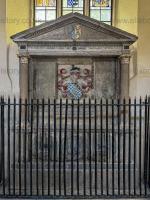
On 2nd April 1568 Ambrose Cave [aged 66] died. Monument at St Nicholas' Church, Stanford-on-Avon [Map].
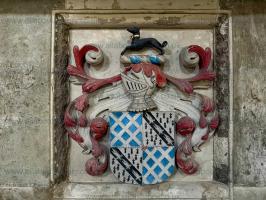
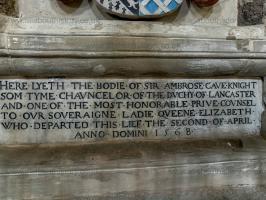
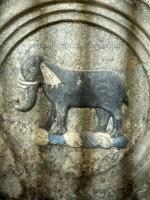

Vesta Monumenta. 1733. Plate 1.39 depicts Tutbury Castle. Engraving by George Vertue [aged 49] after a drawing originally produced for a survey of the properties of the Duchy of Lancaster conducted by the Chancellor of the Duchy, Ambrose Cave, in 1561.

Vesta Monumenta. 1733. Plate 1.40 depicts Melbourne Castle [Map]. Engraving by George [aged 49] Vertue after a drawing originally produced for a survey of the properties of the Duchy of Lancaster conducted by the Chancellor of the Duchy, Ambrose Cave, in 1561.
Annals of the six Kings of England by Nicholas Trivet
Translation of the Annals of the Six Kings of England by that traces the rise and rule of the Angevin aka Plantagenet dynasty from the mid-12th to early 14th century. Written by the Dominican scholar Nicholas Trivet, the work offers a vivid account of English history from the reign of King Stephen through to the death of King Edward I, blending political narrative with moral reflection. Covering the reigns of six monarchs—from Stephen to Edward I—the chronicle explores royal authority, rebellion, war, and the shifting balance between crown, church, and nobility. Trivet provides detailed insight into defining moments such as baronial conflicts, Anglo-French rivalry, and the consolidation of royal power under Edward I, whose reign he describes with particular immediacy. The Annals combines careful year-by-year reporting with thoughtful interpretation, presenting history not merely as a sequence of events but as a moral and political lesson. Ideal for readers interested in medieval history, kingship, and the origins of the English state, this chronicle remains a valuable and accessible window into the turbulent world of the Plantagenet kings.
Available at Amazon in eBook and Paperback format.

Vesta Monumenta. 1734. Plate 1.42. Pontefract Castle [Map]. Engraving by George [aged 50] Vertue after a drawing originally produced for a survey of the properties of the Duchy of Lancaster conducted by the Chancellor of the Duchy, Ambrose Cave, in 1561.

Vesta Monumenta. 1734. Plate 1.44. Knaresborough Castle [Map]. Engraving by George [aged 50] Vertue after a drawing originally produced for a survey of the properties of the Duchy of Lancaster conducted by the Chancellor of the Duchy, Ambrose Cave, in 1561.

Vesta Monumenta. 1734. Plate 1.41. Lancaster Castle [Map] and Priory Church [Map]. Engraving by George [aged 50] Vertue after a drawing originally produced for a survey of the properties of the Duchy of Lancaster conducted by the Chancellor of the Duchy, Ambrose Cave, in 1561.

Vesta Monumenta. 1737. Plate 1.46. Tickhill Castle [Map]. Engraving by George [aged 53] Vertue after a drawing originally produced for a survey of the properties of the Duchy of Lancaster conducted by the Chancellor of the Duchy, Ambrose Cave, in 1561.
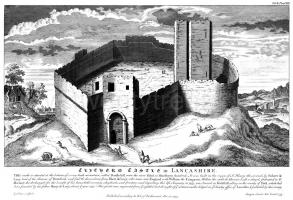
Vesta Monumenta. 1753. Plate 2.13. Clitheroe Castle [Map]. Engraving by George Vertue [aged 69] after a drawing originally produced for a survey of the properties of the Duchy of Lancaster conducted by the Chancellor of the Duchy, Ambrose Cave, in 1561.
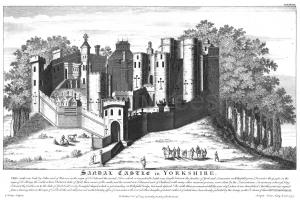
Vesta Monumenta. 1753. Plate 2.11. Sandal Castle [Map]. Engraving by George Vertue [aged 69] after a drawing originally produced for a survey of the properties of the Duchy of Lancaster conducted by the Chancellor of the Duchy, Ambrose Cave, in 1561.