

Jean de Waurin's Chronicle of England Volume 6 Books 3-6: The Wars of the Roses
Jean de Waurin was a French Chronicler, from the Artois region, who was born around 1400, and died around 1474. Waurin’s Chronicle of England, Volume 6, covering the period 1450 to 1471, from which we have selected and translated Chapters relating to the Wars of the Roses, provides a vivid, original, contemporary description of key events some of which he witnessed first-hand, some of which he was told by the key people involved with whom Waurin had a personal relationship.
Available at Amazon in eBook and Paperback format.
On 26th April 1730 Archbishop John Moore was born.
On 21st September 1761 Archbishop John Moore (age 31) was preferred to the fifth prebendal stall at Durham Cathedral [Map].
In April 1763 Archbishop John Moore (age 32) was preferred to a canonry at Christ Church Cathedral, Oxford [Map].
On 29th April 1763 Archbishop John Moore (age 33) and Jane Wright (age 27) were married at St Swithin's Church, Walcot St Swithin.
Around 1765 [his wife] Jane Wright (age 29) died.
On 23rd January 1770 Archbishop John Moore (age 39) and Catherine Eden (age 28) were married.
On 19th September 1771 Archbishop John Moore (age 41) was appointed Dean of Canterbury.
On 10th February 1775 Archbishop John Moore (age 44) was appointed Bishop of Bangor.
On 26th April 1783 Archbishop John Moore (age 53) was preferred Archbishop of Canterbury.
On 3rd June 1796 George Wright 2nd Baronet (age 26) and Rebecca Maclane were married. His uncle-in-law Archbishop John Moore (age 66) officiated.
On 18th January 1805 Archbishop John Moore (age 74) died at Lambeth Palace [Map]. He was buried at St Mary at Lambeth Church, Surrey [Map].
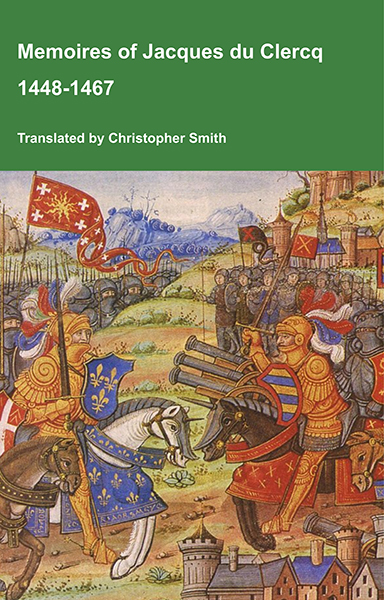
This is a translation of the 'Memoires of Jacques du Clercq', published in 1823 in two volumes, edited by Frederic, Baron de Reissenberg. In his introduction Reissenberg writes: 'Jacques du Clercq tells us that he was born in 1424, and that he was a licentiate in law and a counsellor to Philip the Good, Duke of Burgundy, in the castellany of Douai, Lille, and Orchies. It appears that he established his residence at Arras. In 1446, he married the daughter of Baldwin de la Lacherie, a gentleman who lived in Lille. We read in the fifth book of his Memoirs that his father, also named Jacques du Clercq, had married a lady of the Le Camelin family, from Compiègne. His ancestors, always attached to the counts of Flanders, had constantly served them, whether in their councils or in their armies.' The Memoires cover a period of nineteen years beginning in in 1448, ending in in 1467. It appears that the author had intended to extend the Memoirs beyond that date; no doubt illness or death prevented him from carrying out this plan. As Reissenberg writes the 'merit of this work lies in the simplicity of its narrative, in its tone of good faith, and in a certain air of frankness which naturally wins the reader’s confidence.' Du Clercq ranges from events of national and international importance, including events of the Wars of the Roses in England, to simple, everyday local events such as marriages, robberies, murders, trials and deaths, including that of his own father in Book 5; one of his last entries.
Available at Amazon in eBook and Paperback format.
In 1818 [his former wife] Catherine Eden (age 76) died. She was buried at St Mary at Lambeth Church, Surrey [Map].