

William of Worcester's Chronicle of England
William of Worcester, born around 1415, and died around 1482 was secretary to John Fastolf, the renowned soldier of the Hundred Years War, during which time he collected documents, letters, and wrote a record of events. Following their return to England in 1440 William was witness to major events. Twice in his chronicle he uses the first person: 1. when writing about the murder of Thomas, 7th Baron Scales, in 1460, he writes '… and I saw him lying naked in the cemetery near the porch of the church of St. Mary Overie in Southwark …' and 2. describing King Edward IV's entry into London in 1461 he writes '… proclaimed that all the people themselves were to recognize and acknowledge Edward as king. I was present and heard this, and immediately went down with them into the city'. William’s Chronicle is rich in detail. It is the source of much information about the Wars of the Roses, including the term 'Diabolical Marriage' to describe the marriage of Queen Elizabeth Woodville’s brother John’s marriage to Katherine, Dowager Duchess of Norfolk, he aged twenty, she sixty-five or more, and the story about a paper crown being placed in mockery on the severed head of Richard, 3rd Duke of York.
Available at Amazon in eBook and Paperback format.
1162 Thomas Becket appointed Archbishop of Canterbury
1164 Constitutions of Clarendon
1164 Becket's Relatives Banished
1170 Murder of Thomas a Becket
On 21st December 1119, or 1120, the Feast Day of St Thomas the Apostle, Archbishop Thomas Becket was born. His father was Gilbert, and grandfather from Thierville in Brionne in Normandy. His mother was Matilda; also of Norman descent.
In 1162 William Longsword [aged 25] was to marry Isabella Warenne Countess Boulogne 4th Countess of Surrey [aged 25] but Archbishop Thomas Becket [aged 42] refused to grant the necessary dispensation.
On 23rd May 1162 Archbishop Thomas Becket [aged 42] was elected Archbishop of Canterbury by King Henry "Curtmantle" II of England [aged 29].
On 2nd June 1162 Archbishop Thomas Becket [aged 42] was ordained.
On 3rd June 1162 Archbishop Thomas Becket [aged 42] was consecrated Archbishop of Canterbury by Bishop Henry of Blois [aged 64].
On 24th May 1162 Archbishop Thomas Becket [aged 42] was appointed Archbishop of Canterbury.
Around 1163 Bishop Gilbert Foliot served as Clerk to Archbishop Thomas Becket [aged 43].
On 22nd December 1163 Bishop Robert Melun [aged 63] was consecrated Bishop of Hereford by Archbishop Thomas Becket [aged 44] at Canterbury Cathedral [Map].
On 25th January 1164 King Henry "Curtmantle" II of England [aged 30] attempted to constrain ecclesiastical privileges by the sixteen articles of the Constitutions of Clarendon. Archbishop Thomas Becket [aged 44] rejected the articles.
On 30th January 1164 William Longsword [aged 27] died. He was buried at Notre Dame de Paris Cathedral [Map]. His death said to have been of a broken heart since he was unable to marry Isabella Warenne Countess Boulogne 4th Countess of Surrey [aged 27] as a result of Archbishop Thomas Becket [aged 44] refusing to grant the necessary dispensation. His death may have been the start of the rift between his elder brother King Henry II [aged 30] and Becket.
In October 1164 Archbishop Thomas Becket [aged 44] was put on trial in Northampton [Map] by King Henry "Curtmantle" II of England [aged 31] on a charge of contempt. After a week of discussion Becket fled to Flanders with Bishop John of Salisbury [aged 46].
In 26th December 1164 King Henry "Curtmantle" II of England [aged 31] banished all of Thomas Becket's [aged 45] relatives from England. Around 400 people were affected. They were stripped of their possessions and shipped to Flanders.
Letters. 1165. Letter IV. Empress Matilda [aged 62] to Archbishop Thomas Becket [aged 45].
To Thomas archbishop of Canterbury, Matilda the empress.
My lord pope sent to me, enjoining me, for the remission of my sins, to interfere to renew peace and concord between you and the king, my son [aged 31], and to try to reconcile you to him. You, as you well know, have asked the same thing from me; wherefore, with the more good-will, for the honour of God and the Holy Church, I have begun and carefully treated of that affair. But it seems a very hard thing to the king, as well as to his barons and council, seeing he so loved and honoured you, and appointed you lord of his whole kingdom and of all his lands, and raised you to the highest honours in the land, believing he might trust you rather than any other; and especially so, because he declares that you have, as far as you could, roused his whole kingdom against him; nor was it your fault that you did not disinherit him by main force. Therefore I send you my faithful servant, Archdeacon Laurence, that by him I may know your will in these affairs, and what sort of disposition you entertain towards my son, and how you intend to conduct yourself, if it should happen that he fully grants my petition and prayer on your behalf. One thing I plainly tell you, that you cannot recover the king's favour, except by great humility and most evident moderation. However, what you intend to do in this matter signify to me by my messenger and your letters.
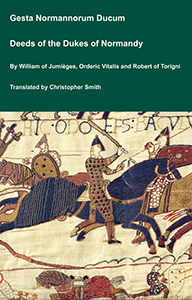
The Deeds of the Dukes of Normandy
The Gesta Normannorum Ducum [The Deeds of the Dukes of Normandy] is a landmark medieval chronicle tracing the rise and fall of the Norman dynasty from its early roots through the pivotal events surrounding the Norman Conquest of England. Originally penned in Latin by the monk William of Jumièges shortly before 1060 and later expanded at the behest of William the Conqueror, the work chronicles the deeds, politics, battles, and leadership of the Norman dukes, especially William’s own claim to the English throne. The narrative combines earlier historical sources with firsthand information and oral testimony to present an authoritative account of Normandy’s transformation from a Viking settlement into one of medieval Europe’s most powerful realms. William’s history emphasizes the legitimacy, military prowess, and governance of the Norman line, framing their expansion, including the conquest of England, as both divinely sanctioned and noble in purpose. Later chroniclers such as Orderic Vitalis and Robert of Torigni continued the history, extending the coverage into the 12th century, providing broader context on ducal rule and its impact. Today this classic work remains a foundational source for understanding Norman identity, medieval statesmanship, and the historical forces that reshaped England and Western Europe between 800AD and 1100AD.
Available at Amazon in eBook and Paperback format.
In 1170 Bishop Jocelin de Bohun [aged 59] was excommunicated by Archbishop Thomas Becket [aged 50] ostensibly for having assisted in the coronation of Henry the Young King, son of Henry II.
On 29th December 1170 Archbishop Thomas Becket [aged 51] was murdered at Canterbury Cathedral [Map] by four knights on behalf of King Henry "Curtmantle" II of England [aged 37]. Whether Henry ordered the murder, or whether the four knights were acting without orders, is a matter of conjecture. The first use of the well-known phrase "Will no-one rid me of this turbulent priest" appears some five hundred and more years later in Robert Dodsley's 1740 Chronicle of the Kings of England.

29th December 1170. A bas-de-page image illustrating the murder of Archbishop Thomas Becket [aged 51], from the Queen Mary Psalter: England (London/Westminster or East Anglia?) between 1310 and 1320, Royal MS 2 B VII, f. 298r.

29th December 1170. Archbishop Thomas Becket [aged 51] is murdered by a group of knights; BL Add MS 38116; 'The Huth Psalter'; 1280 CE-1300 CE; England,N.; f.13r.
29th December 1170. Earliest known depiction of the murder of Archbishop Thomas Becket [aged 51]. BL Cotton MS Claudius B II; Alan of Tewkesbury, Collectio Epistolarum Sancti Thome Cantuariensis; 12th c; England; f.341r.


On 7th July 1220 the remains of Archbishop Thomas Becket were translated from the crypt of Canterbury Cathedral [Map] to an elaborate shrine in the newly-constructed apse at the east end of the cathedral. King Henry III of England [aged 12] was in attendance, together with the political and religious great and good, and a new liturgical office was composed for the occasion.
In September 1538 Henry VIII [aged 47] ordered Thomas of Becket's shrine at Canterbury Cathedral [Map] to be destroyed. Both an attack on the Catholic Church, and a means to generate revenue; Thomas' shrine was covered in precious metals and stones. Two huges chests, each requiring six men to carry, were required to remove the treasure.


On 16th November 1538 Henry VIII [aged 47] attacked Thomas of Becket's reputation, removing his canonisation at the same time.
Henry enacted legislation as follows:
ITEM, for as moche as it appereth now clerely, that Thomas Becket, sometyme Archbyshop of Canterburie, stubburnly to withstand the holsome lawes establyshed agaynste the enormities of the clergie, by the kynges highness mooste noble progenitour, kynge HENRY the Seconde, for the common welthe, reste, and tranquillitie of this realme, of his frowarde mynde fledde the realme into Fraunce, and to the bishop of Rome, mayntenour of those enormities, to procure the abrogation of the sayd lawes, whereby arose moch trouble in this said realme, and that his dethe, which they untruely called martyrdome, happened upon a reskewe by him made, and that, as it is written, he gave opprobrious wordes to the gentyllmen, whiche than counsayled hym to leave his stubbernesse, and to avoyde the commocion of the people, rysen up for that rescue. And he not only callyd the one of them bawde, but also toke Tracy by the bosome, and violently shoke and plucked hym in suche maner, that he had almoste overthrowen hym to the pavement of the Churche; so that upon this fray one of their company, perceivynge the same, strake hym, and so in the thronge Becket was slayne. And further that his canonization was made onely by the bysshop of Rome, bycause he had ben a champion of maynteyne his usurped auctoritie, and a bearer of the iniquitie of the clergie, for these and for other great and urgent causes, longe to recyte, the Kynge's Maiestie, by the advyse of his counsayle, hath thought expedient to declare to his lovynge subjectes, that notwithstandynge the sayde canonization, there appereth nothynge in his lyfe and exteriour conversation, wherby he shuld be callyd a sainct, but rather estemed to have ben a rebell and traytour to his prynce. Therefore his Grace strayghtly chargeth and commandeth that from henseforth the sayde Thomas Becket shall not be estemed, named, reputed, nor called a sayncte, but bysshop Becket; and that his ymages and pictures, through the hole realme, shall be putte downe, and avoyded out of all churches, chapelles, and other places; and that from henseforthe, the dayes used to be festivall in his name shall not be observed, nor the service, office, antiphoners, colletes, and prayers, in his name redde, but rased and put out of all the bokes.