

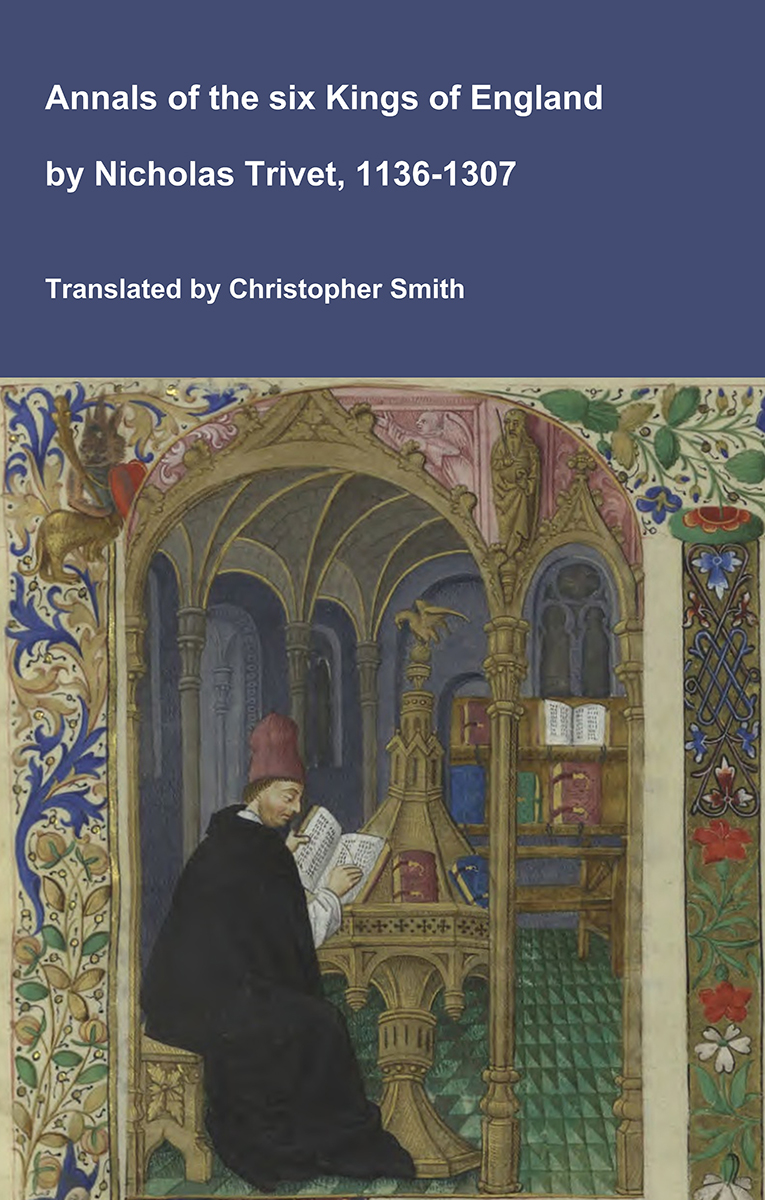
Annals of the six Kings of England by Nicholas Trivet
Translation of the Annals of the Six Kings of England by that traces the rise and rule of the Angevin aka Plantagenet dynasty from the mid-12th to early 14th century. Written by the Dominican scholar Nicholas Trivet, the work offers a vivid account of English history from the reign of King Stephen through to the death of King Edward I, blending political narrative with moral reflection. Covering the reigns of six monarchs—from Stephen to Edward I—the chronicle explores royal authority, rebellion, war, and the shifting balance between crown, church, and nobility. Trivet provides detailed insight into defining moments such as baronial conflicts, Anglo-French rivalry, and the consolidation of royal power under Edward I, whose reign he describes with particular immediacy. The Annals combines careful year-by-year reporting with thoughtful interpretation, presenting history not merely as a sequence of events but as a moral and political lesson. Ideal for readers interested in medieval history, kingship, and the origins of the English state, this chronicle remains a valuable and accessible window into the turbulent world of the Plantagenet kings.
Available at Amazon in eBook and Paperback format.
Paternal Family Tree: Dawes
Before 3rd May 1663 [his father] John Dawes 1st Baronet [aged 19] and [his mother] Christian Hawkins were married without the permission of her guardian Andrew Riccard [aged 59]. Some sources refer to her as Christian Lyons, some Lygons.
In 1671 [his father] John Dawes 1st Baronet [aged 27] died. His son [his brother] Robert [aged 1] succeeded 2nd Baronet Dawes of Putney.
On 12th September 1671 William Dawes was born to John Dawes 1st Baronet and Christian Hawkins.
In 1690 Robert Dawes 2nd Baronet [aged 20] died. His brother William [aged 18] succeeded 3rd Baronet Dawes of Putney.
On 1st December 1692 William Dawes [aged 21] and Francis Cole d'Arcy [aged 19] were married at St Edmund King and Martyr Church.
In or after 1693 [his son] Darcy Dawes 4th Baronet was born to Archbishop William Dawes 3rd Baronet [aged 21] and [his wife] Francis Cole d'Arcy [aged 20]. The date based on that of his parent's marriage on 1st December 1692. He married in or before 1726 Sarah Roundell Lady Dawes and had issue.
In 1705 [his wife] Francis Cole d'Arcy [aged 32] died.
In 1708 William Dawes [aged 36] was appointed Bishop of Chester.
On 17th July 1712, the St Ann's Church, Manchester [Map] was consecrated by the Bishop of Chester [aged 40] and was dedicated to Saint Anne, the Virgin Mary's mother, which was a compliment both to the founder Ann Mosley [aged 47], and to the reigning monarch, Queen Anne.
Before 1713 [his step-father] Anthony Deane [aged 79] and [his mother] Christian Hawkins were married.
In 1714 Archbishop William Dawes 3rd Baronet [aged 42] was appointed Archbishop of York.
On 5th December 1716 [his son-in-law] William Milner 1st Baronet [aged 20] and Elizabeth Dawes Lady Milner were married. She the daughter of Archbishop William Dawes 3rd Baronet [aged 45] and Francis Cole d'Arcy.
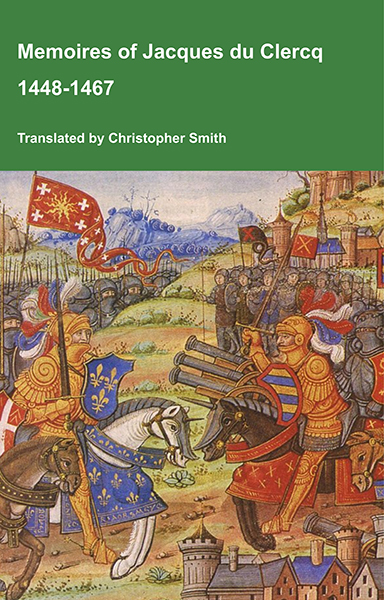
This is a translation of the 'Memoires of Jacques du Clercq', published in 1823 in two volumes, edited by Frederic, Baron de Reissenberg. In his introduction Reissenberg writes: 'Jacques du Clercq tells us that he was born in 1424, and that he was a licentiate in law and a counsellor to Philip the Good, Duke of Burgundy, in the castellany of Douai, Lille, and Orchies. It appears that he established his residence at Arras. In 1446, he married the daughter of Baldwin de la Lacherie, a gentleman who lived in Lille. We read in the fifth book of his Memoirs that his father, also named Jacques du Clercq, had married a lady of the Le Camelin family, from Compiègne. His ancestors, always attached to the counts of Flanders, had constantly served them, whether in their councils or in their armies.' The Memoires cover a period of nineteen years beginning in in 1448, ending in in 1467. It appears that the author had intended to extend the Memoirs beyond that date; no doubt illness or death prevented him from carrying out this plan. As Reissenberg writes the 'merit of this work lies in the simplicity of its narrative, in its tone of good faith, and in a certain air of frankness which naturally wins the reader’s confidence.' Du Clercq ranges from events of national and international importance, including events of the Wars of the Roses in England, to simple, everyday local events such as marriages, robberies, murders, trials and deaths, including that of his own father in Book 5; one of his last entries.
Available at Amazon in eBook and Paperback format.
On 30th April 1718 Archbishop William Dawes 3rd Baronet [aged 46] died. His son Darcy [aged 25] succeeded 4th Baronet Dawes of Putney.
[his daughter] Elizabeth Dawes Lady Milner was born to Archbishop William Dawes 3rd Baronet and Francis Cole d'Arcy. She married 5th December 1716 William Milner 1st Baronet and had issue.
Father: John Dawes 1st Baronet 
Archbishop William Dawes 3rd Baronet
Great x 1 Grandfather: Father Hawkins
GrandFather: Sibling Hawkins
Mother: Christian Hawkins