

Jean de Waurin's Chronicle of England Volume 6 Books 3-6: The Wars of the Roses
Jean de Waurin was a French Chronicler, from the Artois region, who was born around 1400, and died around 1474. Waurin’s Chronicle of England, Volume 6, covering the period 1450 to 1471, from which we have selected and translated Chapters relating to the Wars of the Roses, provides a vivid, original, contemporary description of key events some of which he witnessed first-hand, some of which he was told by the key people involved with whom Waurin had a personal relationship.
Available at Amazon in eBook and Paperback format.
On 26th January 1657 Archbishop William Wake was born in Blandford Forum, Dorset [Map].
John Evelyn's Diary. 1st January 1687. Mr. Wake (age 29) preached at St. Martin's on 1 Tim. iii. 16, concerning the mystery of godliness. He wrote excellently, in answer to the Bishop of Meaux.
John Evelyn's Diary. 20th March 1687. The Bishop of Bath and Wells (age 49) (Dr. Ken) preached at St. Martin's [Map] to a crowd of people not to be expressed, nor the wonderful eloquence of this admirable preacher; the text was Matt. xxvi. 36 to verse 40, describing the bitterness of our Blessed Savior's agony, the ardor of his love, the infinite obligations we have to imitate his patience and resignation; the means by watching against temptations, and over ourselves with fervent prayer to attain it, and the exceeding reward in the end. Upon all which he made most pathetical discourses. The Communion followed, at which I was participant. I afterward dined at Dr. Tenison's (age 50) with the Bishop and that young, most learned, pious, and excellent preacher, Mr. Wake (age 30). In the afternoon, I went to hear Mr. Wake at the newly built church of St. Anne, on Mark viii. 34, upon the subject of taking up the cross, and strenuously behaving ourselves in time of persecution, as this now threatened to be.
In 1688 Archbishop William Wake (age 30) and Ethelreda Hovell (age 18) were married.
In 1693 Archbishop William Wake (age 35) was appointed Rector of St James' Church, Piccadilly.
In 1703 Archbishop William Wake (age 45) was appointed Dean of Exeter.
In 1705 Archbishop William Wake (age 47) was consecrated Bishop of Lincoln.
In 1716 Archbishop William Wake (age 58) was translated to Archbishop of Canterbury.
On 20th July 1729 William Stukeley (age 41) was ordained as a Deacon by Archbishop William Wake (age 72).
The Deeds of the Dukes of Normandy
The Gesta Normannorum Ducum [The Deeds of the Dukes of Normandy] is a landmark medieval chronicle tracing the rise and fall of the Norman dynasty from its early roots through the pivotal events surrounding the Norman Conquest of England. Originally penned in Latin by the monk William of Jumièges shortly before 1060 and later expanded at the behest of William the Conqueror, the work chronicles the deeds, politics, battles, and leadership of the Norman dukes, especially William’s own claim to the English throne. The narrative combines earlier historical sources with firsthand information and oral testimony to present an authoritative account of Normandy’s transformation from a Viking settlement into one of medieval Europe’s most powerful realms. William’s history emphasizes the legitimacy, military prowess, and governance of the Norman line, framing their expansion, including the conquest of England, as both divinely sanctioned and noble in purpose. Later chroniclers such as Orderic Vitalis and Robert of Torigni continued the history, extending the coverage into the 12th century, providing broader context on ducal rule and its impact. Today this classic work remains a foundational source for understanding Norman identity, medieval statesmanship, and the historical forces that reshaped England and Western Europe between 800AD and 1100AD.
Available at Amazon in eBook and Paperback format.
In 1731 [his wife] Ethelreda Hovell (age 61) died.

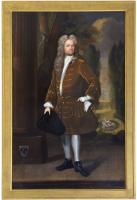
Before 1737 Thomas Gibson (age 56). Portrait of Archbishop William Wake (age 79).
On 24th January 1737 Archbishop William Wake (age 79) died at Lambeth Palace [Map].
[his daughter] Dorothy Wake was born to Archbishop William Wake and Ethelreda Hovell. She married James Pennyman, son of James Pennyman 3rd Baronet and Mary Wharton.