


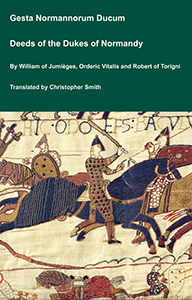
The Deeds of the Dukes of Normandy
The Gesta Normannorum Ducum [The Deeds of the Dukes of Normandy] is a landmark medieval chronicle tracing the rise and fall of the Norman dynasty from its early roots through the pivotal events surrounding the Norman Conquest of England. Originally penned in Latin by the monk William of Jumièges shortly before 1060 and later expanded at the behest of William the Conqueror, the work chronicles the deeds, politics, battles, and leadership of the Norman dukes, especially William’s own claim to the English throne. The narrative combines earlier historical sources with firsthand information and oral testimony to present an authoritative account of Normandy’s transformation from a Viking settlement into one of medieval Europe’s most powerful realms. William’s history emphasizes the legitimacy, military prowess, and governance of the Norman line, framing their expansion, including the conquest of England, as both divinely sanctioned and noble in purpose. Later chroniclers such as Orderic Vitalis and Robert of Torigni continued the history, extending the coverage into the 12th century, providing broader context on ducal rule and its impact. Today this classic work remains a foundational source for understanding Norman identity, medieval statesmanship, and the historical forces that reshaped England and Western Europe between 800AD and 1100AD.
Available at Amazon in eBook and Paperback format.
The Life and Death of Llewelly Jewitt Chapter 7. In 1838, soon after he [[his son] Llewellynn Jewitt] had attained his majority, he went up to London, to join Fairholt in the work of illustrating the leading popular literature of the day, both by drawing and engraving, under the famous Stephen Sly, for Charles Knight and others. After a few months thus spent he found himself in a position to marry the truly charming young lady of his choice, [his daughter-in-law] Elizabeth Sage, whom he had left behind at Derby. His diligence in business was very great, and to save working time it was arranged that the wedding should take place in Derby on Christmas Day of that same year, 1838, and on that same day they started back from Derby, travelling all night — a bitterly cold night — to their London home.
On 7th March 1772 Arthur Jewitt was born to Arthur Jewitt and [his mother] Mary Priestly.
On 7th March 1793 Arthur Jewitt (age 21) and Martha Sheldon of Crooke's Moor in Sheffield were married.
In 1794 Arthur Jewitt (age 21) became Master of a school at Chesterfield.
In 1799 [his son] Thomas Orlando Sheldon Jewitt was born to Arthur Jewitt (age 26) and [his wife] Martha Sheldon of Crooke's Moor in Sheffield at Buxton, Derbyshire [Map].
Arthur Jewitt 1811. The History of Buxton and Visitor's Guide to the Peak including a Descriptive Itinerary of the Excursions usually made and a set of Botanical Tables, exhibiting the Places of Growth, &c. of the most remarkable plants found wild in the neighbourhood of Buxton. By A Jewitt (age 38). Author of the History of Lincoln. 1811.
Arthur Jewitt 1811. British And Roman Antiquities In or Near Buxton by Arthur Jewitt (age 38).
On 24th November 1816 [his son] Llewellynn Jewitt was born to Arthur Jewitt (age 44) and [his wife] Martha Sheldon of Crooke's Moor in Sheffield at Kimberworth, Rotherham. The youngest of seventeen children. He married Elizabeth Sage.
In November 1835 [his wife] Martha Sheldon of Crooke's Moor in Sheffield died.
The Deeds of the Dukes of Normandy
The Gesta Normannorum Ducum [The Deeds of the Dukes of Normandy] is a landmark medieval chronicle tracing the rise and fall of the Norman dynasty from its early roots through the pivotal events surrounding the Norman Conquest of England. Originally penned in Latin by the monk William of Jumièges shortly before 1060 and later expanded at the behest of William the Conqueror, the work chronicles the deeds, politics, battles, and leadership of the Norman dukes, especially William’s own claim to the English throne. The narrative combines earlier historical sources with firsthand information and oral testimony to present an authoritative account of Normandy’s transformation from a Viking settlement into one of medieval Europe’s most powerful realms. William’s history emphasizes the legitimacy, military prowess, and governance of the Norman line, framing their expansion, including the conquest of England, as both divinely sanctioned and noble in purpose. Later chroniclers such as Orderic Vitalis and Robert of Torigni continued the history, extending the coverage into the 12th century, providing broader context on ducal rule and its impact. Today this classic work remains a foundational source for understanding Norman identity, medieval statesmanship, and the historical forces that reshaped England and Western Europe between 800AD and 1100AD.
Available at Amazon in eBook and Paperback format.
On 7th March 1852 Arthur Jewitt (age 80) died at Headington, Oxfordshire.
Father: Arthur Jewitt
GrandFather: Jonathan Priestley of Dronfield
Mother: Mary Priestly