

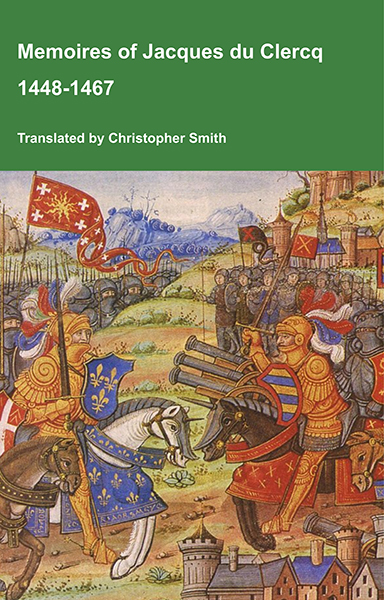
This is a translation of the 'Memoires of Jacques du Clercq', published in 1823 in two volumes, edited by Frederic, Baron de Reissenberg. In his introduction Reissenberg writes: 'Jacques du Clercq tells us that he was born in 1424, and that he was a licentiate in law and a counsellor to Philip the Good, Duke of Burgundy, in the castellany of Douai, Lille, and Orchies. It appears that he established his residence at Arras. In 1446, he married the daughter of Baldwin de la Lacherie, a gentleman who lived in Lille. We read in the fifth book of his Memoirs that his father, also named Jacques du Clercq, had married a lady of the Le Camelin family, from Compiègne. His ancestors, always attached to the counts of Flanders, had constantly served them, whether in their councils or in their armies.' The Memoires cover a period of nineteen years beginning in in 1448, ending in in 1467. It appears that the author had intended to extend the Memoirs beyond that date; no doubt illness or death prevented him from carrying out this plan. As Reissenberg writes the 'merit of this work lies in the simplicity of its narrative, in its tone of good faith, and in a certain air of frankness which naturally wins the reader’s confidence.' Du Clercq ranges from events of national and international importance, including events of the Wars of the Roses in England, to simple, everyday local events such as marriages, robberies, murders, trials and deaths, including that of his own father in Book 5; one of his last entries.
Available at Amazon in eBook and Paperback format.
In 1202 Bishop Hugh of Northwold became a monk of the Bury St Edmund's Abbey [Map].
On 7th August 1213 Bishop Hugh of Northwold was elected Abbot of Bury St Edmunds.
On 3rd February 1229 Bishop Hugh of Northwold was elected Bishop of Ely.
On 19th June 1229 Bishop Hugh of Northwold was consecrated Bishop of Ely at Canterbury Cathedral [Map].
Chronica Majora by Matthew Paris. Before 24th June 1237. In the same year, the emperor Frederick [aged 42], by special messengers and imperial letters, summoned all the great Christian princes of the world to assemble on the day of St. John the Baptist's nativity, at Vaucouleurs, which is on the confines, or near the confines, of the empire and the French kingdom, there to discuss some difficult matters concerning the empire as well as the kingdom. The king of France, as if entertaining suspicion of this conference, proceeded at the time fixed to the place appointed, attended by a large army, which he had assembled for the purpose, and thus set dreadful and pernicious example to others, inasmuch as he went to discuss matters of peace in the same way as he would to attack his enemies. The king of England [aged 29] made reasonable excuses for not coming in person; but sent a peaceful embassy, consisting of some of the chief men of the kingdom; namely, Richard earl of Cornwall [aged 28], his brother, with some other nobles, fit to manage a conference, under the guidance of the venerable archbishop of York [aged 57] and the bishop of Ely, and other trustworthy persons selected for the purpose. The bishop of Winchester, although selected before all others, absolutely refused to go, and, not without reason, gave the following as the cause for excusing himself: "My lord king," said he "you lately laid a heavy complaint against me before the emperor, telling him that I, with some other nobles, disturbed your kingdom: whether you did this with justice, or unjustly, God knows; but I trust that I have saved my conscience in every respect. But if your words were now placed with confidence in my mouth and in your letters, and should declare that I was a familar and faithful friend of yours; all this would appear as contrary, and he would accuse both you and me of instability; and this would blacken your fame in a great degree. Therefore, because it would be manifestly to your dishonour, I will not go on any account." And in the opinion of many, this reply gave sufficient excuse for him. When all preparations had been made, and they were all ready to set sail on this journey, they were met by letters from the emperor, to say that he could not go to the conference then, as he had purposed; but that what he could not do then, should, by God's favour, be carried into effect on the Nativity of St. John the Baptist in the following year; and thus each and all of them returned without effecting anything. In this year, on the day of the Supper, the bishop of Hereford consecrated the holy unction in the church of St. Albans [Map]. About this time, too, John Scott [deceased], earl of Chester, closed his life about Whitsuntide, having been poisoned by the agency of his wife [aged 19], the daughter of Llewellyn [aged 65]. The life of the bishop of Lincoln [aged 69], too, was also attempted by the same means, and he was with difficulty recalled from the gates of death. In the same year, in the week before Whitsuntide, there fell storms of hail which exceeded the size of apples, killing the sheep; and they were followed by continued rain.

Effigy of Hugh de Northwold, Bishop of Ely. HUGH DE NORTHWOLD, Abbot of St. Edmundsbury, was consecrated Bishop of Ely in the year 1229 (14 Henry III.) He was a munificent restorer of his Cathedral Church, which he almost rebuilt from the foundation at the cost of upwards of five thousand pounds, a princely sum for the time in which he flourished. In the dark days of Christianity the pastors of the church exhibited noble ideas of the honour due to the Deity in the piles devoted to his worship, and a corresponding munificence in contributing to their construction. The rebuilding Ely Cathedral [Map] by Northwold occupied seventeen years, and he consecrated the new church in the presence of Henry III [aged 46] and Prince Edward [aged 14], whom he entertained (keeping at the same time "the hall," or open house to all comers) in his palace at Ely. The last mentioned edifice he also entirely rebuilt, and covered with a distinction of the most costly buildings in the middle age. He departed this life on the 9th of August 1254, thankful to Providence for having been allowed to see the completion of his cathedral, where he was interred in the middle of the presbytery. On the removal of the choir the situation of his effigy was changed, and it now lies on the altar tomb of Barnet, who died Bishop of Ely 1373. The niche which canopies the figure of Northwold is in the richest style of sculpture, the pillars are composed of interlacing foliage in scroll work, intermixed with heads of ecclesiastics and birds. At the top of the canopy are fragments of two angels. The sides are adorned with niches containing figures: these do not appear in the etching. The Bishop treads on a dragon and a lion, under both of which images the power of Satan is indicated in Holy Writ. The entablature at the foot of the tomb, delineated in the plate, represents the martyrdom of St. Edmund, King of the East Angles, who was shot to death with arrows by the Danes, A. D. 870. This piece of sculpture of course alludes to Northwold, as Abbot of Saint Edmundsbury.
On 6th August 1254 or 9th August 1254 Bishop Hugh of Northwold died. He was buried at Ely Cathedral [Map].