

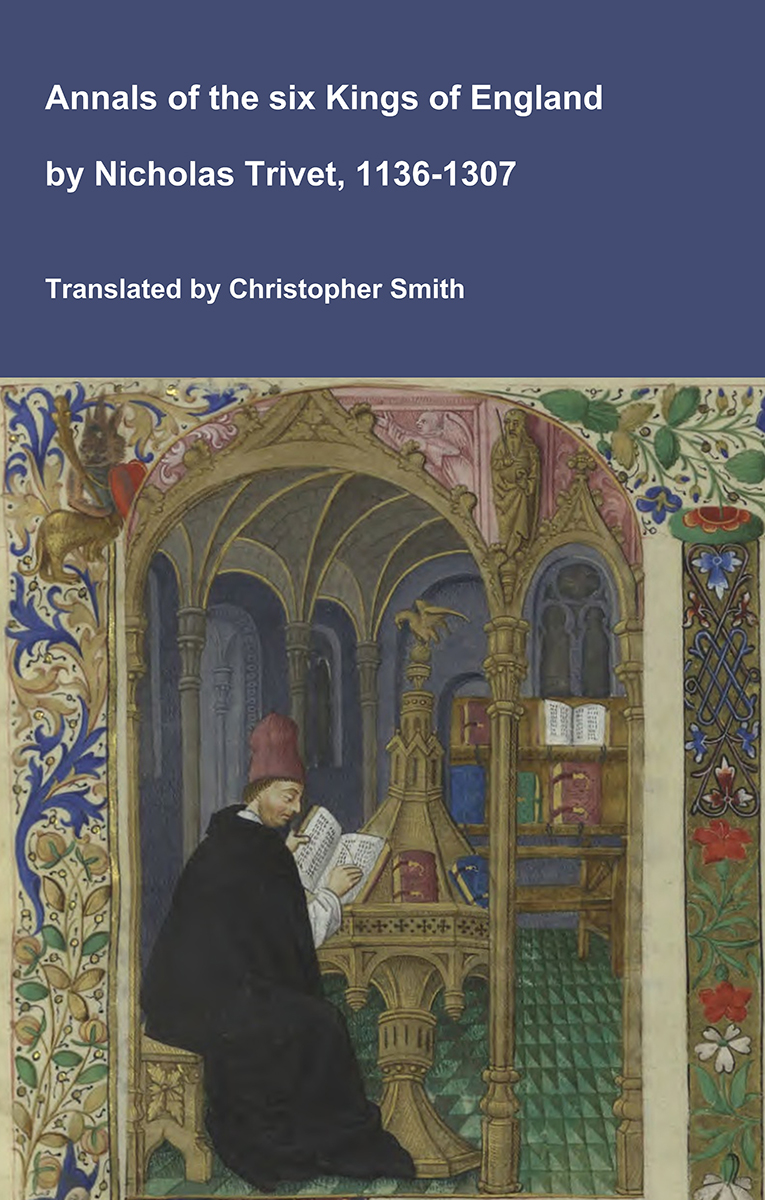
Annals of the six Kings of England by Nicholas Trivet
Translation of the Annals of the Six Kings of England by that traces the rise and rule of the Angevin aka Plantagenet dynasty from the mid-12th to early 14th century. Written by the Dominican scholar Nicholas Trivet, the work offers a vivid account of English history from the reign of King Stephen through to the death of King Edward I, blending political narrative with moral reflection. Covering the reigns of six monarchs—from Stephen to Edward I—the chronicle explores royal authority, rebellion, war, and the shifting balance between crown, church, and nobility. Trivet provides detailed insight into defining moments such as baronial conflicts, Anglo-French rivalry, and the consolidation of royal power under Edward I, whose reign he describes with particular immediacy. The Annals combines careful year-by-year reporting with thoughtful interpretation, presenting history not merely as a sequence of events but as a moral and political lesson. Ideal for readers interested in medieval history, kingship, and the origins of the English state, this chronicle remains a valuable and accessible window into the turbulent world of the Plantagenet kings.
Available at Amazon in eBook and Paperback format.
In 1239 Bishop Nicholas Farnham was elected Bishop of Coventry but he refused the offer.
On 2nd January 1241 Bishop Nicholas Farnham was elected Bishop of Durham. At first he wanted to decline the office, but Bishop Robert Grosseteste (age 73), Bishop of Lincoln persuaded him to accept.
On 26th May 1241 or 9th June 1241 Bishop Nicholas Farnham was consecrated Bishop of Durham.
Chronica Majora by Matthew Paris. The confirmation of Master Nicholas of Farnhamy in the bishopric of Durham
On the 9th of June, in this year. Master Nicholas of Farnham, bishop elect of Durham, was consecrated bishop of that see in St. Oswald's church [Map] at Gloucester, by Walter, archbishop of York (age 61), in the presence of the king (age 33) and queen (age 18), with numerous bishops and abbats. But inasmuch as a question had been mooted concerning his profession, amongst some who wished to excite discord, the said Nicholas refused to claim a liberty that was not his due, or to show himself insolent or recalcitrant; he therefore, at his consecration, in public, before all the prelates and nobles, and in the presence of his metropolitan, the said Archbishop Walter, solemnly and distinctly made his profession in a loud voice, according to custom, as follows; "I Nicholas, bishop elect of the church of Durham, acknowledge canonical subjection, reverence, and obedience to the church of York, and to you, father Walter, its archbishop, and this I subscribe with my own hand." He then immediately, in the presence of all assembled, marked the sign of the cross in ink at the head of the charter, and delivered the same to the archbishop to be kept in his possession in his treasury.
On 2nd February 1249 Bishop Nicholas Farnham resigned as Bishop of Durham.
In 1257 Bishop Nicholas Farnham died. He was buried at Durham Cathedral [Map].