

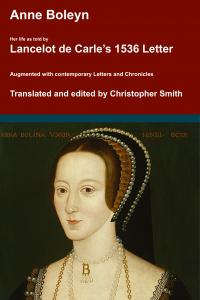
Anne Boleyn. Her Life as told by Lancelot de Carle's 1536 Letter.
In 1536, two weeks after the execution of Anne Boleyn, her brother George and four others, Lancelot du Carle, wrote an extraordinary letter that described Anne's life, and her trial and execution, to which he was a witness. This book presents a new translation of that letter, with additional material from other contemporary sources such as Letters, Hall's and Wriothesley's Chronicles, the pamphlets of Wynkyn the Worde, the Memorial of George Constantyne, the Portuguese Letter and the Baga de Secrets, all of which are provided in Appendices.
Available at Amazon in eBook and Paperback format.
On 9th March 1277 Bishop Thomas Ingoldshorpe was named Dean of St Paul's Cathedral.
Annals of Dunstable. In the same year and at the same time the bishop of Rochester [Bishop John Bradfield], a monk, died [23rd April 1283]; and master Thomas of Inglethorpe, then dean of St Paul's, London, succeeded him in the bishopric.
Eisdem anno et tempore obiit episcopus Roffensis, monachus; et successit ei in episcopatu magister Thomas de Ingelthorp, tunc decanus Sancti Pauli Londoniæ.
Around 12th July 1283 Bishop Thomas Ingoldshorpe was elected Bishop of Rochester.
On 26th September 1283 or 3rd October 1283 Bishop Thomas Ingoldshorpe was consecrated Bishop of Rochester.
On 11th May 1291 Bishop Thomas Ingoldshorpe died.
Annals of Dunstable. In the same year Lorchun Duket, a London goldsmith, grievously wounded Ralph Crepin in West Cheap, and fled into the church of St Mary le Bow. Afterwards certain malefactors, on behalf of the said Ralph, entered that church by night and killed the said Lorchun, who was lying in the church tower, and hanged him there, lowering him down through a window, as though he had hanged himself. Upon this, when an inquest was made by laymen, it was declared that he had hanged himself; wherefore he was dragged by the feet outside the city and buried in a pit. Soon afterwards, however, by the account of a certain boy who had lain with the said Lorchun at the hour of his death, and who had hidden himself in fear, the truth of the matter was discovered. Whereupon a certain womane, who had been the instigator of that crime, and sixteen men with her, were imprisoned; and afterwards several were drawn by horses, and the woman was burned with fire. The said church, moreover, was laid under interdict by the archbishop, and its door and windows were blocked up with thorns. The said Lorchun, meanwhile, having been taken up from the place where he lay, was buried by the clergy in the churchyard. At length the bishop of Rouen2, by command of the archbishop, reconciled the church.
Eodem anno Lorchun Duket, aurifaber Londoniensis, graviter vulneravit Radulfum Crepin in West Chep, et fugit in ecclesiam Sanctæ Mariæ de Arcubus. Postea quidam malevoli, ex parte dicti Radulfi noctanter intrantes dictam ecclesiam, dictum Lorchun, in turri ecclesiæ jacentem, occiderunt, et ibidem suspenderunt, deponentes per fenestram, quasi ipse seipsum suspendisset. Super quo, facta inquisitione per laicos, dictum est, quod ipse seipsum suspenderat; propter quod, tractus per pedes extra civitatem, in fovea est humatus. Cito post ex relatione cujusdam pueri, qui cum dicto Lorchun jacuit hora mortis suæ, et se absconderat præ pavore, rei veritas est comperta. Unde quædam mulier, quæ auctrix fuit dicti sceleris, et sexdecim viri cum ea sunt imprisonati; et postea plures sunt equis tracti et mulier igne cremabatur. Dicta vero ecclesia per archiepiscopum fuit interdicta, et ostium et fenestræ spinis obturatæ. Dictus vero Lorchun a loco ubi jacuit extractus, per clerum in cœmiterio est sepultus. Tandem Rouffensis episcopus ecclesiam reconciliavit, de mandato archiepiscopi.
Note 1. Alice atte Bowe. See Anngier's French Chronicle of London (Camd. Soc.), p. 19.
Note 2. Bishop Thomas Ingoldshorpe.