

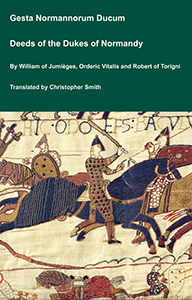
The Deeds of the Dukes of Normandy
The Gesta Normannorum Ducum [The Deeds of the Dukes of Normandy] is a landmark medieval chronicle tracing the rise and fall of the Norman dynasty from its early roots through the pivotal events surrounding the Norman Conquest of England. Originally penned in Latin by the monk William of Jumièges shortly before 1060 and later expanded at the behest of William the Conqueror, the work chronicles the deeds, politics, battles, and leadership of the Norman dukes, especially William’s own claim to the English throne. The narrative combines earlier historical sources with firsthand information and oral testimony to present an authoritative account of Normandy’s transformation from a Viking settlement into one of medieval Europe’s most powerful realms. William’s history emphasizes the legitimacy, military prowess, and governance of the Norman line, framing their expansion, including the conquest of England, as both divinely sanctioned and noble in purpose. Later chroniclers such as Orderic Vitalis and Robert of Torigni continued the history, extending the coverage into the 12th century, providing broader context on ducal rule and its impact. Today this classic work remains a foundational source for understanding Norman identity, medieval statesmanship, and the historical forces that reshaped England and Western Europe between 800AD and 1100AD.
Available at Amazon in eBook and Paperback format.
In 1628 Bishop Thomas White was born.
In 1683 Bishop Thomas White [aged 55] was appointed Chaplain to Princess Anne [aged 17].


In 1685 Bishop Thomas White [aged 57] was appointed Bishop of Peterborough.
John Evelyn's Diary. 28th March 1686. Dr White, Bp. of Peterboro' [aged 58], preach'd in a very eloquent style, on 26 Matthew 29, submission to the will of God on all accidents and at all times.
On 13th May 1688 the Archbishop of Canterbury and seven bishops were imprisoned for seditious libel: Archbishop William Sancroft [aged 71], Bishop Henry Compton [aged 56], Bishop Francis Turner [aged 50], Bishop Thomas White [aged 60], Bishop Thomas Ken [aged 50], Bishop John Lake [aged 64], Bishop Jonathan Trelawny 3rd Baronet [aged 38] and Bishop William Lloyd [aged 51]. Their crime was to not read the Declaration of Indulgence as required by King James II of England Scotland and Ireland [aged 54].


John Evelyn's Diary. 8th June 1688. This day, the Archbishop of Canterbury [aged 71], with the Bishops of Ely [aged 50], Chichester [aged 64], St. Asaph [aged 60], Bristol [aged 38], Peterborough [aged 60], and Bath and Wells [aged 50], were sent from the Privy Council prisoners to the Tower [Map], for refusing to give bail for their appearance, on their not reading the Declaration for liberty of conscience; they refused to give bail, as it would have prejudiced their peerage. The concern of the people for them was wonderful, infinite crowds on their knees begging their blessing, and praying for them, as they passed out of the barge along the Tower wharf.
John Evelyn's Diary. 18th May 1688. King [aged 54] enjoining the ministers to read his Declaration for giving liberty of conscience (as it was styled) in all churches of England, this evening, six Bishops, Bath and Wells [aged 50], Peterborough [aged 60], Ely [aged 50], Chichester [aged 64], St. Asaph [aged 60], and Bristol [aged 38], in the name of all the rest of the Bishops, came to his Majesty to petition him, that he would not impose the reading of it to the several congregations within their dioceses; not that they were averse to the publishing it for want of due tenderness toward dissenters, in relation to whom they should be willing to come to such a temper as should be thought fit, when that matter might be considered and settled in Parliament and Convocation; but that, the Declaration being founded on such a dispensing power as might at pleasure set aside all laws ecclesiastical and civil, it appeared to them illegal, as it had done to the Parliament in 1661 and 1672, and that it was a point of such consequence, that they could not so far make themselve parties to it, as the reading of it in church in time of divine service amounted to.
The King was so far incensed at this address, that he with threatening expressions commanded them to obey him in reading it at their perils, and so dismissed them.
John Evelyn's Diary. 15th January 1689. I visited the Archbishop of Canterbury [aged 71], where I found the Bishops of St. Asaph [aged 61], Ely [aged 51], Bath and Wells [aged 51], Peterborough [aged 61], and Chichester [aged 65], the Earls of Aylesbury [aged 33] and Clarendon, Sir George Mackenzie [aged 53], Lord-Advocate of Scotland, and then came in a Scotch Archbishop, etc. After prayers and dinner, divers serious matters were discoursed, concerning the present state of the Public, and sorry I was to find there was as yet no accord in the judgments of those of the Lords and Commons who were to convene; some would have the Princess [aged 26] made Queen without any more dispute, others were for a Regency; there was a Tory party (then so called), who were for inviting his Majesty [aged 55] again upon conditions; and there were Republicans who would make the Prince of Orange [aged 38] like a Stadtholder. The Romanists were busy among these several parties to bring them into confusion: most for ambition or other interest, few for conscience and moderate resolutions. I found nothing of all this in this assembly of Bishops, who were pleased to admit me into their discourses; they were all for a Regency, thereby to salve their oaths, and so all public matters to proceed in his Majesty's name, by that to facilitate the calling of Parliament, according to the laws in being. Such was the result of this meeting.


John Evelyn's Diary. 19th April 1691. The Archbishop of Canterbury [aged 74], and Bishops of Ely [aged 53], Bath and Wells [aged 53], Peterborough [aged 63], Gloucester [aged 69], and the rest who would not take the oaths to King William [aged 40], were now displaced; and in their rooms, Dr. Tillotson [aged 60], Dean of St. Paul's, was made Archbishop: Patrick [aged 64] removed from Chichester to Ely; Cumberland [aged 59] to Gloucester. Note. A mistake. Bishop Edward Fowler was made Bishop of Gloucester. Bishop Richard Cumberland [aged 59] was made Bishop of Peterborough.

In 1698 Bishop Thomas White [aged 70] died.