

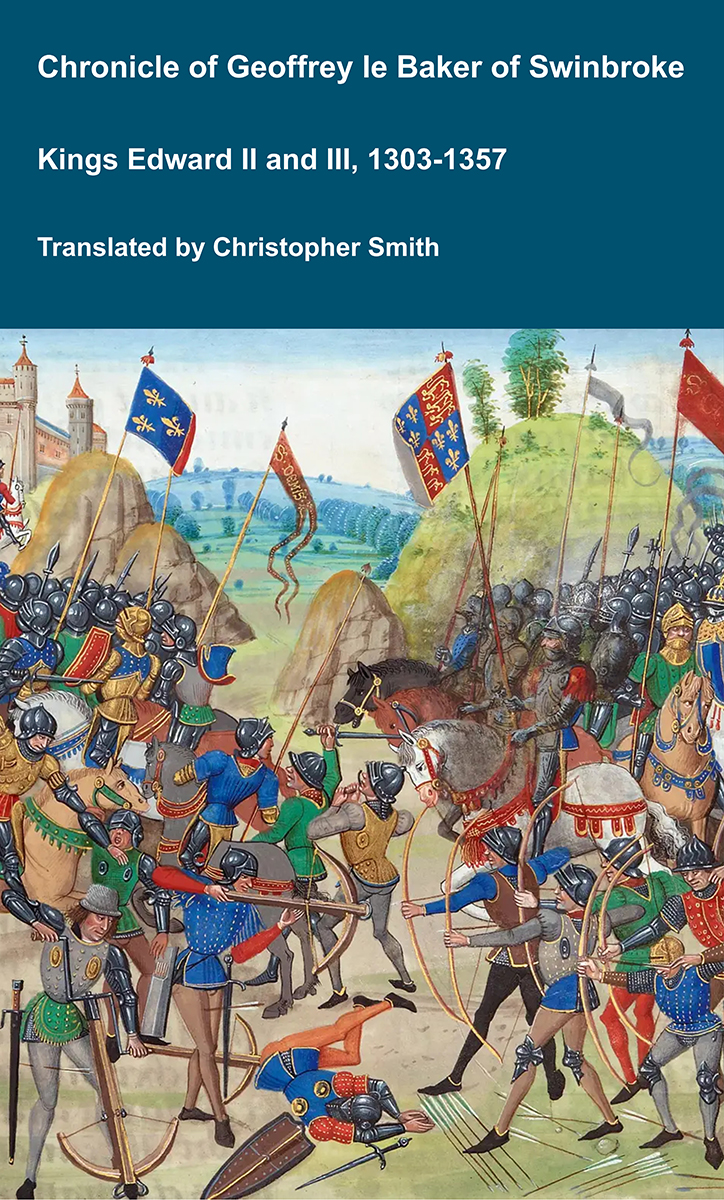
Chronicle of Geoffrey le Baker of Swinbroke
Baker was a secular clerk from Swinbroke, now Swinbrook, an Oxfordshire village two miles east of Burford. His Chronicle describes the events of the period 1303-1356: Gaveston, Bannockburn, Boroughbridge, the murder of King Edward II, the Scottish Wars, Sluys, Crécy, the Black Death, Winchelsea and Poitiers. To quote Herbert Bruce 'it possesses a vigorous and characteristic style, and its value for particular events between 1303 and 1356 has been recognised by its editor and by subsequent writers'. The book provides remarkable detail about the events it describes. Baker's text has been augmented with hundreds of notes, including extracts from other contemporary chronicles, such as the Annales Londonienses, Annales Paulini, Murimuth, Lanercost, Avesbury, Guisborough and Froissart to enrich the reader's understanding. The translation takes as its source the 'Chronicon Galfridi le Baker de Swynebroke' published in 1889, edited by Edward Maunde Thompson.
Available at Amazon in eBook and Paperback format.
On 18th August 1627 Bishop William Lloyd was born in Tilehurst, Berkshire.

Samuel Pepys' Diary. 25th November 1666. Lord's Day. Up, and with Sir J. Minnes [aged 67] by coach to White Hall, and there coming late, I to rights to the chapel, where in my usual place I heard one of the King's chaplains, one Mr. Floyd [aged 39], preach. He was out two or three times in his prayer, and as many in his sermon, but yet he made a most excellent good sermon, of our duty to imitate the lives and practice of Christ and the saints departed, and did it very handsomely and excellent stile; but was a little overlarge in magnifying the graces of the nobility and prelates, that we have seen in our memorys in the world, whom God hath taken from us.
John Evelyn's Diary. 25th October 1667. There were delivered to me two letters from the Vice-Chancellor of Oxford, with the Decree of the Convocation, attested by the Public Notary, ordering four Doctors of Divinity and Law to acknowledge the obligation the University had to me for procuring the Marmora Arundeliana, which was solemnly done by Dr. Barlow [aged 59], Dr. Jenkins, Judge of the Admiralty, Dr. Lloyd [aged 40], and Obadiah Walker [aged 51], of University College, who having made a large compliment from the University, delivered me the decree fairly written;.
Samuel Pepys' Diary. 21st November 1667. Up, and to the office, where all the morning, and at noon home, where my wife not very well, but is to go to Mr. Mills's child's christening, where she is godmother, Sir J. Minnes [aged 68] and Sir R. Brookes [aged 30] her companions. I left her after dinner (my clerks dining with me) to go with Sir J. Minnes, and I to the office, where did much business till after candlelight, and then my eyes beginning to fail me, I out and took coach to Arundell House [Map], where the meeting of Gresham College was broke up; but there meeting Creed, I with him to the taverne in St. Clement's Churchyard, where was Deane Wilkins [aged 53], Dr. Whistler, Dr. Floyd [aged 40], a divine admitted, I perceive, this day, and other brave men; and there, among other things of news, I do hear, that upon the reading of the House of Commons's Reasons of the manner of their proceedings in the business of my Chancellor [aged 58], the Reasons were so bad, that my Lord Bristoll [aged 55] himself did declare that he would not stand to what he had, and did still, advise the Lords to concur to, upon any of the Reasons of the House of Commons; but if it was put to the question whether it should be done on their Reasons, he would be against them; and indeed it seems the Reasons-however they come to escape the House of Commons, which shews how slightly the greatest matters are done in this world, and even in Parliaments were none of them of strength, but the principle of them untrue; they saying, that where any man is brought before a judge, accused of Treason in general, without specifying the particular, the judge do there constantly and is obliged to commit him. Whereas the question being put by the Lords to my Lord Keeper, he said that quite the contrary was true: and then, in the Sixth Article (I will get a copy of them if I can) there are two or three things strangely asserted to the diminishing of the King's power, as is said, at least things that heretofore would not have been heard of. But then the question being put among the Lords, as my Lord Bristoll advised, whether, upon the whole matter and Reasons that had been laid before them, they would commit my Lord Clarendon, it was carried five to one against it; there being but three Bishops against him, of whom Cosens [aged 72] and Dr. Reynolds were two, and I know not the third. This made the opposite Lords, as Bristoll and Buckingham [aged 39], so mad, that they declared and protested against it, speaking very broad that there was mutiny and rebellion in the hearts of the Lords, and that they desired they might enter their dissents, which they did do, in great fury.


In 1680 Bishop William Lloyd [aged 52] was appointed Bishop of St Asaph.
John Evelyn's Diary. 14th June 1680. Came to dine with us the Countess of Clarendon, Dr. Lloyd [aged 52], Dean of Bangor (since Bishop of St. Asaph), Dr. Burnet [aged 36], author of the "History of the Reformation", and my old friend, Mr. Henshaw [aged 62]. After dinner we all went to see the Observatory, and Mr. Flamsted [aged 33], who showed us divers rare instruments, especially the great quadrant.


John Evelyn's Diary. 26th July 1680. My Lord [aged 46], being an exceedingly brave and valiant person, and who had so approved himself in divers signal battles, both at sea and land; so beloved and so esteemed by the people, as one they depended on, upon all occasions worthy of such a captain;-he looked on this as too great an indifference in his Majesty [aged 50], after all his services, and the merits of his father, the Duke of Ormond [aged 69], and a design of some who envied his virtue. It certainly took so deep root in his mind, that he who was the most void of fear in the world (and assured me he would go to Tangier [Map] with ten men if his Majesty commanded him) could not bear up against this unkindness. Having disburdened himself of this to me after dinner, he went with his Majesty to the sheriffs at a great supper in Fishmongers' Hall; but finding himself ill, took his leave immediately of his Majesty, and came back to his lodging. Not resting well this night, he was persuaded to remove to Arlington House, for better accommodation. His disorder turned to a malignant fever, which increasing, after all that six of the most able physicians could do, he became delirious, with intervals of sense, during which Dr. Lloyd [aged 52] (after Bishop of St. Asaph) administered the Holy Sacrament, of which I also participated. He died the Friday following, the 30th of July, to the universal grief of all that knew or heard of his great worth, nor had any a greater loss than myself. Oft would he say I was the oldest acquaintance he had in England (when his father was in Ireland), it being now of about thirty years, contracted abroad, when he rode in the Academy in Paris, and when we were seldom asunder.


John Evelyn's Diary. 31st October 1680. I began and spent the whole week in examining my life, begging pardon for my faults, assistance and blessing for the future, that I might, in some sort, be prepared for the time that now drew near, and not have the great work to begin, when one can work no longer. The Lord Jesus help and assist me! I therefore stirred little abroad till the 5th of November, when I heard Dr. Tenison [aged 44], the now vicar of St. Martin's [Map]; Dr. Lloyd [aged 53], the former incumbent, being made Bishop of St. Asaph.
John Evelyn's Diary. 31st October 1680. I spent this whole day in exercises. A stranger preached at Whitehall [Map] on Luke xvi. 30, 31. I then went to St. Martin's [Map], where the Bishop of St. Asaph [aged 53] [Note. The next post refers to Bishop William Lloyd being made Bishop of St Asaph. The previous incumbent Isaac Barrow had died 24th June 1680] preached on 1 Peter iii. 15; the Holy Communion followed, at which I participated, humbly imploring God's assistance in the great work I was entering into. In the afternoon, I heard Dr. Sprat [aged 45], at St. Margaret's [Map], on Acts xvii. 11.
John Evelyn's Diary. 11th April 1681. I took my leave of Dr. Lloyd [aged 53] (Bishop of St. Asaph) at his house in Leicester Fields, now going to reside in his diocese.
John Evelyn's Diary. 9th July 1685. Just as I was coming into the lodgings at Whitehall [Map], a little before dinner, my Lord of Devonshire [aged 45] standing very neere his Ma's [aged 51] bed-chamber doore in the lobby, came Col. Culpeper [aged 50], and in a rude manner looking my Lord in the face, asked whether this was a time and place for excluders to appeare; my Lord at first tooke little notice of what he said, knowing him to be a hot-headed fellow, but he reiterating it, my Lord ask'd Culpeper whether he meant him; he said, yes, he meant his Lordship. My Lord told him he was no excluder (as indeed he was not); the other affirming it againe, my Lord told him he lied, on which Culpeper struck him a box on the eare, which my Lord return'd and fell'd him. They were soone parted, Culpeper was seiz'd, and his Ma*, who was all the while in his bed-chamber, order'd him to be carried to the Green Cloth Officer, who sent him to the Marshalsea [Map] as he deserv'd. My Lord Devon had nothing said to him. I supp'd this night at Lambeth at my old friend's Mr. Elias Ashmole's [aged 68], with my Lady Clarendon, ye Bishop of St. Asaph [aged 57], and Dr. Tenison [aged 48], when we were treated at a greate feast.


John Evelyn's Diary. 14th November 1685. I dined at Lambeth [Map], my Lord Archbishop [aged 68] carrying me with him in his barge: there were my Lord Deputy of Ireland, the Bp. of Ely [aged 48], and St. Asaph [aged 58], Dr. Sherlock, and other divines; Sir Wm Hayward, Sir Paule Rycaut, &c.


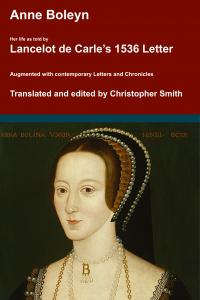
Anne Boleyn. Her Life as told by Lancelot de Carle's 1536 Letter.
In 1536, two weeks after the execution of Anne Boleyn, her brother George and four others, Lancelot du Carle, wrote an extraordinary letter that described Anne's life, and her trial and execution, to which he was a witness. This book presents a new translation of that letter, with additional material from other contemporary sources such as Letters, Hall's and Wriothesley's Chronicles, the pamphlets of Wynkyn the Worde, the Memorial of George Constantyne, the Portuguese Letter and the Baga de Secrets, all of which are provided in Appendices.
Available at Amazon in eBook and Paperback format.
John Evelyn's Diary. 18th May 1688. King [aged 54] enjoining the ministers to read his Declaration for giving liberty of conscience (as it was styled) in all churches of England, this evening, six Bishops, Bath and Wells [aged 50], Peterborough [aged 60], Ely [aged 50], Chichester [aged 64], St. Asaph [aged 60], and Bristol [aged 38], in the name of all the rest of the Bishops, came to his Majesty to petition him, that he would not impose the reading of it to the several congregations within their dioceses; not that they were averse to the publishing it for want of due tenderness toward dissenters, in relation to whom they should be willing to come to such a temper as should be thought fit, when that matter might be considered and settled in Parliament and Convocation; but that, the Declaration being founded on such a dispensing power as might at pleasure set aside all laws ecclesiastical and civil, it appeared to them illegal, as it had done to the Parliament in 1661 and 1672, and that it was a point of such consequence, that they could not so far make themselve parties to it, as the reading of it in church in time of divine service amounted to.
The King was so far incensed at this address, that he with threatening expressions commanded them to obey him in reading it at their perils, and so dismissed them.


John Evelyn's Diary. 8th June 1688. This day, the Archbishop of Canterbury [aged 71], with the Bishops of Ely [aged 50], Chichester [aged 64], St. Asaph [aged 60], Bristol [aged 38], Peterborough [aged 60], and Bath and Wells [aged 50], were sent from the Privy Council prisoners to the Tower [Map], for refusing to give bail for their appearance, on their not reading the Declaration for liberty of conscience; they refused to give bail, as it would have prejudiced their peerage. The concern of the people for them was wonderful, infinite crowds on their knees begging their blessing, and praying for them, as they passed out of the barge along the Tower wharf.
John Evelyn's Diary. 13th June 1688. I went to the Tower [Map] to see the Bishops, visited the Archbishop [aged 71] and the Bishops of Ely [aged 50], St. Asaph [aged 60], and Bath and Wells [aged 50].
John Evelyn's Diary. 15th January 1689. I visited the Archbishop of Canterbury [aged 71], where I found the Bishops of St. Asaph [aged 61], Ely [aged 51], Bath and Wells [aged 51], Peterborough [aged 61], and Chichester [aged 65], the Earls of Aylesbury [aged 33] and Clarendon, Sir George Mackenzie [aged 53], Lord-Advocate of Scotland, and then came in a Scotch Archbishop, etc. After prayers and dinner, divers serious matters were discoursed, concerning the present state of the Public, and sorry I was to find there was as yet no accord in the judgments of those of the Lords and Commons who were to convene; some would have the Princess [aged 26] made Queen without any more dispute, others were for a Regency; there was a Tory party (then so called), who were for inviting his Majesty [aged 55] again upon conditions; and there were Republicans who would make the Prince of Orange [aged 38] like a Stadtholder. The Romanists were busy among these several parties to bring them into confusion: most for ambition or other interest, few for conscience and moderate resolutions. I found nothing of all this in this assembly of Bishops, who were pleased to admit me into their discourses; they were all for a Regency, thereby to salve their oaths, and so all public matters to proceed in his Majesty's name, by that to facilitate the calling of Parliament, according to the laws in being. Such was the result of this meeting.
John Evelyn's Diary. 12th April 1689. I went with the Bishop of St. Asaph [aged 61] to visit my Lord of Canterbury [aged 58] at Lambeth [Map], who had excused himself from officiating at the coronation, which was performed by the Bishop of London [aged 57], assisted by the Archbishop of York [aged 74]. We had much private and free discourse with his Grace concerning several things relating to the Church, there being now a bill of comprehension to be brought from the Lords to the Commons. I urged that when they went about to reform some particulars in the Liturgy, Church discipline, Canons, etc., the baptizing in private houses without necessity might be reformed, as likewise so frequent burials in churches; the one proceeding much from the pride of women, bringing that into custom which was only indulged in case of imminent danger, and out of necessity during the rebellion, and persecution of the clergy in our late civil wars; the other from the avarice of ministers, who, in some opulent parishes, made almost as much of permission to bury in the chancel and the church, as of their livings, and were paid with considerable advantage and gifts for baptizing in chambers. To this they heartily assented, and promised their endeavor to get it reformed, utterly disliking both practices as novel and indecent.


John Evelyn's Diary. 26th April 1689. I heard the lawyers plead before the Lords the writ of error in the judgment of Oates [aged 39], as to the charge against him of perjury, which after debate they referred to the answer of Holloway, etc., who were his judges. I then went with the Bishop of St. Asaph [aged 61] to the Archbishop [aged 72] at Lambeth [Map], where they entered into discourse concerning the final destruction of Antichrist, both concluding that the third trumpet and vial were now pouring out. My Lord St. Asaph considered the killing of the two witnesses, to be the utter destruction of the Cevennes Protestants by the French and Duke of Savoy, and the other the Waldenses and Pyrenean Christians, who by all appearance from good history had kept the primitive faith from the very Apostles' time till now. The doubt his Grace suggested was, whether it could be made evident that the present persecution had made so great a havoc of those faithful people as of the other, and whether there were not yet some among them in being who met together, it being stated from the text, Apoc. xi., that they should both be slain together. They both much approved of Mr. Mede's way of interpretation, and that he only failed in resolving too hastily on the King of Sweden's (Gustavus Adolphus) success in Germany. They agreed that it would be good to employ some intelligent French minister to travel as far as the Pyrenees to understand the present state of the Church there, it being a country where hardly anyone travels.
John Evelyn's Diary. 6th June 1689. I dined with the Bishop of Asaph [aged 61]; Monsieur Capellus, the learned son of the most learned Ludovicus, presented to him his father's works, not published till now.
John Evelyn's Diary. 5th November 1689. The Bishop of St. Asaph [aged 62], Lord Almoner, preached before the King [aged 39] and Queen [aged 27], the whole discourse being an historical narrative of the Church of England's several deliverances, especially that of this anniversary, signalized by being also the birthday of the Prince of Orange, his marriage (which was on the 4th), and his landing at Torbay this day. There was a splendid ball and other rejoicings.


John Evelyn's Diary. 19th February 1690. I dined with the Marquis of Carmarthen [aged 57] (late Lord Danby), where was Lieutenant-General Douglas [aged 45], a very considerate and sober commander, going for Ireland. He related to us the exceeding neglect of the English soldiers, suffering severely for want of clothes and necessaries this winter, exceedingly magnifying their courage and bravery during all their hardships. There dined also Lord Lucas, Lieutenant of the Tower [aged 40], and the Bishop of St. Asaph [aged 62]. The Privy Seal was again put in commission, Mr. Cheny (who married my kinswoman, Mrs. Pierrepoint), Sir Thomas Knatchbull [aged 50], and Sir P. W. Pultney. The imprudence of both sexes was now become so great and universal, persons of all ranks keeping their courtesans publicly, that the King had lately directed a letter to the Bishops to order their clergy to preach against that sin, swearing, etc., and to put the ecclesiastical laws in execution without any indulgence.
John Evelyn's Diary. 9th March 1690. I dined at the Bishop of St. Asaph's [aged 62], Almoner to the new Queen [aged 27], with the famous lawyer Sir George Mackenzie [aged 54] (late Lord Advocate of Scotland), against whom both the Bishop and myself had written and published books, but now most friendly reconciled. He related to us many particulars of Scotland, the present sad condition of it, the inveterate hatred which the Presbyterians show to the family of the Stuarts, and the exceeding tyranny of those bigots who acknowledge no superior on earth, in civil or divine matters, maintaining that the people only have the right of government; their implacable hatred to the Episcopal Order and Church of England. He observed that the first Presbyterian dissents from our discipline were introduced by the Jesuits' order, about the 20 of Queen Elizabeth, a famous Jesuit among them feigning himself a Protestant, and who was the first who began to pray extempore, and brought in that which they since called, and are still so fond of, praying by the Spirit. This Jesuit remained many years before he was discovered, afterward died in Scotland, where he was buried at ... having yet on his. Monument, "Rosa inter spinas"..
John Evelyn's Diary. 18th June 1690. Fast day. Visited the Bishop of St. Asaph [aged 62]; his conversation was on the Vaudois in Savoy, who had been thought so near destruction and final extirpation by the French, being totally given up to slaughter, so that there were no hopes for them; but now it pleased God that the Duke of Savoy, who had hitherto joined with the French in their persecution, being now pressed by them to deliver up Saluzzo and Turin as cautionary towns, on suspicion that he might at last come into the Confederacy of the German Princes, did secretly concert measures with, and afterward declared for, them. He then invited these poor people from their dispersion among the mountains whither they had fled, and restored them to their country, their dwellings, and the exercise of their religion, and begged pardon for the ill usage they had received, charging it on the cruelty of the French who forced him to it. These being the remainder of those persecuted Christians which the Bishop of St. Asaph had so long affirmed to be the two witnesses spoken of in the Revelation, who should be killed and brought to life again, it was looked on as an extraordinary thing that this prophesying Bishop should persuade two fugitive ministers of the Vaudois to return to their country, and furnish them with £20 toward their journey, at that very time when nothing but universal destruction was to be expected, assuring them and showing them from the Apocalypse, that their countrymen should be returned safely to their country before they arrived. This happening contrary to all expectation and appearance, did exceedingly credit the Bishop's confidence how that prophecy of the witnesses should come to pass, just at the time, and the very month, he had spoken of some years before.
John Evelyn's Diary. 15th August 1690. I was desired to be one of the bail of the Earl of Clarendon, for his release from the Tower [Map], with divers noblemen. The Bishop of St. Asaph [aged 62] expounds his prophecies to me and Mr. Pepys [aged 57], etc. The troops from Blackheath [Map] march to Portsmouth [Map]. That sweet and hopeful youth, Sir Charles Tuke [aged 19], died of the wounds he received in the fight of the Boyne, to the great sorrow of all his friends, being (I think) the last male of that family, to which my wife [aged 55] is related. A more virtuous young gentleman I never knew; he was learned for his age, having had the advantage of the choicest breeding abroad, both as to arts and arms; he had traveled much, but was so unhappy as to fall in the side of his unfortunate King [aged 56].


In 1692 Bishop William Lloyd [aged 64] was appointed Bishop of Lichfield and Coventry.
John Evelyn's Diary. 8th March 1695. I supped at the Bishop of Lichfield and Coventry's [aged 67], who related to me the pious behavior of the Queen in all her sickness, which was admirable. She never inquired of what opinion persons were, who were objects of charity; that, on opening a cabinet, a paper was found wherein she had desired that her body might not be opened, or any extraordinary expense at her funeral, whenever she should die. This paper was not found in time to be observed. There were other excellent things under her own hand, to the very least of her debts, which were very small, and everything in that exact method, as seldom is found in any private person. In sum, she was such an admirable woman, abating for taking the Crown without a more due apology, as does, if possible, outdo the renowned Queen Elizabeth.
Henrici Quinti, Angliæ Regis, Gesta, is a first-hand account of the Agincourt Campaign, and subsequent events to his death in 1422. The author of the first part was a Chaplain in King Henry's retinue who was present from King Henry's departure at Southampton in 1415, at the siege of Harfleur, the battle of Agincourt, and the celebrations on King Henry's return to London. The second part, by another writer, relates the events that took place including the negotiations at Troye, Henry's marriage and his death in 1422.
Available at Amazon in eBook and Paperback format.
On 30th August 1717 Bishop William Lloyd [aged 90] died in Hartlebury Castle, Worcestershire [Map]. he was buried in Fladbury, Evesham.