

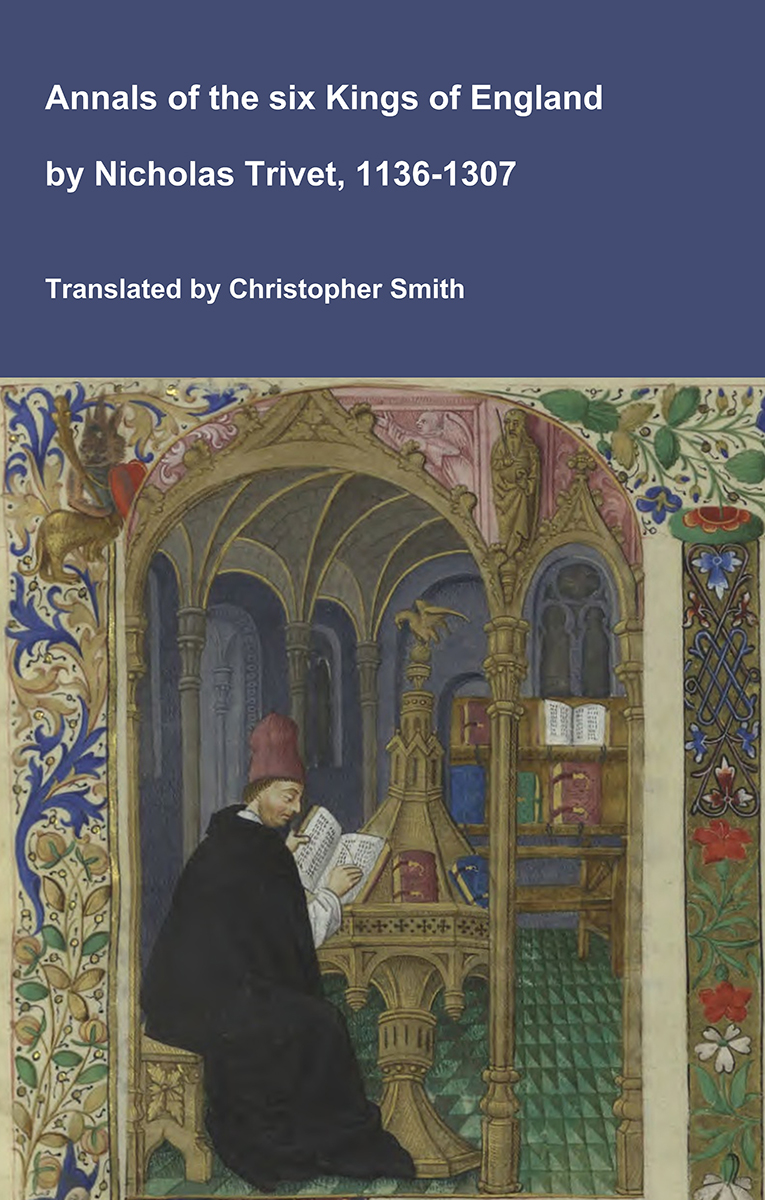
Annals of the six Kings of England by Nicholas Trivet
Translation of the Annals of the Six Kings of England by that traces the rise and rule of the Angevin aka Plantagenet dynasty from the mid-12th to early 14th century. Written by the Dominican scholar Nicholas Trivet, the work offers a vivid account of English history from the reign of King Stephen through to the death of King Edward I, blending political narrative with moral reflection. Covering the reigns of six monarchs—from Stephen to Edward I—the chronicle explores royal authority, rebellion, war, and the shifting balance between crown, church, and nobility. Trivet provides detailed insight into defining moments such as baronial conflicts, Anglo-French rivalry, and the consolidation of royal power under Edward I, whose reign he describes with particular immediacy. The Annals combines careful year-by-year reporting with thoughtful interpretation, presenting history not merely as a sequence of events but as a moral and political lesson. Ideal for readers interested in medieval history, kingship, and the origins of the English state, this chronicle remains a valuable and accessible window into the turbulent world of the Plantagenet kings.
Available at Amazon in eBook and Paperback format.
Archaeologia Volume 22 Section XVI. The Bishopp of Winchesterl recovereth his temporalytyes by mediation of Ales Peres (age 29).
[March 1377] In the meane tyme the byshopp of Wynchester, whoo with many losses & iniuryes was afflicted, seynge the lawes of the lande not to be iustly handled, but accordyng to the will of certein persons, & beynge destitute almost of all man's helpe, although he thought the sayme to be unfyttynge for hym, be turned himselffe to the women kynde, that ys to wytt, forced with necessytye he dyd that whiche he ought to doo, providynge not only for hym selffe, but also for the oppressions & losses of hys churche. Therfor knowynge that Ales Peres, the kynge's con- cubyne, cold doo all thynges that she wolde, & that there was not any man that wolde in any thynge resyste her wyll, he requested her helpe, he offered her money, he promysed her greate frendshipp, yf she colde helpe hys bishopricke furth of such troubles. She promysed easely to dispatch his cause, & whoesoever thou be that knowest the manners of harlots, thou will not doubt of this, especiallye for that his cause was greate [harde], hys adversaryes stronge, and she overcovetous; for truly she not refusynge that whiche was offered, & hyred (as ys sayed) for a suffycyent rewarde, went forwardes to trye yf any sparkes of love yett reigned in the kynge, yf the deceites of a harlott myghte now, as in tymes paste, have place with hym. He therfor that long had been taken with her love, mitigated with her speache & prayers, supposed nothynge to be denyed her now that she asked. Therfor agaynst the duke's will, he commanded hys temporalytyes to be gyven unto hym agayne, & so the bishopp by ryght & wronge, maikeynge hymselffe freinds with the ritches of this worlde, he recovered that whiche was loste. The duke, althoughe he greavously tooke that whiche Ales had doone contrarye to hys desyre, yet fearynge the kynge's wrath, he purposed to be silent for a tyme, in deferringe his revengement, & to temper hys wrathe untell he myght more fyttly reward them.
Note 1. Bishop Lowth, anxious to support the reputation of his hero, observes with respect to this statement, that it "has been advanced without any other foundation of proof, or colour of probability than the supposed influence of this lady with the king by some late writers, at a time when, as it could not possibly be verified, so neither could it easily be confuted." But he appears to have forgotten that in his preface he had in effect admitted the antiquity, at least, of the story, by remarking that the work in which it was found appeared to have been written recentibus odiis i.e. "because of recent hostilities". Whether the statement be true or false, it seems to have been propagated in Wykeham's lifetime, and though perhaps a calumny, it cannot now be easily refuted. Towards the conclusion of his work, the Bishop labours with better success to disprove Bohun's assertion that Alice Perrers was Wykeham's niece. The family name of Alice his niece was Chawmpeneys, and she was married to William Perot. On this question, however, as well as on that of the alleged bribe to Alice Perrers, doubts unfavourable to Wykeham appear to have been entertained by Archbishop Parker, who most probably derived his information from the original of the Chronicle before us. De Antiq. Brit. Eccl. p. 386, edit. 1729.
In 1539 Bishop William Wickham was born.
In 1584 Bishop William Wickham (age 45) was appointed Bishop of Lincoln.
On 1st August 1587 Mary Queen of Scots was buried at Peterborough Cathedral [Map]. Bishop William Wickham (age 48) preached.


Before 1590 Bishop William Wickham (age 50) and Antonia Barlow (age 49) were married. She the daughter of Bishop William Barlow.
In 1595 Bishop William Wickham (age 56) was appointed Bishop of Winchester.
On 11th June 1595 Bishop William Wickham (age 56) died at Winchester Palace [Map]. He was buried at Southwark Cathedral [Map].
[his son] Henry Wickham was born to Bishop William Wickham.