

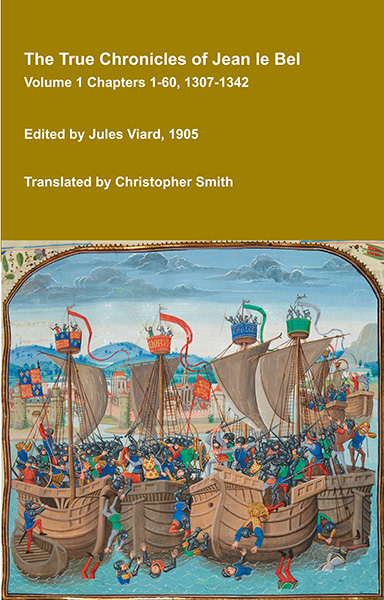
The True Chronicles of Jean le Bel Volume 1 Chapters 1-60 1307-1342
The True Chronicles of Jean le Bel offer one of the most vivid and immediate accounts of 14th-century Europe, written by a knight who lived through the events he describes, and experienced some of them first hand. Covering the early decades of the Hundred Years’ War, this remarkable chronicle follows the campaigns of Edward III of England, the politics of France and the Low Countries, and the shifting alliances that shaped medieval warfare. Unlike later historians, Jean le Bel writes with a strong sense of eyewitness authenticity, drawing on personal experience and the testimony of fellow soldiers. His narrative captures not only battles and sieges, but also the realities of military life, diplomacy, and the ideals of chivalry that governed noble society. A key source for Jean Froissart, Le Bel’s chronicle stands on its own as a compelling and insightful work, at once historical record and literary achievement. This translation builds on the 1905 edition published in French by Jules Viard, adding extensive translations from other sources Rymer's Fœdera, the Chronicles of Adam Murimuth, William Nangis, Walter of Guisborough, a Bourgeois of Valenciennes, Geoffrey le Baker of Swinbroke and Richard Lescot to enrich the original text and Viard's notes.
Available at Amazon in eBook and Paperback format.
Paternal Family Tree: Broughton
On 1st June 1857 Delves Louis Broughton 10th Baronet was born to Henry Delves Broughton 9th Baronet [aged 48] at Tillotson Place Waterloo Road Lambeth, Surrey.
On 26th April 1881 Delves Louis Broughton 10th Baronet [aged 23] and Rosamond Broughton [aged 19] were married at Yazor, Herefordshire.
On 10th September 1883 [his son] Major John Delves Broughton 11th Baronet was born to Delves Louis Broughton 10th Baronet [aged 26] and [his wife] Rosamond Broughton [aged 21] at Doddington Hall, Cheshire [Map]. He married (1) 8th July 1913 Vera Edyth Griffith-Boscawen Lady Boughton and had issue (2) 5th November 1940 Diana Caldwell Baroness Delamere.
On 11th October 1885 [his wife] Rosamond Broughton [aged 23] died.
On 21st December 1887 Delves Louis Broughton 10th Baronet [aged 30] and Mary Evelyn Cotton Lady Broughton [aged 23] were married at St George's Church, Hanover Square. She by marriage Lady Broughton of Broughton in Staffordshire.
Chester Chronicle, and Cheshire and North Wales General Advertiser. 30th April 1892. The Duchess Of Westminster [aged 35] At Wybunbury.
Laying The Foundation Stone Of A New Church.
A new epoch in the church history at Wybunbury [St Chad's Church, Wybunbury [Map]] was celebrated on Monday afternoon, when the Duchess of Westminster, in the presence of a large gathering of churchpeople, formally laid the foundation stone of a new church.
The ceremony was one which the Duke of Westminster had promised to perform, but owing to unavoidable circumstances, His Grace was unable to attend.
A procession of church choirs, consisting of Nantwich, Wisaston, Audlem, and Wybunbury (surpliced for the first time) was formed at the Wybunbury Girls' School, and, headed by the bishop [aged 47], the Rev. C.A. Stolterforth (Vicar), the Rev. F.G. Blackburne (Nantwich), the Rev. W.C. Reid, and the ministers of neighbouring parishes, marched, singing an appropriate processional hymn, to the site whereon the new church is to be erected.
The service here was in keeping with hearty church worship. The words of the hymns and psalms had special significance to the occasion, and the voices all sang with one accord the praises of the hour.
Upon the raised platforms were gathered some of the best county families. The Duchess of Westminster was supported by Lord Arthur Grosvenor [aged 31], and there were also on the platform showing the same interest in the founding of the new church which his ancestors, who lie in the tombs of old Wybunbury churches, are reputed to have evinced in church work in the parish, Mr Louis Delves Broughton [aged 34] and [his wife] Mrs Broughton [aged 27]. Mr Twemlow, of Betley Court, was also an interested spectator, as was Judge Hughes who came over from Chester and mingled amongst the crowd.
The Duchess very gracefully performed the foundation stone laying, after which Lord Arthur Grosvenor apologised for the absence of His Grace, who said that he had been laid up with a cold for two or three days. In conclusion he wished every success to the building of the new church.
The Bishop, in the course of some remarks, said that they were refounding the old Church of St Chad's upon St Mark's Day, and St Mark's Day was peculiarly appropriate for such a work because the very keynote of St Mark's Day, as the character and life of the apostle was set before them in Holy Scripture, and in the service of their prayer book, was stability and recovered stability. He was sure that everyone here hoped that the work started today would be carried on with all that thoroughness or workmanship could bestow upon it, and that future generations would look back to the work begun today as worthy of both man and God. In conclusion the bishop gave hearty expression to the thanks of the congregation to the Duchess of Westmnister, to Sir Henry Bristowe and Miss Bristowe to whose energy and zeal he alluded, as also to the active work of the late Mr Acton, who was one of the churchwardens, and to whose memory he paid a tribute of respect, and to those who by their presence and support had assisted in the progress of the movement.
After the ceremony, tea was provided in a tent, and an organ recital was given in the evening.
The site of the new church is the site upon which the old church was built, and upon which, in fact, at least four Wybunbury churches have stood. The church at Wybunbury has a grand history. The records of the parish, although incomplete, prove that so far back as 1290 Wybunbury had its church and also its vicar. The identification of the latter is somewhat scanty, but the church records clearly set forth that Roberts was the name of the vicar at this early period. But there are forthcoming fragments of early church architecture which the workmen in digging up the foundations have come upon, that prove there was a church esxisting here even before 1290. They unearthed in a well-preserved state a stone so distinctly shaped and chiselled that the architect, Mr Spooner (Charles Sydney Spooner, 1862-1938 - Stu), who has had 20 years of experience of architecture, was persuaded that it belonged to the Norman style of architecture, or First Pointed or Transitional period. The stone was discovered in the rubble of the church, and had probably lain there for hundreds of years. The date is from 1130 to 1150, and it suggested that at some time it formed part of a circular doorway. Other stones have been discovered, several of which are of the 15th Century style of architecture, and it is supopsed that these once formed part of an arch. The fabric of the church of 1838, which in architectural phraseology was of the Churchwarden Gothic Style, has been demolished, with the exception of a good part of the south wall. The foundations of the demolished were very building were unsound, and the beams which supported this structure has shifted several inches. The builder of 50 years ago succeeded in restoring to the tower the perpendicular, a gigantic work, as in that day the tower had got out of position to the extent of 5 feet 6 inches.
The new church will be built central with the tower, and will be as near as possible a facsimile of the fifteenth-century church. There will be no galleries which formed part of the old church. The organ and vestry will be built in the south chancel aisle, and in the north chancel aisle there will be a Morning Chapel.
The foundation will consist of monolithic slabs of Portland Cement. The concrete for the foundation will be a thickness of 3 feet six inches, and the whole will be bound together by a network of inter-ties. The stones which have been unearthed will again be utilised for building up the new church, and a number of brass plates, which bear the names of long since dead parishioners who lie within the tombs of the church, will be carefully put back again. One of these plates is of great antiquity and is one of half a dozen similar plates in the county.
The cost of the new church will be about £6,000. Towards this amount a considerable sum has already been raised. The Duke of Westminster sent a donation of £100, and a collection on the ground realised a considerable sum. The work will be completed in about 12 months.
The architect is Mr James Brookes, the well-known church architect, of Wellington Street, Strand, London, and the clerk of the works is Mr Spooner. Messrs Treasure & Son, of Shrewsbury, are the contractors; and Mr John Bebbington is foreman of the works.
On 26th February 1899 [his father] Henry Delves Broughton 9th Baronet [aged 90] died. His son Delves [aged 41] succeeded 10th Baronet Broughton of Broughton in Staffordshire.
On 8th July 1913 [his son] Major John Delves Broughton 11th Baronet [aged 29] and [his daughter-in-law] Vera Edyth Griffith-Boscawen Lady Boughton [aged 19] were married.
On 15th April 1914 Delves Louis Broughton 10th Baronet [aged 56] died. His son John [aged 30] succeeded 11th Baronet Broughton of Broughton in Staffordshire. Vera Edyth Griffith-Boscawen Lady Boughton [aged 20] by marriage Lady Broughton of Broughton in Staffordshire.
On 13th May 1915 [his former wife] Mary Evelyn Cotton Lady Broughton [aged 50] died.
Kings Wessex: Great x 24 Grand Son of King Edmund "Ironside" I of England
Kings Gwynedd: Great x 21 Grand Son of Owain "Great" King Gwynedd
Kings Seisyllwg: Great x 27 Grand Son of Hywel "Dda aka Good" King Seisyllwg King Deheubarth
Kings Powys: Great x 22 Grand Son of Maredudd ap Bleddyn King Powys
Kings Godwinson: Great x 25 Grand Son of King Harold II of England
Kings England: Great x 15 Grand Son of King Edward III of England
Kings Scotland: Great x 23 Grand Son of King Duncan I of Scotland
Kings Franks: Great x 31 Grand Son of Charles "Charlemagne aka Great" King of the Franks King Lombardy Holy Roman Emperor
Kings France: Great x 25 Grand Son of Hugh I King of the Franks
Kings Duke Aquitaine: Great x 29 Grand Son of Ranulf I Duke Aquitaine
Great x 4 Grandfather: Thomas Broughton 2nd Baronet  15 x Great Grand Son of King Henry "Curtmantle" II of England
Great x 3 Grandfather: Brian Broughton 3rd Baronet 15 x Great Grand Son of King John of England
Great x 4 Grandmother: Rhoda Amcotts Lady Broughton 14 x Great Grand Daughter of King John of England
Great x 2 Grandfather: Brian Broughton-Delves 4th Baronet 11 x Great Grand Son of King Edward III of England
Great x 4 Grandfather: Thomas Delves 4th Baronet  15 x Great Grand Son of King Henry "Curtmantle" II of England
Great x 3 Grandmother: Elizabeth Delves 10 x Great Grand Daughter of King Edward III of England
Great x 4 Grandmother: Jane Knightley  9 x Great Grand Daughter of King Edward III of England
Great x 1 Grandfather: Thomas Broughton 6th Baronet 12 x Great Grand Son of King Edward III of England
GrandFather: Henry Delves Broughton 8th Baronet 13 x Great Grand Son of King Edward III of England
Great x 1 Grandmother: Mary Wicker Lady Boughton
Father: Henry Delves Broughton 9th Baronet 14 x Great Grand Son of King Edward III of England
GrandMother: Mary Pigott Lady Broughton
Delves Louis Broughton 10th Baronet 15 x Great Grand Son of King Edward III of England