

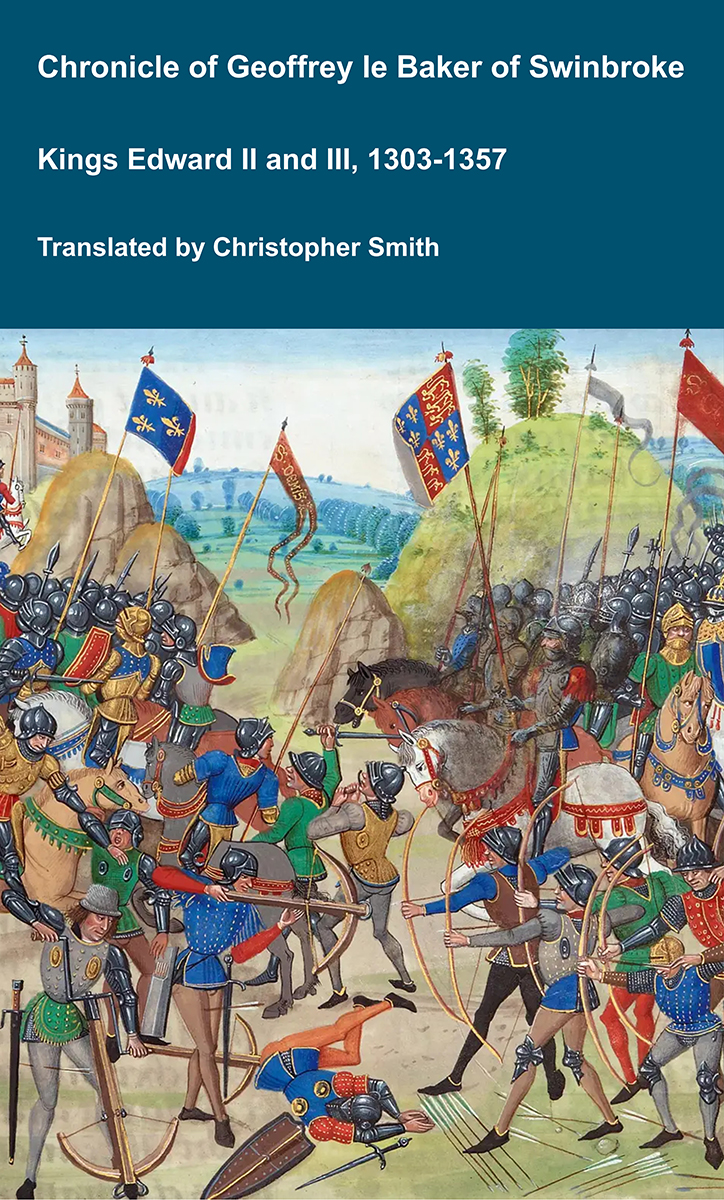
Chronicle of Geoffrey le Baker of Swinbroke
Baker was a secular clerk from Swinbroke, now Swinbrook, an Oxfordshire village two miles east of Burford. His Chronicle describes the events of the period 1303-1356: Gaveston, Bannockburn, Boroughbridge, the murder of King Edward II, the Scottish Wars, Sluys, Crécy, the Black Death, Winchelsea and Poitiers. To quote Herbert Bruce 'it possesses a vigorous and characteristic style, and its value for particular events between 1303 and 1356 has been recognised by its editor and by subsequent writers'. The book provides remarkable detail about the events it describes. Baker's text has been augmented with hundreds of notes, including extracts from other contemporary chronicles, such as the Annales Londonienses, Annales Paulini, Murimuth, Lanercost, Avesbury, Guisborough and Froissart to enrich the reader's understanding. The translation takes as its source the 'Chronicon Galfridi le Baker de Swynebroke' published in 1889, edited by Edward Maunde Thompson.
Available at Amazon in eBook and Paperback format.
Paternal Family Tree: Dering
In or before 1598 [his father] Anthony Dering of Surrenden Dering in Pluckley in Kent and [his mother] Frances Bell were married.
In 1598 Edward Dering 1st Baronet was born to [his father] Anthony Dering of Surrenden Dering in Pluckley in Kent and [his mother] Frances Bell at the Tower of London [Map] where his father was Deputy-Lieutenant.
On 22nd January 1619 Edward Dering 1st Baronet (age 21) was knighted at Newmarket, Suffolk.
On 26th November 1619 Edward Dering 1st Baronet (age 21) and Elizabeth Tufton were married at St Dionis Backchurch. She the daughter of Nicholas Tufton 1st Earl of Thanet (age 41) and Frances Cecil Countess Isle Thanet (age 38).
On 24th January 1622 [his wife] Elizabeth Tufton died.
After 24th January 1622 Edward Dering 1st Baronet (age 24) and Anne Ashburnham Lady Dering (age 17) were married. She a second-cousin once-removed of the King's favourite George Villiers 1st Duke of Buckingham (age 29).
On 5th December 1623 Edward Dering 1st Baronet (age 25) purchased two copies of William Shakespeare's First Folio; the earliest recorded retail purchase of this book.
On 8th November 1625 [his son] Edward Dering 2nd Baronet was born to Edward Dering 1st Baronet (age 27) and [his wife] Anne Ashburnham Lady Dering (age 20) at Surrenden Dering, Pluckley. He married 5th April 1648 Mary Harvey Lady Dering and had issue.
On 1st February 1626 Edward Dering 1st Baronet (age 28) was created 1st Baronet Dering of Surrenden Dering in Kent. [his wife] Anne Ashburnham Lady Dering (age 21) by marriage Lady Dering of Surrenden Dering in Kent.
On or before 17th April 1628 [his wife] Anne Ashburnham Lady Dering (age 23) died. She was buried on 17th April 1628.
After 16th April 1629 Edward Dering 1st Baronet (age 31) and Unton Gibbs Lady Dering were married. She by marriage Lady Dering of Surrenden Dering in Kent.
In 1636 [his father] Anthony Dering of Surrenden Dering in Pluckley in Kent died.

Around 1642. William Dobson (age 30). Portrait of Edward Dering 1st Baronet (age 44).
In 1644 Edward Dering 1st Baronet (age 46) died. His son Edward (age 18) succeeded 2nd Baronet Dering of Surrenden Dering in Kent.
In 1676 [his former wife] Unton Gibbs Lady Dering died.
GrandFather: Robert Bell
Mother: Frances Bell
Great x 2 Grandfather: Nicholas Beaupre of Beaupre Hall in Outwell
Great x 1 Grandfather: Edmonde Beaupré of Beaupré Hall Norfolk
Great x 2 Grandmother: Margaret Fotheringay
GrandMother: Dorothie Beaupré