

The History of William Marshal was commissioned by his son shortly after William’s death in 1219 to celebrate the Marshal’s remarkable life; it is an authentic, contemporary voice. The manuscript was discovered in 1861 by French historian Paul Meyer. Meyer published the manuscript in its original Anglo-French in 1891 in two books. This book is a line by line translation of the first of Meyer’s books; lines 1-10152. Book 1 of the History begins in 1139 and ends in 1194. It describes the events of the Anarchy, the role of William’s father John, John’s marriages, William’s childhood, his role as a hostage at the siege of Newbury, his injury and imprisonment in Poitou where he met Eleanor of Aquitaine and his life as a knight errant. It continues with the accusation against him of an improper relationship with Margaret, wife of Henry the Young King, his exile, and return, the death of Henry the Young King, the rebellion of Richard, the future King Richard I, war with France, the death of King Henry II, and the capture of King Richard, and the rebellion of John, the future King John. It ends with the release of King Richard and the death of John Marshal.
Available at Amazon in eBook and Paperback format.
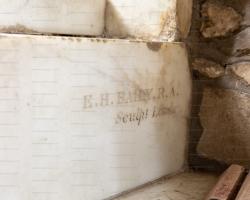
Edward Hodges Baily is in Sculptors.
On 10th March 1788 Edward Hodges Baily was born.
In 1806 Edward Hodges Baily (age 17) and Elizabeth Wardley (age 18) were married. They had four children.
On 7th February 1827 Bishop George Pelham (age 60) died at his residence at Connaught Place, Bayswater. He was buried in the Pelham family vault at All Saint's Church, Laughton.
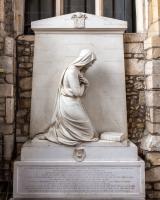
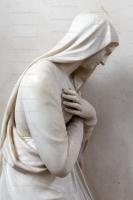
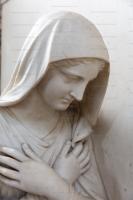
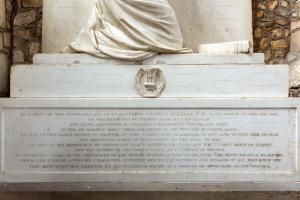
Monument at St Mary's Church, Buckden [Map] to Bishop George Pelham sculpted by Edward Hodges Baily (age 38).
In 1834 William Calder Marshall (age 20) enrolled in the Royal Academy where he studied under Francis Leggatt Chantrey (age 52) and Edward Hodges Baily (age 45). In 1835 he was awarded a Silver Medal by the Royal Academy.
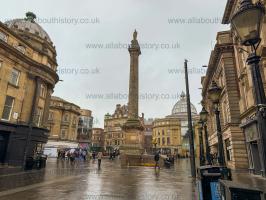
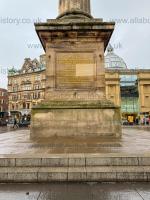
1838. Monument in Grey Square, Newcastle upon Tyne [Map] to Charles Grey 2nd Earl Grey (age 73) by Edward Hodges Baily (age 49).



On 17th January 1843 Thomas Botfield (age 80) died. He was buried at St Michael and All Angels' Church, Hopton Wafers where he and his wife have a fine monument by Edward Hodges Baily (age 54). His nephew Beriah Botfield (age 35) inherited a life interest in Hopton Court, Shropshire.
On 8th March 1858 [his wife] Elizabeth Wardley (age 70) died.
Cansick's Monumental Inscriptions Volume 2 Highgate Cemetery. Highgate Cemetery. Sacred to the memory of Edward Hodges Baily (age 69), Esq., R.A., Who died May 22 May, 1867, aged 79 years. Also of [his former wife] Elizabeth (deceased), wife of the said Edward Hodges Baily, Esqre., R.A., Who died March 8th 1858, aged 70 years.
On 22nd May 1867 Edward Hodges Baily (age 79) died.
The History of William Marshal was commissioned by his son shortly after William’s death in 1219 to celebrate the Marshal’s remarkable life; it is an authentic, contemporary voice. The manuscript was discovered in 1861 by French historian Paul Meyer. Meyer published the manuscript in its original Anglo-French in 1891 in two books. This book is a line by line translation of the first of Meyer’s books; lines 1-10152. Book 1 of the History begins in 1139 and ends in 1194. It describes the events of the Anarchy, the role of William’s father John, John’s marriages, William’s childhood, his role as a hostage at the siege of Newbury, his injury and imprisonment in Poitou where he met Eleanor of Aquitaine and his life as a knight errant. It continues with the accusation against him of an improper relationship with Margaret, wife of Henry the Young King, his exile, and return, the death of Henry the Young King, the rebellion of Richard, the future King Richard I, war with France, the death of King Henry II, and the capture of King Richard, and the rebellion of John, the future King John. It ends with the release of King Richard and the death of John Marshal.
Available at Amazon in eBook and Paperback format.
St Nicholas Church, Linton [Map]. Britsh Listed Buildings:
Free-standing white marble monument in north-east corner, to the same Charles James Mann, signed by Baily. Young man lying upon Grecian couch. Free-standing marble monument in south-west corner, to Laura, Countess Cornwallis, d.1840, by Baily. Woman, book in hand, turning on couch.


