

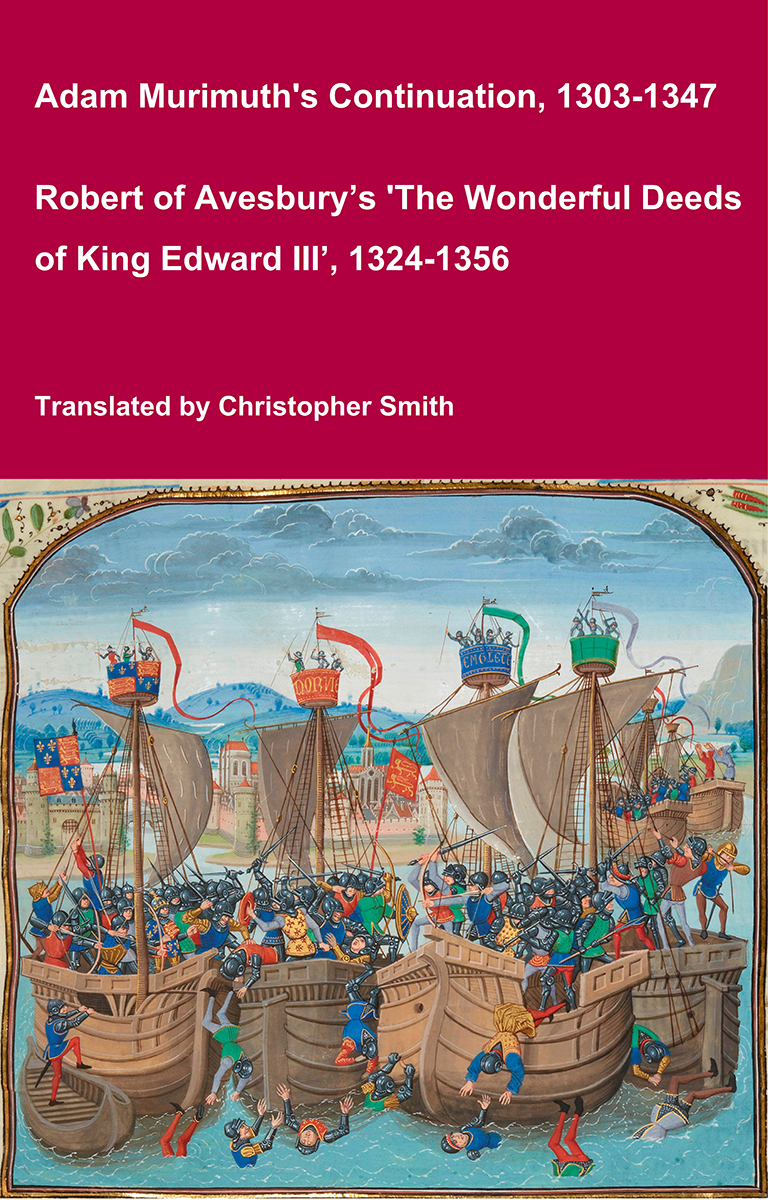
Adam Murimuth's Continuation and Robert of Avesbury’s 'The Wonderful Deeds of King Edward III'
This volume brings together two of the most important contemporary chronicles for the reign of Edward III and the opening phases of the Hundred Years’ War. Written in Latin by English clerical observers, these texts provide a vivid and authoritative window into the political, diplomatic, and military history of fourteenth-century England and its continental ambitions. Adam Murimuth Continuatio's Chronicarum continues an earlier chronicle into the mid-fourteenth century, offering concise but valuable notices on royal policy, foreign relations, and ecclesiastical affairs. Its annalistic structure makes it especially useful for establishing chronology and tracing the development of events year by year. Complementing it, Robert of Avesbury’s De gestis mirabilibus regis Edwardi tertii is a rich documentary chronicle preserving letters, treaties, and official records alongside narrative passages. It is an indispensable source for understanding Edward III’s claim to the French crown, the conduct of war, and the mechanisms of medieval diplomacy. Together, these works offer scholars, students, and enthusiasts a reliable and unembellished account of a transformative period in English and European history. Essential for anyone interested in medieval chronicles, the Hundred Years’ War, or the reign of Edward III.
Available at Amazon in eBook and Paperback format.
On 4th April 1593 Edward Nicholas was born.
In 1660 Joseph Williamson (age 26) entered the service of the Secretary of State for the Southern Department, Sir Edward Nicholas (age 66), retaining his position under the succeeding secretary, Sir Henry Bennet (age 42), afterwards Earl of Arlington.


Samuel Pepys' Diary. 6th June 1660. My letters tell me, that Mr. Calamy1 had preached before the King in a surplice (this I heard afterwards to be false); that my Lord, Gen. Monk (age 51), and three more Lords, are made Commissioners for the Treasury2; that my Lord had some great place conferred on him, and they say Master of the Wardrobe3; that the two Dukes [Duke of York and Duke of Gloucester.] do haunt the Park much, and that they were at a play, Madam Epicene,-["Epicene, or the Silent Woman", a comedy, by Ben Jonson.] the other day; that Sir. Ant. Cooper (age 38), Mr. Hollis (age 60), and Mr. Annesly (age 45), & late President of the Council of State, are made Privy Councillors to the King. At night very busy sending Mr. Donne away to London, and wrote to my father for a coat to be made me against I come to London, which I think will not be long. At night Mr. Edward Montagu came on board and staid long up with my Lord. I to bed and about one in the morning,
Note 1. Edmund Calamy, D.D., the celebrated Nonconformist divine, born February, 1600, appointed Chaplain to Charles II., 1660. He refused the bishopric of Lichfield which was offered to him. Died October 29th, 1666.
Note 2. The names of the Commissioners were Sir Edward Hyde (age 51), afterwards Earl of Clarendon, General Monk, Thomas, Earl of Southampton (age 53), John, Lord Robartes (age 54), Thomas, Lord Colepeper (age 60), Sir Edward Montagu, with Sir Edward Nicholas (age 67) and Sir William Morrice (age 57) as principal Secretaries of State. The patents are dated June 19th, 1660.
Note 3. The duty of the Master of the Wardrobe was to provide "proper furniture for coronations, marriages, and funerals" of the sovereign and royal family, "cloaths of state, beds, hangings, and other necessaries for the houses of foreign ambassadors, cloaths of state for Lord Lieutenant of Ireland, Prince of Wales, and ambassadors abroad", as also to provide robes for Ministers of State, Knights of the Garter, &c. The last Master of the Wardrobe was Ralph, Duke of Montague (age 21), who died 1709.


Samuel Pepys' Diary. 26th June 1660. My Lord dined at his lodgings all alone to-day. I went to Secretary Nicholas (age 67)1 to carry him my Lord's resolutions about his title, which he had chosen, and that is Portsmouth2. I met with Mr. Throgmorton, a merchant, who went with me to the old Three Tuns, at Charing Cross, who did give me five pieces of gold for to do him a small piece of service about a convoy to Bilbo, which I did. In the afternoon, one Mr. Watts came to me, a merchant, to offer me £500 if I would desist from the Clerk of the Acts place. I pray God direct me in what I do herein. Went to my house, where I found my father, and carried him and my wife to Whitefriars, and myself to Puddlewharf [Map], to the Wardrobe, to Mr. Townsend, who went with me to Backwell, the goldsmith's, and there we chose £100 worth of plate for my Lord to give Secretary Nicholas. Back and staid at my father's (age 59), and so home to bed.
Note 1. Sir Edward Nicholas, Secretary of State to Charles I and II. He was dismissed from his office through the intrigues of Lady Castlemaine (age 19) in 1663. He died 1669, aged seventy-seven.
Note 2. Montagu changed his mind, and ultimately took his title from the town of Sandwich, Kent [Map], leaving that of Portsmouth for the use of a King's (age 30) mistress (age 10).

Samuel Pepys' Diary. 4th July 1660. From thence to the Excise Office in Broad Street, where I received £500 for my Lord, by appointment of the Treasurer, and went afterwards down with Mr. Luddyard and drank my morning draft with him and other officers. Thence to Mr. Backewell's, the goldsmith, where I took my Lord's £100 in plate for Mr. Secretary Nicholas (age 67), and my own piece of plate, being a state dish and cup in chased work for Mr. Coventry (age 32), cost me above £19. Carried these and the money by coach to my Lord's at White Hall, and from thence carried Nicholas's plate to his house and left it there, intending to speak with him anon. So to Westminster Hall [Map], where meeting with M. L'Impertinent and W. Bowyer, I took them to the Sun Tavern, and gave them a lobster and some wine, and sat talking like a fool till 4 o'clock. So to my Lord's, and walking all the afternoon in White Hall Court, in expectation of what shall be done in the Council as to our business. It was strange to see how all the people flocked together bare, to see the King looking out of the Council window. At night my Lord told me how my orders that I drew last night about giving us power to act, are granted by the Council. At which he and I were very glad. Home and to bed, my boy lying in my house this night the first time.
Samuel Pepys' Diary. 22nd May 1662. This morning comes an order from the Secretary of State, Nicholas (age 69), for me to let one Mr. Lee, a Councellor, to view what papers I have relating to passages of the late times, wherein Sir H. Vane's (age 49) hand is employed, in order to the drawing up his charge; which I did, and at noon he, with Sir W. Pen (age 41) and his daughter, dined with me, and he to his work again, and we by coach to the Theatre [Map] and saw "Love in a Maze". The play hath little in it but Lacy's part of a country fellow, which he did to admiration.


Samuel Pepys' Diary. 2nd March 1664. This morning Mr. Burgby, one of the writing clerks belonging to the Council, was with me about business, a knowing man, he complains how most of the Lords of the Council do look after themselves and their own ends, and none the publique, unless Sir Edward Nicholas (age 70). Sir G. Carteret (age 54) is diligent, but all for his own ends and profit. My Lord Privy Seale (age 58), a destroyer of every body's business, and do no good at all to the publique. The Archbishop of Canterbury (age 65) speaks very little, nor do much, being now come to the highest pitch that he can expect. He tells me, he believes that things will go very high against the Chancellor (age 55) by Digby (age 51), and that bad things will be proved. Talks much of his neglecting the King (age 33); and making the King to trot every day to him, when he is well enough to go to visit his cozen Chief-Justice Hide (age 69), but not to the Council or King. He commends my Lord of Ormond (age 53) mightily in Ireland; but cries out cruelly of Sir G. Lane (age 44) for his corruption; and that he hath done my Lord great dishonour by selling of places here, which are now all taken away, and the poor wretches ready to starve. That nobody almost understands or judges of business better than the King, if he would not be guilty of his father's fault to be doubtfull of himself, and easily be removed from his own opinion. That my Lord Lauderdale (age 47) is never from the King's care nor council, and that he is a most cunning fellow. Upon the whole, that he finds things go very bad every where; and even in the Council nobody minds the publique.
John Evelyn's Diary. 14th September 1665. I went to Wotton, Surrey [Map]; and on 16th September, to visit old Secretary Nicholas (age 72), being now at his new purchase of West Horsley, once mortgaged to me by Lord Viscount Montague (age 55): a pretty dry seat on the Down. Returned to Wotton, Surrey [Map].
Samuel Pepys' Diary. 16th November 1667. Thence, it being too soon, I to Westminster Hall [Map], it being now about 7 at night, and there met Mr. Gregory, my old acquaintance, an understanding gentleman; and he and I walked an hour together, talking of the bad prospect of the times; and the sum of what I learn from him is this: That the King (age 37) is the most concerned in the world against the Chancellor (age 58), and all people that do not appear against him, and therefore is angry with the Bishops, having said that he had one Bishop on his side (Crofts ), and but one: that Buckingham (age 39) and Bristoll (age 55) are now his only Cabinet Council1 and that, before the Duke of York (age 34) fell sick, Buckingham was admitted to the King of his Cabinet, and there stayed with him several hours, and the Duke of York shut out. That it is plain that there is dislike between the King and Duke of York, and that it is to be feared that the House will go so far against the Chancellor, that they must do something to undo the Duke of York, or will not think themselves safe. That this Lord Vaughan (age 28), that is so great against the Chancellor, is one of the lewdest fellows of the age, worse than Sir Charles Sidly (age 28); and that he was heard to swear, God damn him, he would do my Lord Clarendon's business. That he do find that my Lord Clarendon hath more friends in both Houses than he believes he would have, by reason that they do see what are the hands that pull him down; which they do not like. That Harry Coventry (age 48) was scolded at by the King severely the other day; and that his answer was that, if he must not speak what he thought in this business in Parliament, he must not come thither. And he says that by this very business Harry Coventry hath got more fame and common esteem than any gentleman in England hath at this day, and is an excellent and able person. That the King, who not long ago did say of Bristoll, that he was a man able in three years to get himself a fortune in any kingdom in the world, and lose all again in three months, do now hug him, and commend his parts every where, above all the world. How fickle is this man [the King], and how unhappy we like to be! That he fears some furious courses will be taken against the Duke of York; and that he hath heard that it was designed, if they cannot carry matters against the Chancellor, to impeach the Duke of York himself, which God forbid! That Sir Edward Nicholas (age 74), whom he served while Secretary, is one of the best men in the world, but hated by the Queen-Mother (age 57), for a service he did the old King against her mind and her favourites; and that she and my Baroness Castlemayne (age 26) did make the King to lay him aside: but this man says that he is one of the most perfect heavenly and charitable men in the whole world.
Note 1. The term Cabinet Council, as stated by Clarendon, originated thus, in 1640: "The bulk and burden of the state affairs lay principally upon the shoulders of the Archbishop of Canterbury, the Earl of Strafford, and the Lord Cottington; some others being joined to them, as the Earl of Northumberland for ornament, the Bishop of London for his place, the two Secretaries, Sir H. Vane and Sir Francis Windebank, for service and communication of intelligence: only the Marquis of Hamilton, indeed, by his skill and interest, bore as great a part as he had a mind to do, and had the skill to meddle no further than he had a mind. These persons made up the committee of state, which was reproachfully after called the junto, and enviously then in the Court the Cabinet Council" ("History of the Rebellion", vol. i., p. 211, edit. 1849).
In 1669 Edward Nicholas (age 75) died.
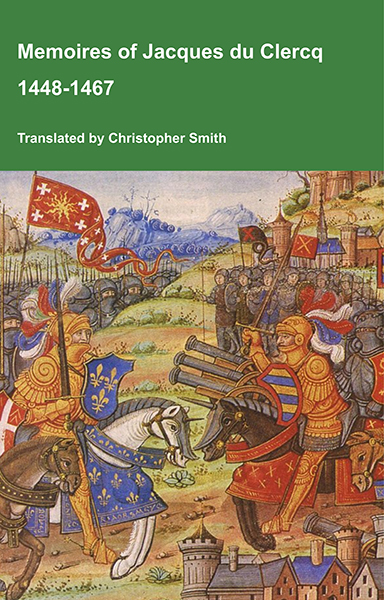
This is a translation of the 'Memoires of Jacques du Clercq', published in 1823 in two volumes, edited by Frederic, Baron de Reissenberg. In his introduction Reissenberg writes: 'Jacques du Clercq tells us that he was born in 1424, and that he was a licentiate in law and a counsellor to Philip the Good, Duke of Burgundy, in the castellany of Douai, Lille, and Orchies. It appears that he established his residence at Arras. In 1446, he married the daughter of Baldwin de la Lacherie, a gentleman who lived in Lille. We read in the fifth book of his Memoirs that his father, also named Jacques du Clercq, had married a lady of the Le Camelin family, from Compiègne. His ancestors, always attached to the counts of Flanders, had constantly served them, whether in their councils or in their armies.' The Memoires cover a period of nineteen years beginning in in 1448, ending in in 1467. It appears that the author had intended to extend the Memoirs beyond that date; no doubt illness or death prevented him from carrying out this plan. As Reissenberg writes the 'merit of this work lies in the simplicity of its narrative, in its tone of good faith, and in a certain air of frankness which naturally wins the reader’s confidence.' Du Clercq ranges from events of national and international importance, including events of the Wars of the Roses in England, to simple, everyday local events such as marriages, robberies, murders, trials and deaths, including that of his own father in Book 5; one of his last entries.
Available at Amazon in eBook and Paperback format.
[his daughter] Susannah Nicholas was born to Edward Nicholas. She married George Lane 1st Viscount Lanesborough.