

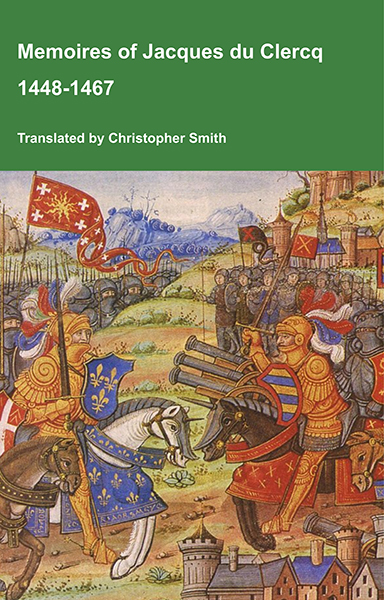
This is a translation of the 'Memoires of Jacques du Clercq', published in 1823 in two volumes, edited by Frederic, Baron de Reissenberg. In his introduction Reissenberg writes: 'Jacques du Clercq tells us that he was born in 1424, and that he was a licentiate in law and a counsellor to Philip the Good, Duke of Burgundy, in the castellany of Douai, Lille, and Orchies. It appears that he established his residence at Arras. In 1446, he married the daughter of Baldwin de la Lacherie, a gentleman who lived in Lille. We read in the fifth book of his Memoirs that his father, also named Jacques du Clercq, had married a lady of the Le Camelin family, from Compiègne. His ancestors, always attached to the counts of Flanders, had constantly served them, whether in their councils or in their armies.' The Memoires cover a period of nineteen years beginning in in 1448, ending in in 1467. It appears that the author had intended to extend the Memoirs beyond that date; no doubt illness or death prevented him from carrying out this plan. As Reissenberg writes the 'merit of this work lies in the simplicity of its narrative, in its tone of good faith, and in a certain air of frankness which naturally wins the reader’s confidence.' Du Clercq ranges from events of national and international importance, including events of the Wars of the Roses in England, to simple, everyday local events such as marriages, robberies, murders, trials and deaths, including that of his own father in Book 5; one of his last entries.
Available at Amazon in eBook and Paperback format.
Edward Onslow Ford is in Sculptors.
On 27th July 1852 Edward Onslow Ford was born to [his father] Edward Ford and [his mother] Martha Lydia Gardner.
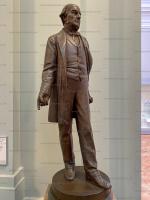
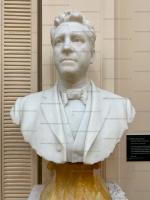
1883. William Ewart Gladstone [aged 73] by Edward Onslow Ford [aged 30]. In the collection of the Lady Lever Art Gallery [Map].

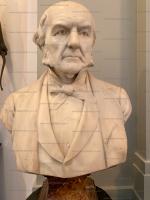
1883. Marble bust of William Ewart Gladstone [aged 73] by Edward Onslow Ford [aged 30]. In the collection of the Lady Lever Art Gallery [Map].
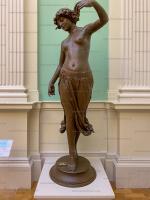
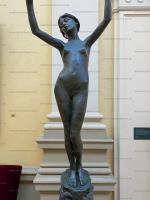
1890. "Dancing". Edward Onslow Ford [aged 37]. In the collection of the Lady Lever Art Gallery [Map]. Originally displayed at Lord Lever's London home The Hill, Hampstead. In 1922 it was moved to the Lady Lever Art Gallery [Map] and displayed outside the south entrance.
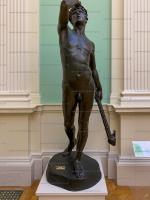
1890. "Linus". Edward Onslow Ford [aged 37]. In the collection of the Lady Lever Art Gallery [Map]. Originally displayed at Lord Lever's London home The Hill, Hampstead. In 1922 it was moved to the Lady Lever Art Gallery [Map] and displayed outside the south entrance.
The Royal Academy Conversazione, 1891, by George Henry Grenville Manton [aged 36].
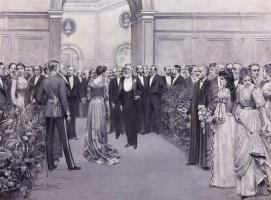
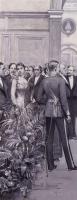
John Seymour Lucas, Dame Alice Ellen Terry [aged 43], Sir William Quiller Orchardson, Rachel, Countess of Dudley [aged 23], Marcus Stone, Henry Stacy Marks, Sir Henry Irving, Unidentified man, Unidentified man, Sir John Everett Millais [aged 61], William Charles Thomas Dobson.
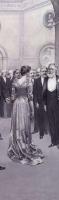
Unidentified woman, James Sant, William Powell Frith, Sir Hubert von Herkomer [aged 41], Unidentified woman, Briton Riviere, Unidentified man, John Pettie, Sir Lawrence Alma-Tadema [aged 54], Frederic Leighton [aged 60], Baron Leighton.
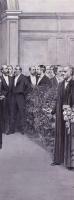
Philip Hermogenes Calderon, Walter William Ouless, Thomas Faed, Robert Walker Macbeth, Edward Onslow Ford [aged 38], William Frederick Yeames, Unidentified woman, Sir Edward Coley Burne-Jones [aged 57], Unidentified man.
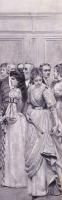
Mary Anderson, John Calcott Horsley, possibly Joanna Margaret Hadley, Unidentified man, Henry Tanworth Wells, possibly Alice Joanna Street, Marion Harry Spielmann, Unidentified woman.
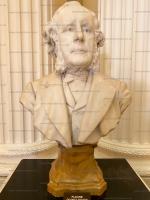
1895. Bust of James Lever [aged 85], father of William Lever 1st Viscount Leverhulme [aged 43] by Edward Onslow Ford [aged 42]. In the collection of the Lady Lever Art Gallery [Map].
James Lever: In 1810 he was born. Before 19th September 1851 he and Eliza Hesketh were married. On 25th May 1897 he died.
1895. "Echo" by Edward Onslow Ford [aged 42]. In the collection of the Lady Lever Art Gallery [Map].
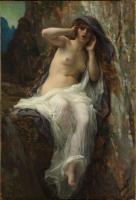
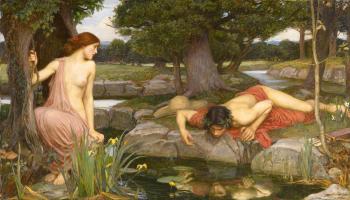
1900. Marble bust of William Lever 1st Viscount Leverhulme [aged 48] by Edward Onslow Ford [aged 47]. In the collection of the Lady Lever Art Gallery [Map].

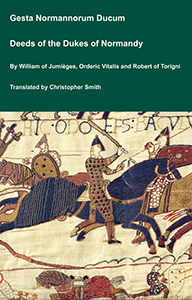
The Deeds of the Dukes of Normandy
The Gesta Normannorum Ducum [The Deeds of the Dukes of Normandy] is a landmark medieval chronicle tracing the rise and fall of the Norman dynasty from its early roots through the pivotal events surrounding the Norman Conquest of England. Originally penned in Latin by the monk William of Jumièges shortly before 1060 and later expanded at the behest of William the Conqueror, the work chronicles the deeds, politics, battles, and leadership of the Norman dukes, especially William’s own claim to the English throne. The narrative combines earlier historical sources with firsthand information and oral testimony to present an authoritative account of Normandy’s transformation from a Viking settlement into one of medieval Europe’s most powerful realms. William’s history emphasizes the legitimacy, military prowess, and governance of the Norman line, framing their expansion, including the conquest of England, as both divinely sanctioned and noble in purpose. Later chroniclers such as Orderic Vitalis and Robert of Torigni continued the history, extending the coverage into the 12th century, providing broader context on ducal rule and its impact. Today this classic work remains a foundational source for understanding Norman identity, medieval statesmanship, and the historical forces that reshaped England and Western Europe between 800AD and 1100AD.
Available at Amazon in eBook and Paperback format.
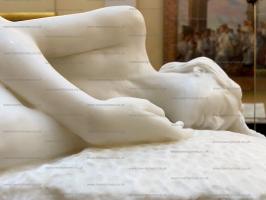
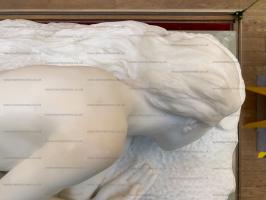
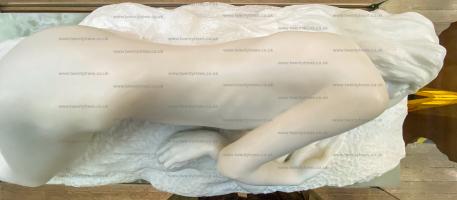
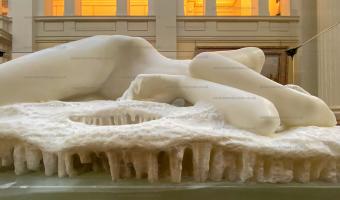
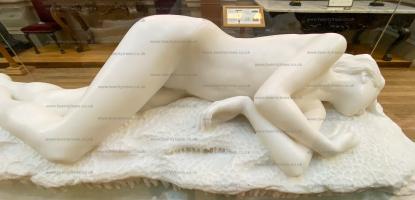
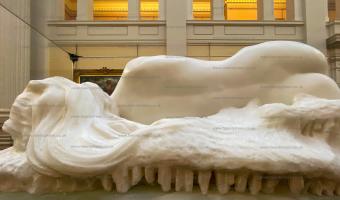
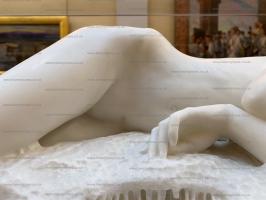
1901. "Snowdrift". Marble, green onyx for base, with lapis lazuli below with silver mounts, and black marble below. The last work of Edward Onslow Ford [aged 48]. Completed following his death. In the collection of the Lady Lever Art Gallery [Map].
On 23rd December 1901 Edward Onslow Ford [aged 49] died.