

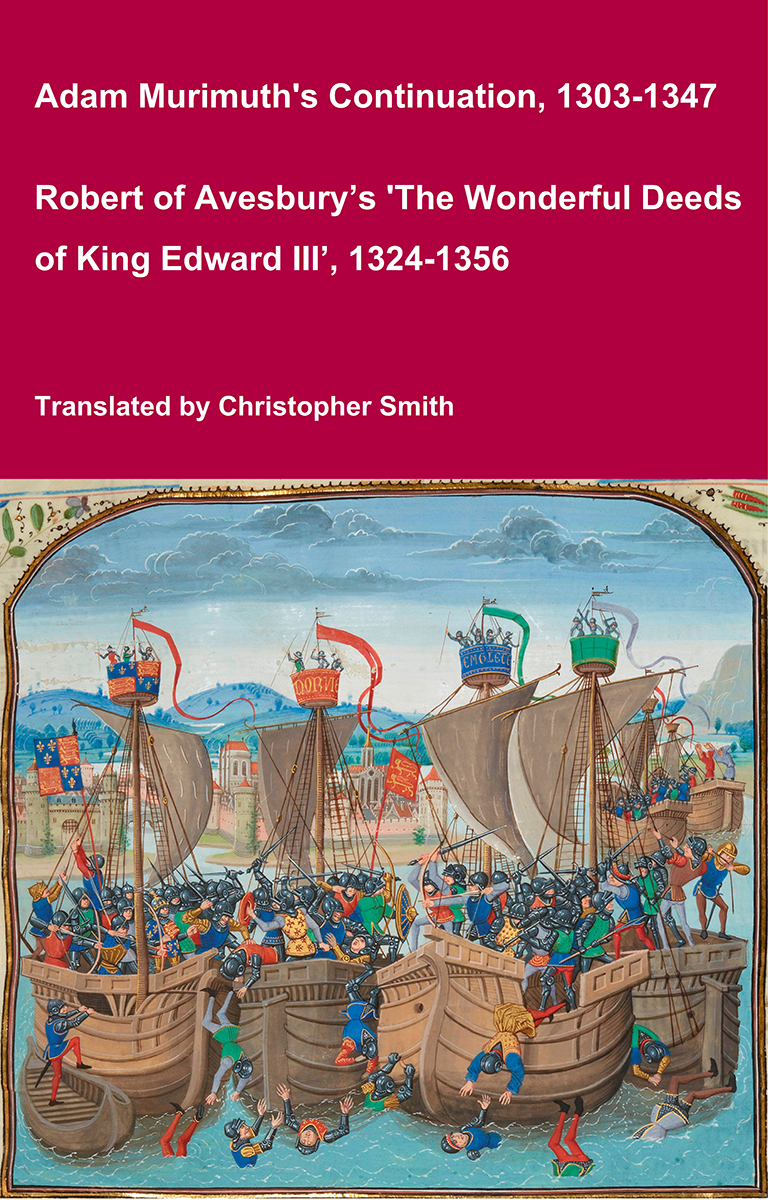
Adam Murimuth's Continuation and Robert of Avesbury’s 'The Wonderful Deeds of King Edward III'
This volume brings together two of the most important contemporary chronicles for the reign of Edward III and the opening phases of the Hundred Years’ War. Written in Latin by English clerical observers, these texts provide a vivid and authoritative window into the political, diplomatic, and military history of fourteenth-century England and its continental ambitions. Adam Murimuth Continuatio's Chronicarum continues an earlier chronicle into the mid-fourteenth century, offering concise but valuable notices on royal policy, foreign relations, and ecclesiastical affairs. Its annalistic structure makes it especially useful for establishing chronology and tracing the development of events year by year. Complementing it, Robert of Avesbury’s De gestis mirabilibus regis Edwardi tertii is a rich documentary chronicle preserving letters, treaties, and official records alongside narrative passages. It is an indispensable source for understanding Edward III’s claim to the French crown, the conduct of war, and the mechanisms of medieval diplomacy. Together, these works offer scholars, students, and enthusiasts a reliable and unembellished account of a transformative period in English and European history. Essential for anyone interested in medieval chronicles, the Hundred Years’ War, or the reign of Edward III.
Available at Amazon in eBook and Paperback format.
In 1611 Edward Walker was born.
In 1645 Edward Walker (age 34) was appointed Garter King of Arms.
John Evelyn's Diary. 6th September 1662. Dined with me Sir Edward Walker (age 51), Garter King-at-Arms, Mr. Slingsby (age 41), master of the Mint, and several others.
John Evelyn's Diary. 17th September 1662. We now resolved that the Arms of the Society should be a field argent, with a canton of the arms of England; the supporters two talbots argent; crest, an eagle Or holding a shield with the like arms of England, viz, three lions. The words "Nullius in verbâ". It was presented to his Majesty (age 32) for his approbation, and orders given to Garter King-at-Arms (age 51) to pass the diploma of their office for it.
Samuel Pepys' Diary. 16th January 1667. Then all withdrew, and by and by the Council rose, and I spoke with the Duke of York (age 33), and he told me my business was done, which I found accordingly in Sir Edward Walker's (age 56) books. And so away, mightily satisfied, to Arundell House [Map], and there heard a little good discourse, and so home, and there to Sir W. Batten (age 66), where I heard the examinations in two of our prizes, which do make but little for us, so that I do begin to doubt their proving prize, which troubled me.

John Evelyn's Diary. 18th August 1673. And I the rather am confident of it, remembering what Sir Edward Walker (age 62) (Garter King at Arms) had likewise affirmed to me a long time before, even when he was first made a Lord; that carrying his pedigree to Lord Clifford (age 43) on his being created a peer, and, finding him busy, he bade him go into his study and divert himself there till he was at leisure to discourse with him about some things relating to his family; there lay, said Sir Edward, on his table, his horoscope and nativity calculated, with some writing under it, where he read that he should be advanced to the highest degree in the state that could be conferred upon him, but that he should not long enjoy it, but should die, or expressions to that sense; and I think, (but cannot confidently say) a bloody death. This Sir Edward affirmed both to me and Sir Richard Browne; nor could I forbear to note this extraordinary passage in these memoirs.
In February 1677 Edward Walker (age 66) died.