

The Deeds of the Dukes of Normandy
The Gesta Normannorum Ducum [The Deeds of the Dukes of Normandy] is a landmark medieval chronicle tracing the rise and fall of the Norman dynasty from its early roots through the pivotal events surrounding the Norman Conquest of England. Originally penned in Latin by the monk William of Jumièges shortly before 1060 and later expanded at the behest of William the Conqueror, the work chronicles the deeds, politics, battles, and leadership of the Norman dukes, especially William’s own claim to the English throne. The narrative combines earlier historical sources with firsthand information and oral testimony to present an authoritative account of Normandy’s transformation from a Viking settlement into one of medieval Europe’s most powerful realms. William’s history emphasizes the legitimacy, military prowess, and governance of the Norman line, framing their expansion, including the conquest of England, as both divinely sanctioned and noble in purpose. Later chroniclers such as Orderic Vitalis and Robert of Torigni continued the history, extending the coverage into the 12th century, providing broader context on ducal rule and its impact. Today this classic work remains a foundational source for understanding Norman identity, medieval statesmanship, and the historical forces that reshaped England and Western Europe between 800AD and 1100AD.
Available at Amazon in eBook and Paperback format.
On 20th May 1875 Florence Harriet Young was born at Rushall, Staffordshire.
On 12th August 1899 Harold St George Gray [aged 27] and Florence Harriet Young [aged 24] were married at St Mary's Church, Motcombe. The witnesses were her sister Elizabeth, and the bride and groom's fathers.
On or before 10th February 1901, the date he was baptised at St Mary's Church, Iffley, [her son] Lionel St George Gray was born to [her husband] Harold St George Gray [aged 29] and Florence Harriet Young [aged 25].

Keiller Collection Photos. 1908. West Kennet Avenue. Probably Florence Harriet Young [aged 32].
1911. Census. [her husband] Harold St George Gray [aged 38], Florence Harriet Young [aged 35] and [her son] Lionel St George Gray [aged 9] at Castle House, Taunton.

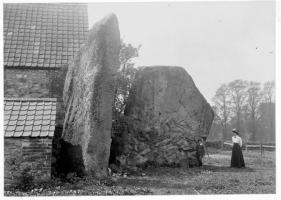
Keiller Collection Photos. May 1911. Two figures, thought to be [her husband] Harold Gray's [aged 39] wife Florence [aged 35] and their son Lionel [aged 10], with two stones of Avebury's Northern Inner Circle.
Avebury North Circle Cove [Map]. 13th May 1911. Photograph by [her husband] Harold St George Gray [aged 39] of (presumably) his wife Florence [aged 35] and their son Lionel [aged 10].
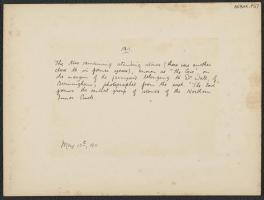
Keiller Collection Photos. April 1914. A photo of Avebury's bank and ditch. The figures on the bank are thought to be [her husband] Harold Gray's [aged 42] wife Florence Harriet Young [aged 38] and their son Lionel St George Gray [aged 13].
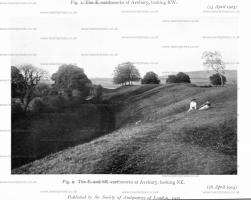
Archaeologia Volume 84 1935 Section VI. 28th April 1914. Plate XXXI. Fig. 2. The E. and SE. earthworks at Avebury, looking NE. With Florence Harriet Young [aged 38] and [her son] Lionel St George Gray [aged 13].
In July 1923 [her son] Lionel St George Gray [aged 22] died.
Chronicle of Walter of Guisborough
A canon regular of the Augustinian Guisborough Priory, Yorkshire, formerly known as The Chronicle of Walter of Hemingburgh, describes the period from 1066 to 1346. Before 1274 the Chronicle is based on other works. Thereafter, the Chronicle is original, and a remarkable source for the events of the time. This book provides a translation of the Chronicle from that date. The Latin source for our translation is the 1849 work edited by Hans Claude Hamilton. Hamilton, in his preface, says: 'In the present work we behold perhaps one of the finest samples of our early chronicles, both as regards the value of the events recorded, and the correctness with which they are detailed; Nor will the pleasing style of composition be lightly passed over by those capable of seeing reflected from it the tokens of a vigorous and cultivated mind, and a favourable specimen of the learning and taste of the age in which it was framed.'
Available at Amazon in eBook and Paperback format.
Diary of WEV Young. 23rd September 1930. Pages 129-131.
[her husband] Mr Gray [aged 58] called me into the hut at five o'clock and paid me off, remarking as he did so that funds this time were very short (I hope he will get enough for his own "honorarium"). Mrs Gray [aged 55] also joined in with a few well chosen remarks, plainly intended for my edification, although addressed to her spouse – "Really dear: I cannot keep on making up the expenses of the excavations, my purse will not allow it. I had to make up five pounds for the Ham Hill work." … In the presence of Sir Joseph and Lady Bowley, I listened meekly to all this … behaving myself with that gruelling humility one should do, in the presence of their superiors, then touching my ragged cap I backed away, and took my leave.
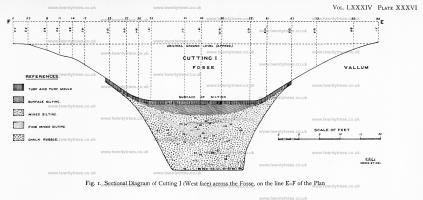
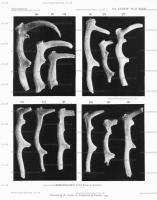
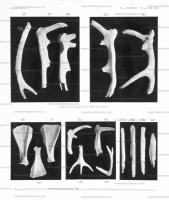
Archaeologia Volume 84 1935 Section VI. With one exception the other 'finds' in the chalk rubble were of little value as evidence of date. But that exception was an important one, viz. the finding of nine red deer antler picks (nos. 89, 90, 91, 94, 95, 131, 133, 135, and 136), for the most part fractured and incomplete, but capable of considerable repair,1 resting on the solid chalk floor of the fosse—thrown away when they became useless as tools (pl. XXXVI, fig. 1, and p. 150). Some of these picks proved to be excellent specimens, and nos. 89, 90, 133, 135, and 136 are figured in pls. XLVII and XLVIII. It is difficult to realize how this stupendous fosse was excavated out of the solid chalk by means of antler picks only. There can be no doubt that the hardest chalk must have been loosened, at least to some extent, by the blows ol flint hammers and mauls. The other appliances used in this work would probably be wooden and bone shovels, and baskets and ropes to haul the chalk to the surface. Close to the bottom a fragmentary shoulder-blade bone was found in a very bad state of preservation, and it was uncertain whether it had been used as a shovel.2
Note 1. All the picks and other antler and bone implements found in the Avebury excavations were restored by Mrs. St. George Gray [aged 58].
Note 2. Three bone shovels, described on pp. 115-116, were found at the bottom of the fosse in Cutting II.
On 28th February 1963 [her husband] Harold St George Gray [aged 91] died.
On 5th June 1970 Florence Harriet Young [aged 95] died at Martock, Somerset.