

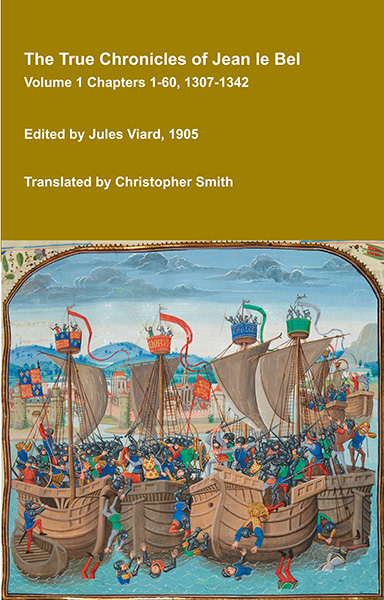
The True Chronicles of Jean le Bel Volume 1 Chapters 1-60 1307-1342
The True Chronicles of Jean le Bel offer one of the most vivid and immediate accounts of 14th-century Europe, written by a knight who lived through the events he describes, and experienced some of them first hand. Covering the early decades of the Hundred Years’ War, this remarkable chronicle follows the campaigns of Edward III of England, the politics of France and the Low Countries, and the shifting alliances that shaped medieval warfare. Unlike later historians, Jean le Bel writes with a strong sense of eyewitness authenticity, drawing on personal experience and the testimony of fellow soldiers. His narrative captures not only battles and sieges, but also the realities of military life, diplomacy, and the ideals of chivalry that governed noble society. A key source for Jean Froissart, Le Bel’s chronicle stands on its own as a compelling and insightful work, at once historical record and literary achievement. This translation builds on the 1905 edition published in French by Jules Viard, adding extensive translations from other sources Rymer's Fœdera, the Chronicles of Adam Murimuth, William Nangis, Walter of Guisborough, a Bourgeois of Valenciennes, Geoffrey le Baker of Swinbroke and Richard Lescot to enrich the original text and Viard's notes.
Available at Amazon in eBook and Paperback format.
Frederick Richard Say is in Painters.
On 30th November 1804 Frederick Richard Say was born.

1830-1840. Frederick Richard Say [aged 25]. Portrait of Edward Ward 3rd Viscount Bangor [aged 40].
Edward Ward 3rd Viscount Bangor: In 1790 he was born to Edward Ward. On 14th February 1826 he and Harriet Margaret Maxwell Viscountess Bangor were married. On 11th September 1827 Nicholas Ward 2nd Viscount Bangor died unmarried. His nephew Edward succeeded 3rd Viscount Bangor of Castleward in County Downe. In 1837 he died.
1830. Frederick Richard Say [aged 25]. Portrait of Martha Buckworth, Mrs William Lyde Wiggett aka Chute [aged 30].
Martha Buckworth: In or before 1838 William Lyde Wiggett aka Chute and she were married.
1830. Frederick Richard Say [aged 25]. Portrait of William Lyde Wiggett aka Chute [aged 30].

1830. Frederick Richard Say [aged 25]. Portrait of Edmund Parker 2nd Earl Morley [aged 19].
Edmund Parker 2nd Earl Morley: On 10th June 1810 he was born to John Parker 1st Earl Morley and Frances Talbot Countess Morley. On 14th March 1840 John Parker 1st Earl Morley died. His son Edmund succeeded 2nd Earl Morley, 2nd Viscount Boringdon of North Malton in Devon, 3rd Baron Boringdon. In 1842 Edmund Parker 2nd Earl Morley and Harriet Sophia Parker Countess Morley were married. She by marriage Countess Morley. He the son of John Parker 1st Earl Morley and Frances Talbot Countess Morley. They were second cousins. On 28th August 1864 Edmund Parker 2nd Earl Morley died. His son Albert succeeded 3rd Earl Morley, 3rd Viscount Boringdon of North Malton in Devon, 4th Baron Boringdon.

1830. Frederick Richard Say [aged 25]. Portrait of Frances Talbot Countess Morley [aged 48].
Frances Talbot Countess Morley: In 1782 she was born to Thomas Talbot of Wymondham. In 1809 John Parker 1st Earl Morley and she were married. On 6th December 1857 she died.

1830. Frederick Richard Say [aged 25]. Portrait of John Parker 1st Earl Morley [aged 57].

1844. Frederick Richard Say [aged 39]. Portrait of Edward Smith-Stanley 14th Earl of Derby [aged 44].

1848. Frederick Richard Say [aged 43]. Portrait of Henry Pelham-Clinton 5th Duke Newcastle-under-Lyne [aged 36].

Before 1868. Frederick Richard Say [aged 63]. Portrait of Lucy Graham Countess Powis [aged 74].
On 30th March 1868 Frederick Richard Say [aged 63] died.