

Jean de Waurin's Chronicle of England Volume 6 Books 3-6: The Wars of the Roses
Jean de Waurin was a French Chronicler, from the Artois region, who was born around 1400, and died around 1474. Waurin’s Chronicle of England, Volume 6, covering the period 1450 to 1471, from which we have selected and translated Chapters relating to the Wars of the Roses, provides a vivid, original, contemporary description of key events some of which he witnessed first-hand, some of which he was told by the key people involved with whom Waurin had a personal relationship.
Available at Amazon in eBook and Paperback format.
Paternal Family Tree: Fane
On 12th January 1778 [his father] Henry Fane of Fulbeck (age 38) and [his mother] Anne Buckley Batson (age 20) were married. He the son of [his grandfather] Thomas Fane 8th Earl of Westmoreland and [his grandmother] Elizabeth Swymmer Countess Westmoreland.
On 26th November 1778 General Henry Fane was born to [his father] Henry Fane of Fulbeck (age 39) and [his mother] Anne Buckley Batson (age 20).
In 1792 General Henry Fane (age 13) joined the 6th Dragoon Guards as a Cornet.
In 1794 General Henry Fane (age 15) was promoted to Captain-Lieutenancy of the 4th Dragoon Guards.
From 1801 General Henry Fane (age 22) lived with Isabella Gorges who was married to Edward Cooke.
In 1802 General Henry Fane (age 23) was elected MP Lyme Regis which seat he held until 1816.
In 1802 [his illegitimate son] Henry Fane was born illegitimately to General Henry Fane (age 23) and Isabella Gorges.
On 4th June 1802 [his father] Henry Fane of Fulbeck (age 63) died. He was buried at St Nicholas' Church, Fulbeck. General Henry Fane (age 23) inherited Fulbeck Hall.
In 1804 [his illegitimate daughter] Isabella Fane was born illegitimately to General Henry Fane (age 25) and Isabella Gorges.
In 1807 [his illegitimate son] Vere Fane was born illegitimately to General Henry Fane (age 28) and Isabella Gorges.
On 17th August 1808 the Battle of Roliça an Anglo-Portuguese army under Sir Arthur Wellesley defeated an outnumbered Imperial French division under General of Division Henri François Delaborde, near the village of Roliça in Portugal.
General Henry Fane (age 29) commanded.
Between 27th July 1809 and 28th July 1809 the Battle of Talavera, part of the Peninsular War, was fought between an Anglo Spanish army commanded by Arthur Wellesley 1st Duke Wellington (age 40) against the French. The French army withdrew at night after several of its attacks had been repulsed. Following the battle Arthur Wellesley 1st Duke Wellington was created 1st Viscount Wellington of Talavera.
Hugh Gough 1st Viscount Gough (age 29) commanded the 2nd Battalion of the 87th (Royal Irish Fusiliers) Regiment of Foot.
General Henry Fane (age 30) commanded the 3rd Prince of Wales Dragoon Guards, 4th Queen's Own Dragoons.
Charles Henry Farrington 2nd Baronet (age 14) fought.


In 1811 [his illegitimate son] Arthur Fane was born illegitimately to General Henry Fane (age 32) and Isabella Gorges.

On 21st June 1813 the Battle of Vitoria was fought between a British, Portuguese and Spanish army under the Marquess of Wellington (age 44) and the French army under King Joseph Bonaparte and Marshal Jean-Baptiste Jourdan.
Brothers General Thomas Bradford (age 35) and Lieutenant-Colonel Henry Hollis Bradford (age 31) fought.
Hugh Gough 1st Viscount Gough (age 33) fought.
General Henry Fane (age 34) commanded.
[his brother] General Mildmay Fane (age 18) fought.
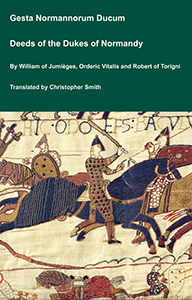
The Deeds of the Dukes of Normandy
The Gesta Normannorum Ducum [The Deeds of the Dukes of Normandy] is a landmark medieval chronicle tracing the rise and fall of the Norman dynasty from its early roots through the pivotal events surrounding the Norman Conquest of England. Originally penned in Latin by the monk William of Jumièges shortly before 1060 and later expanded at the behest of William the Conqueror, the work chronicles the deeds, politics, battles, and leadership of the Norman dukes, especially William’s own claim to the English throne. The narrative combines earlier historical sources with firsthand information and oral testimony to present an authoritative account of Normandy’s transformation from a Viking settlement into one of medieval Europe’s most powerful realms. William’s history emphasizes the legitimacy, military prowess, and governance of the Norman line, framing their expansion, including the conquest of England, as both divinely sanctioned and noble in purpose. Later chroniclers such as Orderic Vitalis and Robert of Torigni continued the history, extending the coverage into the 12th century, providing broader context on ducal rule and its impact. Today this classic work remains a foundational source for understanding Norman identity, medieval statesmanship, and the historical forces that reshaped England and Western Europe between 800AD and 1100AD.
Available at Amazon in eBook and Paperback format.
On 5th June 1815 General Henry Fane (age 36) was appointed Knight Commander of the Order of the Bath.
On 24th January 1826 General Henry Fane (age 47) was appointed Knight Grand Cross of the Order of the Bath.
In 1829 General Henry Fane (age 50) was elected MP Lyme Regis which seat he held until 1830.
In 1830 General Henry Fane (age 51) was elected MP Hastings which seat he held until 1831.
In 1830 General Henry Fane (age 51) was appointed Commander-in-Chief of India.
In or before 1835 [his illegitimate son] Arthur Fane (age 23) and [his daughter-in-law] Lucy Bennett were married.
On 12th November 1835 [his grandson] Captain Henry John Fane was born to Henry Fane (age 33) and Christine Isabelle Roche aka O'Shea at Calcutta, India. He was baptised 21st November 1835. The descent somewhat speculative based on the memorial at St Nicholas' Church, Fulbeck in which Major-General Vere Bonamy Fane is described as the son of Captain Henry John Fane of the Dorset Regiment. There is no explicit evidence that Captain Henry John Fane is one of the illegitimate sons of General Henry Fane (age 56) and Isabella Gorges.
In 1836 [his illegitimate son] Henry Fane (age 34) died. Major-General Walter Fane (age 8) inherited Fulbeck Hall.
On 19th January 1838 [his mother] Anne Buckley Batson (age 80) died at Fulbeck Hall. She was buried at St Nicholas' Church, Fulbeck.
On 25th March 1840 General Henry Fane (age 61) died on board the East India ship Malabar on his passage home from Bombay, India. He was buried at sea later that day. [his illegitimate son] Henry Fane, being illegitmate, inherited a life interest in Fulbeck Hall only.
Abbot John Whethamstede’s Chronicle of the Abbey of St Albans
Abbot John Whethamstede's Register aka Chronicle of his second term at the Abbey of St Albans, 1451-1461, is a remarkable text that describes his first-hand experience of the beginning of the Wars of the Roses including the First and Second Battles of St Albans, 1455 and 1461, respectively, their cause, and their consequences, not least on the Abbey itself. His text also includes Loveday, Blore Heath, Northampton, the Act of Accord, Wakefield, and Towton, and ends with the Coronation of King Edward IV. In addition to the events of the Wars of the Roses, Abbot John, or his scribes who wrote the Chronicle, include details in the life of the Abbey such as charters, letters, land exchanges, visits by legates, and disputes, which provide a rich insight into the day-to-day life of the Abbey, and the challenges faced by its Abbot.
Available at Amazon in eBook and Paperback format.

After 25th March 1840. Memorial to General Henry Fane (deceased) at St Nicholas' Church, Fulbeck.
On 22nd October 1840 the will of General Henry Fane was proved. His personalty sworn under £30,000. He had inherited the Dorset and Hampshire estates from his [his mother] mother in 1838, but she had entailed them, in default of his legitimate male issue, on his next brother the Reverend Edward Fane (age 56).
Before General Henry Fane and Christine Isabelle Roche aka O'Shea were married.
Kings Wessex: Great x 22 Grand Son of King Edmund "Ironside" I of England
Kings Gwynedd: Great x 19 Grand Son of Owain "Great" King Gwynedd
Kings Seisyllwg: Great x 25 Grand Son of Hywel "Dda aka Good" King Seisyllwg King Deheubarth
Kings Powys: Great x 20 Grand Son of Maredudd ap Bleddyn King Powys
Kings Godwinson: Great x 22 Grand Son of King Harold II of England
Kings England: Great x 12 Grand Son of King Edward III of England
Kings Scotland: Great x 21 Grand Son of King Duncan I of Scotland
Kings Franks: Great x 28 Grand Son of Charles "Charlemagne aka Great" King of the Franks King Lombardy Holy Roman Emperor
Kings France: Great x 23 Grand Son of Hugh I King of the Franks
Kings Duke Aquitaine: Great x 26 Grand Son of Ranulf I Duke Aquitaine
Great x 4 Grandfather: Francis Fane 1st Earl of Westmoreland  6 x Great Grand Son of King Edward III of England
Great x 3 Grandfather: Francis Fane 7 x Great Grand Son of King Edward III of England
Great x 4 Grandmother: Mary Mildmay Countess of Westmoreland  10 x Great Grand Daughter of King Edward I of England
Great x 2 Grandfather: Francis Fane 8 x Great Grand Son of King Edward III of England
Great x 4 Grandfather: William West 
Great x 3 Grandmother: Elizabeth West Baroness Darcy 8 x Great Grand Daughter of King Edward III of England
Great x 4 Grandmother: Katherine Darcy  7 x Great Grand Daughter of King Edward III of England
Great x 1 Grandfather: Henry Fane of Brympton 9 x Great Grand Son of King Edward III of England
Great x 4 Grandfather: Lawrence Rushworth
Great x 3 Grandfather: John Rushworth
Great x 2 Grandmother: Hannah Rushworth
GrandFather: Thomas Fane 8th Earl of Westmoreland 10 x Great Grand Son of King Edward III of England
Great x 4 Grandfather: Robert Scrope  6 x Great Grand Son of King Edward III of England
Great x 3 Grandfather: Adrian Scrope 7 x Great Grand Son of King Edward III of England
Great x 4 Grandmother: Margaret Cornwall  10 x Great Grand Daughter of King Edward I of England
Great x 2 Grandfather: Thomas Scrope 8 x Great Grand Son of King Edward III of England
Great x 4 Grandfather: Robert Waller
Great x 3 Grandmother: Mary Waller
Great x 4 Grandmother: Mary Bracey
Great x 1 Grandmother: Anne Scrope 9 x Great Grand Daughter of King Edward III of England
Great x 4 Grandfather: Humphrey Hooke
Great x 3 Grandfather: Thomas Hooke
Great x 2 Grandmother: Mary Hooke
Father: Henry Fane of Fulbeck 11 x Great Grand Son of King Edward III of England
Great x 1 Grandfather: William Swymmer
GrandMother: Elizabeth Swymmer Countess Westmoreland
General Henry Fane 12 x Great Grand Son of King Edward III of England
GrandFather: Edward Buckley Batson
Mother: Anne Buckley Batson