

The Deeds of the Dukes of Normandy
The Gesta Normannorum Ducum [The Deeds of the Dukes of Normandy] is a landmark medieval chronicle tracing the rise and fall of the Norman dynasty from its early roots through the pivotal events surrounding the Norman Conquest of England. Originally penned in Latin by the monk William of Jumièges shortly before 1060 and later expanded at the behest of William the Conqueror, the work chronicles the deeds, politics, battles, and leadership of the Norman dukes, especially William’s own claim to the English throne. The narrative combines earlier historical sources with firsthand information and oral testimony to present an authoritative account of Normandy’s transformation from a Viking settlement into one of medieval Europe’s most powerful realms. William’s history emphasizes the legitimacy, military prowess, and governance of the Norman line, framing their expansion, including the conquest of England, as both divinely sanctioned and noble in purpose. Later chroniclers such as Orderic Vitalis and Robert of Torigni continued the history, extending the coverage into the 12th century, providing broader context on ducal rule and its impact. Today this classic work remains a foundational source for understanding Norman identity, medieval statesmanship, and the historical forces that reshaped England and Western Europe between 800AD and 1100AD.
Available at Amazon in eBook and Paperback format.
George Frederick Bodley is in Sculptors.
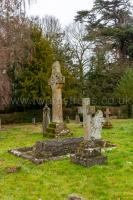
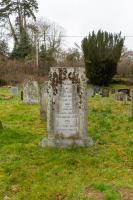
Graves of George Frederick Bodley, flat, next to the large cross, and Reverend Frederick Andrews in the churchyard of St James' Church, Kinnersley [Map].
Reverend Frederick Andrews: In 1873 he was appointed Vicar of St James' Church, Kinnersley [Map]. In 1920 he died. He was buried in the churchyard of St James' Church, Kinnersley [Map].
On 14th March 1827 George Frederick Bodley was born to [his father] William Hulme Bodley.
In 1872 George Frederick Bodley (age 44) and Minna Reavely were married at Kinnersley Castle, Herefordshire [Map].
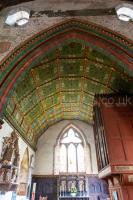
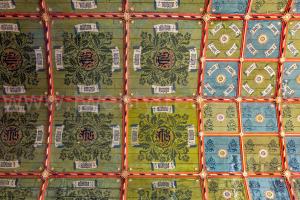
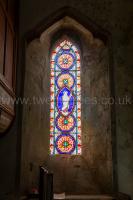
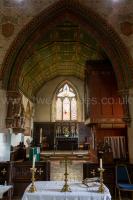
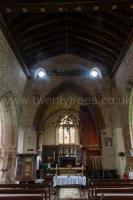
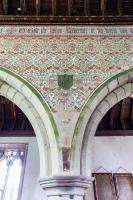
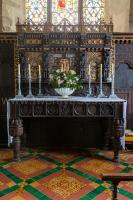
From 1873 the interior of St James' Church, Kinnersley [Map] was revised by George Frederick Bodley (age 45) working with the Reverend Frederick Andrews. Reredos by George Frederick Bodley. Altar Jacobean.
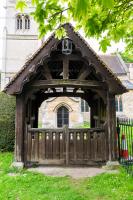
1883. Lych Gate at St Oswald's Church, Blankney. By George Frederick Bodley (age 55). Inscription over the gate: 'ERECTED IN MEMORY OF FLORENCE CHAPLIN, 1883'.
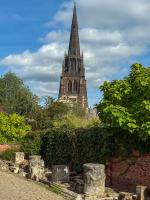
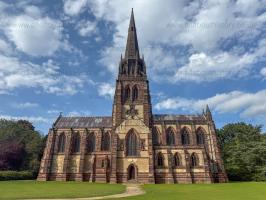
Clumber Chapel [Map] was commissioned by Henry Pelham-Clinton 7th Duke Newcastle-under-Lyne (age 25) and designed by George Frederick Bodley (age 62). Built in Runcorn Sandstone and white Steetley Stone, the building is 42m long. The spire is 55m high. The oak screen that separates the Crossing from the Chancel is also designed by Bodley. The Chapel was dedicated by Bishop George Ridding (age 61) on 23rd October 1889.
Henry Pelham-Clinton 7th Duke Newcastle-under-Lyne: On 28th September 1864 he was born to Henry Pelham Alexander Pelham-Clinton 6th Duke Newcastle-under-Lyne and Henrietta Adela Hope Duchess Newcastle under Lyne. On 22nd February 1879 Henry Pelham Alexander Pelham-Clinton 6th Duke Newcastle-under-Lyne died. His son Henry succeeded 7th Duke Newcastle under Lyme, 14th Earl Lincoln. On 30th May 1928 Henry Pelham-Clinton 7th Duke Newcastle-under-Lyne died. His brother Francis succeeded 8th Duke Newcastle under Lyme, 15th Earl Lincoln.
On 21st October 1907 George Frederick Bodley (age 80) died at Water Eaton, Oxfordshire. He was buried in the churchyard of St James' Church, Kinnersley [Map].


