


Text this colour links to Pages. Text this colour links to Family Trees. Text this colour are links that disabled for Guests.
Place the mouse over images to see a larger image. Click on paintings to see the painter's Biography Page.
Mouse over links for a preview. Move the mouse off the painting or link to close the popup.
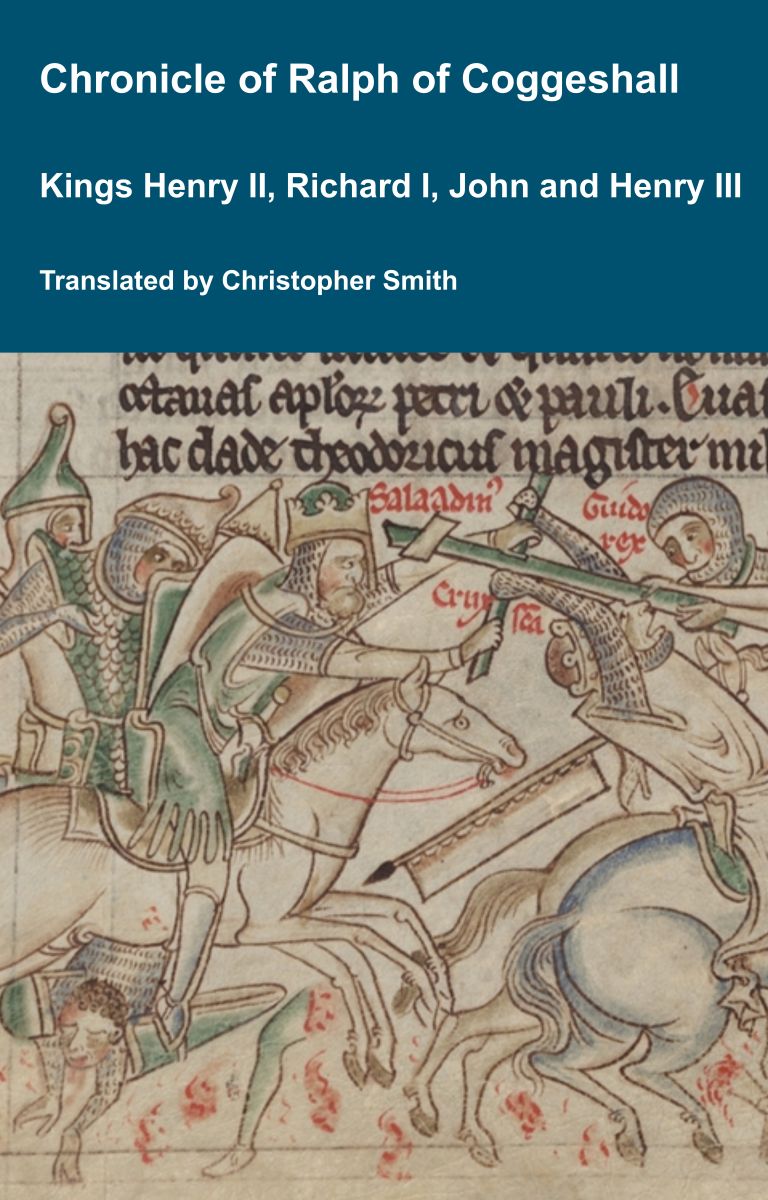
Chronicle of Abbot Ralph of Coggeshall
The Chronicle of Abbot Ralph of Coggeshall (Chronicon Anglicanum) is an indispensable medieval history that brings to life centuries of English and European affairs through the eyes of a learned Cistercian monk. Ralph of Coggeshall, abbot of the Abbey of Coggeshall in Essex in the early 13th century, continued and expanded his community’s chronicle, documenting events from the Norman Conquest of 1066 into the tumultuous reign of King Henry III. Blending eyewitness testimony, careful compilation, and the monastic commitment to record-keeping, this chronicle offers a rare narrative of political intrigue, royal power struggles, and social upheaval in England and beyond. Ralph’s work captures the reigns of pivotal figures such as Richard I and King John, providing invaluable insights into their characters, decisions, and the forces that shaped medieval rule. More than a simple annal, Chronicon Anglicanum conveys the texture of medieval life and governance, making it a rich source for scholars and readers fascinated by English history, monastic authorship, and the shaping of the medieval world.
Available at Amazon in eBook and Paperback format.
Before 1644 George Norbury and Sarah Sutton (age 23) were married.
Before 1644 [his daughter] Catherine Norbury was born to George Norbury and [his wife] Sarah Sutton (age 23). She married on or after 21st March 1665 Robert Wooley and had issue.
Samuel Pepys' Diary. 12th February 1664. So Creed and I by boat to my house, and thence to coach with my wife and called at Alderman Backewell's (age 46) and there changed Mr. Falconer's state-cup, that he did give us the other day, for a fair tankard. The cup weighed with the fashion £5 16s., and another little cup that Joyce Norton did give us 17s., both £6 13s.; for which we had the tankard, which came to £6 10s., at 5s. 7d. per oz., and 3s. in money, and with great content away thence to my brother's, Creed going away there, and my brother bringing me the old silk standard that I lodged there long ago, and then back again home, and thence, hearing that my uncle Wight (age 62) had been at my house, I went to him to the Miter [Map], and there with him and Maes, Norbury, and Mr. Rawlinson (age 50) till late eating some pot venison (where the Crowne earthen pot pleased me mightily), and then homewards and met Mr. Barrow, so back with him to the Miter [Map] and sat talking about his business of his discontent in the yard, wherein sometimes he was very foolish and pettish, till 12 at night, and so went away, and I home and up to my wife a-bed, with my mind ill at ease whether I should think that I had by this made myself a bad end by missing the certainty of £100 which I proposed to myself so much, or a good one by easing myself of the uncertain good effect but the certain trouble and reflection which must have fallen on me if we had proceeded to a public dispute, ended besides embarking myself against my Lord, who (which I had forgot) had given him his hand for the value of the pieces of eight at his rates which were all false, which by the way I shall take heed to the giving of my Lord notice of it hereafter whenever he goes out again.
Samuel Pepys' Diary. 14th February 1664. All the afternoon at my office alone doing business, and then in the evening after a walk with my wife in the garden, she and I to my uncle Wight's (age 62) to supper, where Mr. Norbury, but my uncle out of tune, and after supper he seemed displeased mightily at my aunt's desiring [to] put off a copper kettle, which it seems with great study he had provided to boil meat in, and now she is put in the head that it is not wholesome, which vexed him, but we were very merry about it, and by and by home, and after prayers to bed.
Samuel Pepys' Diary. 3rd May 1664. My wife abroad with my aunt Wight (age 45) and Norbury.
Samuel Pepys' Diary. 3rd May 1664. Thence to my uncle Wight's (age 62), and he not being at home I went with Mr. Norbury near hand to the Fleece, a mum house in Leadenhall, and there drunk mum and by and by broke up, it being about 11 o'clock at night, and so leaving them also at home, went home myself and to bed.
Samuel Pepys' Diary. 15th May 1664. In the evening came Mr. Vernaty to see me and discourse about my Lord Peterborough's (age 42) business, and also my uncle Wight (age 62) and Norbury, but I took no notice nor showed any different countenance to my uncle Wight, or he to me, for all that he carried himself so basely to my wife the last week, but will take time to make my use of it. So, being exceeding hot, to bed, and slept well.
The Deeds of the Dukes of Normandy
The Gesta Normannorum Ducum [The Deeds of the Dukes of Normandy] is a landmark medieval chronicle tracing the rise and fall of the Norman dynasty from its early roots through the pivotal events surrounding the Norman Conquest of England. Originally penned in Latin by the monk William of Jumièges shortly before 1060 and later expanded at the behest of William the Conqueror, the work chronicles the deeds, politics, battles, and leadership of the Norman dukes, especially William’s own claim to the English throne. The narrative combines earlier historical sources with firsthand information and oral testimony to present an authoritative account of Normandy’s transformation from a Viking settlement into one of medieval Europe’s most powerful realms. William’s history emphasizes the legitimacy, military prowess, and governance of the Norman line, framing their expansion, including the conquest of England, as both divinely sanctioned and noble in purpose. Later chroniclers such as Orderic Vitalis and Robert of Torigni continued the history, extending the coverage into the 12th century, providing broader context on ducal rule and its impact. Today this classic work remains a foundational source for understanding Norman identity, medieval statesmanship, and the historical forces that reshaped England and Western Europe between 800AD and 1100AD.
Available at Amazon in eBook and Paperback format.
Samuel Pepys' Diary. 8th December 1664. In the evening comes my aunt and uncle Wight (age 62), [his wife] Mrs. Norbury (age 44), and her daughter, and after them Mr. Norbury, where no great pleasure, my aunt being out of humour in her fine clothes, and it raining hard. Besides, I was a little too bold with her about her doating on Dr. Venner. Anon they went away, and I till past 12 at night at my office, and then home to bed.
Samuel Pepys' Diary. 1st May 1666. Thence by water to Redriffe [Map], reading a new French book my Lord Bruncker (age 46) did give me to-day, "L'Histoire Amoureuse des Gaules"1, being a pretty libel against the amours of the Court of France. I walked up and down Deptford, Kent [Map] yarde, where I had not been since I come from living at Greenwich, Kent [Map], which is some months. There I met with Mr. Castle (age 37), and was forced against my will to have his company back with me. So we walked and drank at Halfway house and so to his house, where I drank a cupp of syder, and so home, where I find Mr. Norbury newly come to town to see us. After he gone my wife tells me the ill newes that our Susan is sicke and gone to bed, with great pain in her head and back, which troubles us all. However we to bed expecting what to-morrow would produce. She hath we conceive wrought a little too much, having neither maid nor girle to help her.
Note 1. This book, which has frequently been reprinted, was written by Roger de Rabutin, Comte de Bussy, for the amusement of his mistress, Madame de Montglas, and consists of sketches of the chief ladies of the court, in which he libelled friends and foes alike. These circulated in manuscript, and were printed at Liege in 1665. Louis XIV. was so much annoyed with the book that he sent the author to the Bastille for over a year.
Samuel Pepys' Diary. 27th May 1666. Thence home to dinner, whither come my uncle Wight (age 64), and aunt and uncle Norbury, and Mr. Shepley. A good dinner and very merry.