

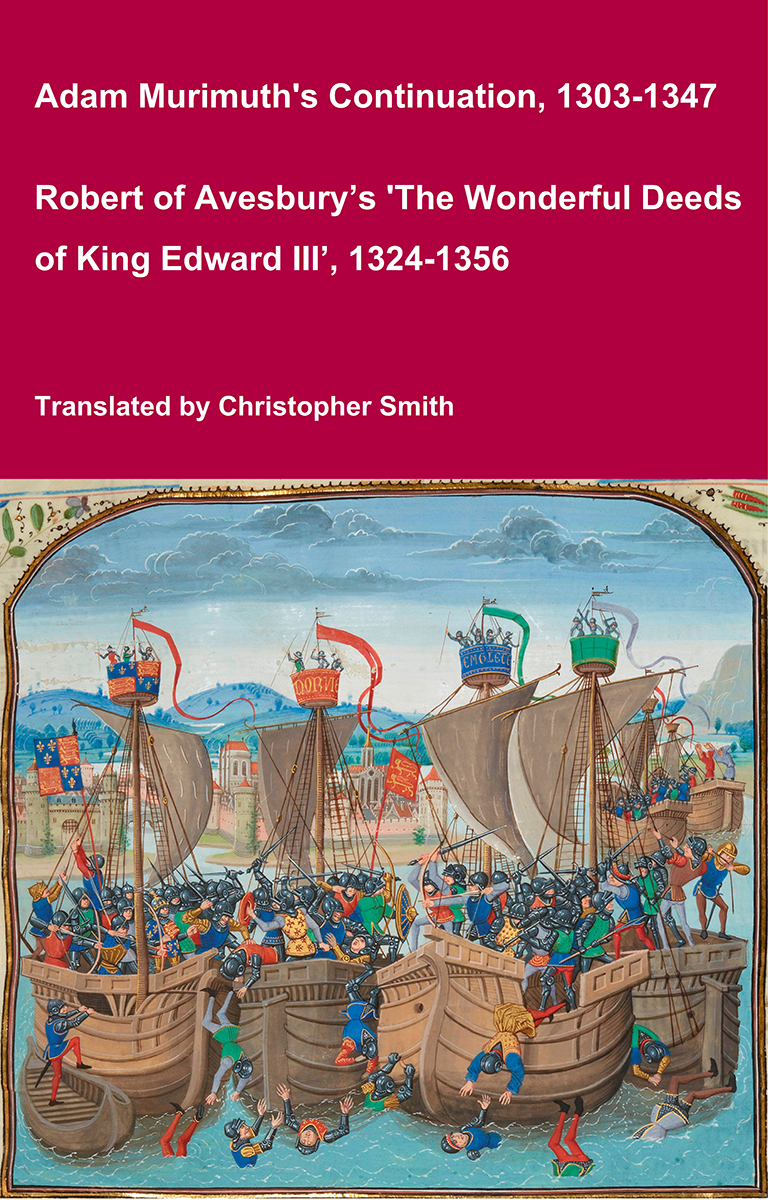
Adam Murimuth's Continuation and Robert of Avesbury’s 'The Wonderful Deeds of King Edward III'
This volume brings together two of the most important contemporary chronicles for the reign of Edward III and the opening phases of the Hundred Years’ War. Written in Latin by English clerical observers, these texts provide a vivid and authoritative window into the political, diplomatic, and military history of fourteenth-century England and its continental ambitions. Adam Murimuth Continuatio's Chronicarum continues an earlier chronicle into the mid-fourteenth century, offering concise but valuable notices on royal policy, foreign relations, and ecclesiastical affairs. Its annalistic structure makes it especially useful for establishing chronology and tracing the development of events year by year. Complementing it, Robert of Avesbury’s De gestis mirabilibus regis Edwardi tertii is a rich documentary chronicle preserving letters, treaties, and official records alongside narrative passages. It is an indispensable source for understanding Edward III’s claim to the French crown, the conduct of war, and the mechanisms of medieval diplomacy. Together, these works offer scholars, students, and enthusiasts a reliable and unembellished account of a transformative period in English and European history. Essential for anyone interested in medieval chronicles, the Hundred Years’ War, or the reign of Edward III.
Available at Amazon in eBook and Paperback format.
George Spencer Watson is in Painters.
On 8th March 1869 George Spencer Watson was born to [his father] William Spencer Burton Watson [aged 33].
From 1889 George Spencer Watson [aged 19] studied at the Royal Academy Schools. He exhibited from 1891 winning a Silver Medal in 1889 and 1891, and the Landseer Scholarship in 1892.
In 1900 George Spencer Watson [aged 30] was elected to the Royal Institute of Oil Painters, the Royal Society of Portrait Painters in 1904, Associate of the Royal Academy in 1923, and a Member of the Royal Academy in 1932.
On 17th September 1906 [his father] William Spencer Burton Watson [aged 70] died.
In 1909 George Spencer Watson [aged 39] and Hilda Mary Gardiner were married.

1911. George Spencer Watson [aged 41]. "Hilda and Maggie". Portrait of [his wife] Hilda Mary Gardiner.
Hilda Mary Gardiner: In 1909 George Spencer Watson and she were married.
On 7th May 1913 [his daughter] Mary Spencer Watson was born to George Spencer Watson [aged 44] and [his wife] Hilda Mary Gardiner.

1917. George Spencer Watson [aged 47]. Portrait of the artist's brother Lieutenant-Colonel Oliver Cyril Spencer Watson [aged 40].
Lieutenant-Colonel Oliver Cyril Spencer Watson: On 7th September 1876 he was born to William Spencer Burton Watson. On 28th March 1918 Lieutenant-Colonel Oliver Cyril Spencer Watson was killed in action. He was awarded the Victoria Cross - see The Gazette.
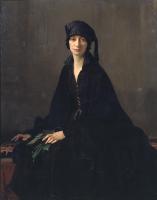
1922. George Spencer Watson [aged 52]. "A Lady in Black" aka "Miss Mullock".

1922. George Spencer Watson [aged 52]. "Four Loves I found, a Woman, a Child, a Horse and a Hound". George Spencer Watson, [his wife] Hilda Mary Gardiner and [his daughter] Mary Spencer Watson [aged 8].
Mary Spencer Watson: On 7th May 1913 she was born to George Spencer Watson and Hilda Mary Gardiner. On 7th March 2006 she died. She bequeathed Dunshay Manor [Map] to the Landmark Trust.
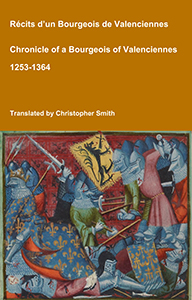
Chronicle of a Bourgeois of Valenciennes
Récits d’un bourgeois de Valenciennes aka The Chronicle of a Bourgeois of Valenciennes is a vivid 14th-century vernacular chronicle written by an anonymous urban chronicler from Valenciennes in the County of Hainaut. It survives in a manuscript that describes local and regional history from about 1253 to 1366, blending chronology, narrative episodes, and eyewitness-style accounts of political, military, and social events in medieval France, Flanders, and the Low Countries. The work begins with a chronological framework of events affecting Valenciennes and its region under rulers such as King Philip VI of France and the shifting allegiances of local nobility. It includes accounts of conflicts, sieges, diplomatic manoeuvres, and the impact of broader struggles like the Hundred Years’ War on urban life in Hainaut. Written from the perspective of a burgher (bourgeois) rather than a monastery or royal court, the chronicle offers a rare lay viewpoint on high politics and warfare, reflecting how merchants, townspeople, and civic institutions experienced the turbulence of the 13th and 14th centuries. Its narrative style combines straightforward reporting of events with moral and civic observations, making it a valuable source for readers interested in medieval urban society, regional politics, and the lived experience of war and governance in pre-modern Europe.
Available at Amazon in eBook and Paperback format.
In 1923 George Spencer Watson [aged 53] puchased Dunshay Manor [Map] in the hills of the Isle of Purbeck.
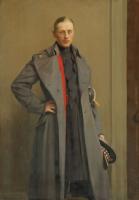
1924. George Spencer Watson [aged 54]. Portrait of 2nd Lieutenant William Gilbert Houldsworth (1891-1914) of the 1st Batallion, Scots Guard.
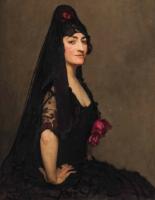
1924. George Spencer Watson [aged 54]. Portrait of Marcelle Azra Hincks, Countess Morphy, wearing a Spanish mantilla.
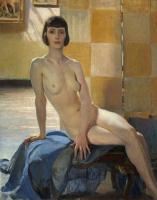
Around 1925. George Spencer Watson [aged 55]. "Sunlight Nude".
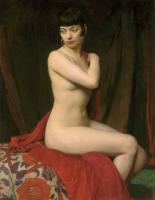
1926. George Spencer Watson [aged 56]. "Marishka".
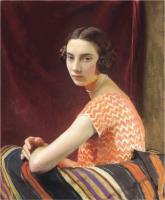
1926. George Spencer Watson [aged 56]. "The Orange Dress".
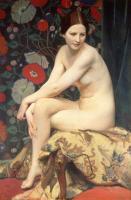
1927. George Spencer Watson [aged 57]. "Nude".
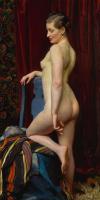
1928. George Spencer Watson [aged 58]. "A Study from Life".
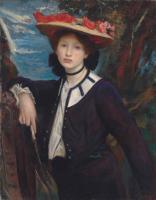
1929. George Spencer Watson [aged 59]. Portrait of a lady holding a parasol.
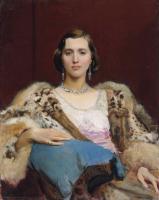
1929. George Spencer Watson [aged 59]. Portrait of Miss Dewitt wearing a leopard stole.
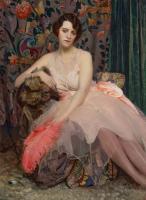
1929. George Spencer Watson [aged 59]. "Dorothy, daughter of F.J. Elliott Esq."
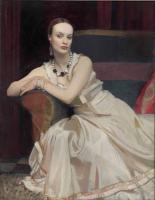
1932. George Spencer Watson [aged 62]. "Cynthia".

1932. George Spencer Watson [aged 62]. "Mary". Portrait of the artist's daughter Mary Spencer Watson [aged 18].
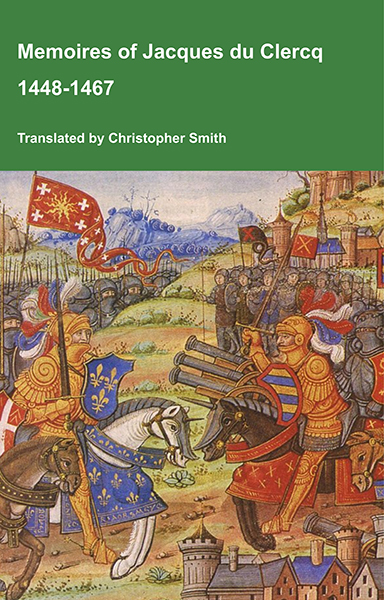
This is a translation of the 'Memoires of Jacques du Clercq', published in 1823 in two volumes, edited by Frederic, Baron de Reissenberg. In his introduction Reissenberg writes: 'Jacques du Clercq tells us that he was born in 1424, and that he was a licentiate in law and a counsellor to Philip the Good, Duke of Burgundy, in the castellany of Douai, Lille, and Orchies. It appears that he established his residence at Arras. In 1446, he married the daughter of Baldwin de la Lacherie, a gentleman who lived in Lille. We read in the fifth book of his Memoirs that his father, also named Jacques du Clercq, had married a lady of the Le Camelin family, from Compiègne. His ancestors, always attached to the counts of Flanders, had constantly served them, whether in their councils or in their armies.' The Memoires cover a period of nineteen years beginning in in 1448, ending in in 1467. It appears that the author had intended to extend the Memoirs beyond that date; no doubt illness or death prevented him from carrying out this plan. As Reissenberg writes the 'merit of this work lies in the simplicity of its narrative, in its tone of good faith, and in a certain air of frankness which naturally wins the reader’s confidence.' Du Clercq ranges from events of national and international importance, including events of the Wars of the Roses in England, to simple, everyday local events such as marriages, robberies, murders, trials and deaths, including that of his own father in Book 5; one of his last entries.
Available at Amazon in eBook and Paperback format.
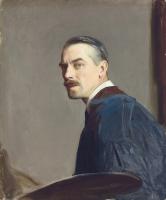
Before 1934. George Spencer Watson [aged 64]. Self-portrait.
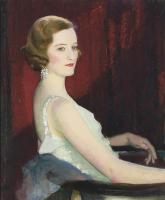
Before 1934. George Spencer Watson [aged 64]. "'Baba' Beaton, Mrs. Alec Hambro". Portrait of Barbara "Baba" Beaton [aged 21].

Before 1934. George Spencer Watson [aged 64]. Portrait of the artist's wife Hilda Mary Gardiner.
On 11th April 1934 George Spencer Watson [aged 65] died.