

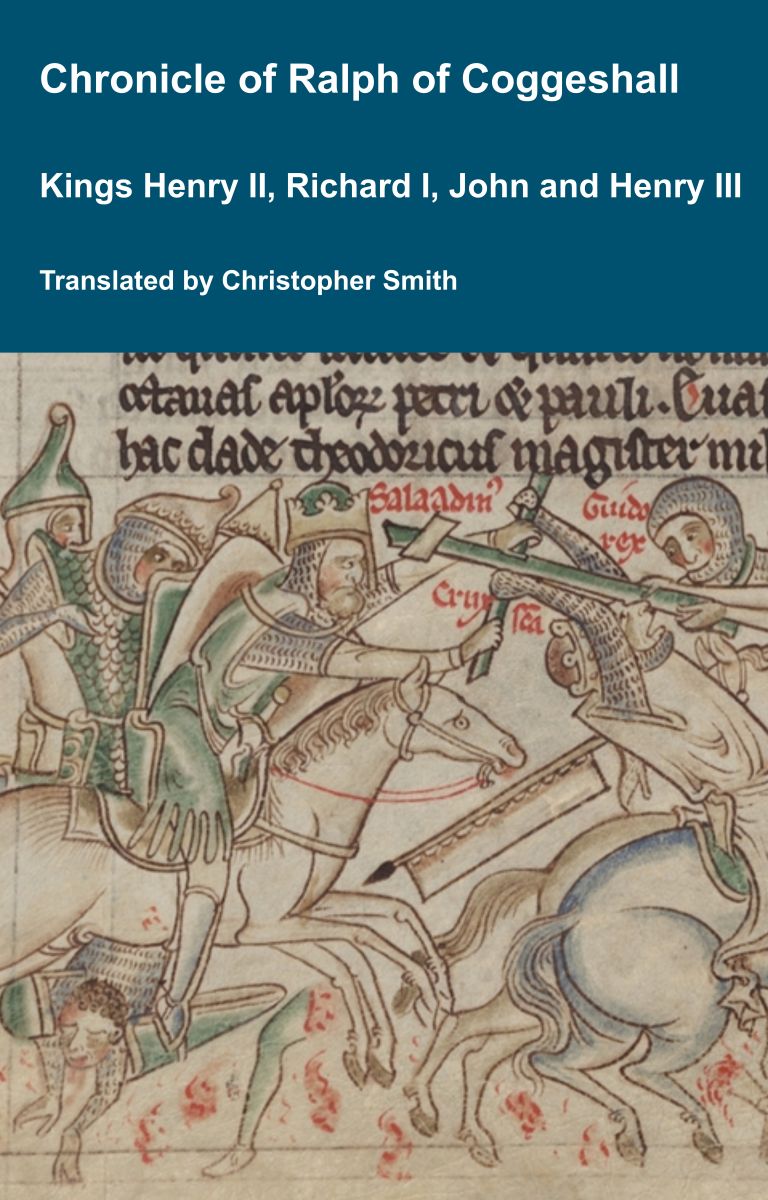
Chronicle of Abbot Ralph of Coggeshall
The Chronicle of Abbot Ralph of Coggeshall (Chronicon Anglicanum) is an indispensable medieval history that brings to life centuries of English and European affairs through the eyes of a learned Cistercian monk. Ralph of Coggeshall, abbot of the Abbey of Coggeshall in Essex in the early 13th century, continued and expanded his community’s chronicle, documenting events from the Norman Conquest of 1066 into the tumultuous reign of King Henry III. Blending eyewitness testimony, careful compilation, and the monastic commitment to record-keeping, this chronicle offers a rare narrative of political intrigue, royal power struggles, and social upheaval in England and beyond. Ralph’s work captures the reigns of pivotal figures such as Richard I and King John, providing invaluable insights into their characters, decisions, and the forces that shaped medieval rule. More than a simple annal, Chronicon Anglicanum conveys the texture of medieval life and governance, making it a rich source for scholars and readers fascinated by English history, monastic authorship, and the shaping of the medieval world.
Available at Amazon in eBook and Paperback format.
On 20th July 1812 Henry Edwards 1st Baronet was born to [his father] Henry Lees Edwards and [his mother] Lea Priestley at Pye Nest, Halifax.
On 3rd June 1840 [his son] Henry Coster Lea Edwards 2nd Baronet was born to Henry Edwards 1st Baronet [aged 27]. He married (1) 22nd June 1872 Agnes Harcourt Clark (2) 29th September 1887 Laura Selina Clark Lady Edwards and had issue.
In 1847 Henry Edwards 1st Baronet [aged 34] was elected MP Halifax which seat he held until 1852.
In 1852 Henry Edwards 1st Baronet [aged 39] was elected MP Beverley.
The London Gazette 23143. Whitehall, July 21, 1866.
The Queen [aged 47] has been pleased to direct letters patent to be passed under the Great Seal, granting the dignity of a Baronet of the United Kingdom of Great Britain and Ireland unto the Right Honourable Sir Frederick Pollock [aged 82], of Hatton, in the county of Middlesex, Knt., late Chief Baron of Her Majesty's Court of Exchequer, and the heirs male of his body lawfully begotten.
The Queen has also been pleased to direct letters patent to be passed under the Great Seal granting the dignity of a Baronet of the United Kingdom of Great Britain and Ireland unto Henry Edwards [aged 54], of Pyenest, in the West Riding of the county of York, Esq., and the heirs male of his body lawfully begotten. [Sarah Anne Anowah Langslow Lady Pollock by marriage Lady Edwards of Pyenest in West Yorkshire.]
The Queen has also been pleased to direct letters patent to be passed under the Great Seal granting the dignity of a Baronet of the United Kingdom of Great Britain and Ireland unto William Williams [aged 74], of Tregullow, in the county of Cornwall, Esq., and the heirs male of his body lawfully begotten.
Adeline Horsey Recollections. One fine March morning he told me that he was going to ride and see a gamekeeper who had accidentally shot himself.
He asked me and Sir Henry Edwards [aged 55] to accompany him, but when we reached the keeper's cottage he told us to return to Deene [Map], saying that as he intended to sit an hour with the man he would come on later. We declared our willingness to wait, but Cardigan would not hear of it, and so we somewhat reluctantly rode home without him.
The luncheon hour arrived, but Lord Cardigan did not come; the afternoon dragged on, and still there were no signs of him. I had a horrible presentment that something must have happened, and at once ordered some of the servants to go in search of his Lordship.
My fears were only too well grounded; my husband was found lying insensible on the roadside, nearly lifeless. A roadmender told us afterwards that Lord Cardigan had passed him and spoken a few words and seemed apparently quite well; the horse he was riding shied at a heap of stones and commenced to rear and plunge rather wildly, but my husband kept the animal well under control, for the roadmender saw him ride quietly away. The effort must, however, have afterwards brought on a seizure, for Cardigan fell from his horse, and lay helpless until he was found and brought back to Deene [Map].
For three dreadful days and nights he lay quite unconscious, gasping for breath, and the knowledge that he could not speak to me and did not recognise me intensified my grief a thousandfold. But mercifully his suffering was not prolonged, and on March 28, 1868, my beloved husband passed away.
There are some griefs that are too deep to speak of, even after Time's soothing touch has taken away the first deadly pain of a great sorrow. When I look back and remember the kindness and love which my husband lavished on me, I feel proud to think he often said that the happiest period of his life was after he married me, and that his great possessions and military fame were as nothing compared to the wife he adored.
Lord Cardigan's body lay in state in the ballroom at Deene [Map] for twelve days, during which time six thousand people came to look their last at the remains of the leader of the Charge of the Light Brigade. On April 9 he was buried in Deene Church [Map]; the whole regiment of the 11th Hussars attended the funeral, and he was carried to his last resting-place by eight of his old officers.
When the will was read, it was found that he had left everything to me.
On 22nd June 1872 [his son] Henry Coster Lea Edwards 2nd Baronet [aged 32] and [his daughter-in-law] Agnes Harcourt Clark were married.
In 1886 [his son] Henry Coster Lea Edwards 2nd Baronet [aged 45] and [his daughter-in-law] Agnes Harcourt Clark were divorced.
On 23rd April 1886 Henry Edwards 1st Baronet [aged 73] died. His son Henry [aged 45] succeeded 2nd Baronet Edwards of Pyenest in West Yorkshire.