

William of Worcester's Chronicle of England
William of Worcester, born around 1415, and died around 1482 was secretary to John Fastolf, the renowned soldier of the Hundred Years War, during which time he collected documents, letters, and wrote a record of events. Following their return to England in 1440 William was witness to major events. Twice in his chronicle he uses the first person: 1. when writing about the murder of Thomas, 7th Baron Scales, in 1460, he writes '… and I saw him lying naked in the cemetery near the porch of the church of St. Mary Overie in Southwark …' and 2. describing King Edward IV's entry into London in 1461 he writes '… proclaimed that all the people themselves were to recognize and acknowledge Edward as king. I was present and heard this, and immediately went down with them into the city'. William’s Chronicle is rich in detail. It is the source of much information about the Wars of the Roses, including the term 'Diabolical Marriage' to describe the marriage of Queen Elizabeth Woodville’s brother John’s marriage to Katherine, Dowager Duchess of Norfolk, he aged twenty, she sixty-five or more, and the story about a paper crown being placed in mockery on the severed head of Richard, 3rd Duke of York.
Available at Amazon in eBook and Paperback format.
Paternal Family Tree: Montagu
Maternal Family Tree: Anne Pakenham 1485-1544
In 1557 [his father] Edward Montagu [aged 27] and [his mother] Elizabeth Harrington [aged 12] were married.
Around 1563 Henry Montagu 1st Earl Manchester was born to [his father] Edward Montagu [aged 33] and [his mother] Elizabeth Harrington [aged 18] at Boughton, Northamptonshire.
Around 1573 Henry Montagu 1st Earl Manchester [aged 10] educated at Christ's College, Cambridge University [Map].
On 21st September 1585 [his brother] Edward Montagu 1st Baron Montagu [aged 22] and [his sister-in-law] Elizabeth Jeffrey [aged 17] were married at Weekley, Northamptonshire.
On 1st June 1601 Henry Montagu 1st Earl Manchester [aged 38] and Catherine Spencer [aged 15] were married. The difference in their ages was 23 years.
In 1602 [his son] James Montagu was born to Henry Montagu 1st Earl Manchester [aged 39] and [his wife] Catherine Spencer [aged 16]. He married 11th November 1635 Mary Baynard and had issue.

In 1602 [his son] Edward Montagu 2nd Earl Manchester was born to Henry Montagu 1st Earl Manchester [aged 39] and [his wife] Catherine Spencer [aged 16]. He married (1) 6th February 1623 Susannah Hill (2) 1st July 1625 Anne Rich Viscountess Mandeville, daughter of Robert Rich 2nd Earl Warwick and Frances Hatton Countess Warwick, and had issue (3) 20th December 1642 Essex Cheeke Countess Manchester (4) July 1659 Eleanor Wortley Countess Sussex Warwick Manchester, daughter of Richard Wortley and Elizabeth Boughton Countess Devonshire (5) 31st July 1667 Margaret Russell Countess Manchester and Carlisle, daughter of Francis Russell 4th Earl Bedford and Catherine Brydges Countess Bedford.
On 26th January 1602 [his father] Edward Montagu [aged 72] died at Brigstock, Boughton.
Around 1603 [his son] Abbot Walter Montagu was born to Henry Montagu 1st Earl Manchester [aged 40] and [his wife] Catherine Spencer [aged 17].
On 17th November 1603 Walter Raleigh [aged 49] was tried by Henry Montagu 1st Earl Manchester [aged 40] at Great Hall, Winchester Castle.


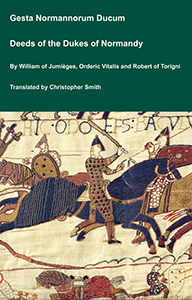
The Deeds of the Dukes of Normandy
The Gesta Normannorum Ducum [The Deeds of the Dukes of Normandy] is a landmark medieval chronicle tracing the rise and fall of the Norman dynasty from its early roots through the pivotal events surrounding the Norman Conquest of England. Originally penned in Latin by the monk William of Jumièges shortly before 1060 and later expanded at the behest of William the Conqueror, the work chronicles the deeds, politics, battles, and leadership of the Norman dukes, especially William’s own claim to the English throne. The narrative combines earlier historical sources with firsthand information and oral testimony to present an authoritative account of Normandy’s transformation from a Viking settlement into one of medieval Europe’s most powerful realms. William’s history emphasizes the legitimacy, military prowess, and governance of the Norman line, framing their expansion, including the conquest of England, as both divinely sanctioned and noble in purpose. Later chroniclers such as Orderic Vitalis and Robert of Torigni continued the history, extending the coverage into the 12th century, providing broader context on ducal rule and its impact. Today this classic work remains a foundational source for understanding Norman identity, medieval statesmanship, and the historical forces that reshaped England and Western Europe between 800AD and 1100AD.
Available at Amazon in eBook and Paperback format.
In 1607 [his daughter] Elizabeth Montagu Lady Sebright and Mansel was born to Henry Montagu 1st Earl Manchester [aged 44] and [his wife] Catherine Spencer [aged 21]. She married (1) 25th August 1627 Lewis Mansel 2nd Baronet, son of Thomas Mansel 1st Baronet, and had issue (2) before 1645 Edward Sebright 1st Baronet and had issue.
On 29th March 1608 [his brother] Bishop James Montagu [aged 40] was elected Bishop of Bath and Wells.
Around 1610 [his daughter] Lucy Montagu Baroness Coleraine was born to Henry Montagu 1st Earl Manchester [aged 47] and [his wife] Catherine Spencer [aged 24]. She married 1632 Hugh Hare 1st Baron Coleraine and had issue.

On 24th February 1612 [his brother] Edward Montagu 1st Baron Montagu [aged 49] and [his sister-in-law] Frances Cotton [aged 34] were married at Weekley, Northamptonshire.
On 7th December 1612 [his wife] Catherine Spencer [aged 26] died.
On 9th November 1613 Henry Montagu 1st Earl Manchester [aged 50] and Anne Wincot [aged 60] were married.
On 29th November 1614 [his wife] Anne Wincot [aged 61] died.
In 1616 Henry Montagu 1st Earl Manchester [aged 53] was appointed Chief Justice of the King's Bench.
Letters of John Chamberlain Volume 2.252. 252. To Sir Dudley Carleton [aged 43]. [S. P. Dom., Jac. I, lxxxix, 21.] London, November 14, 1616.
My very goode Lord: Beeing last night at Master Secretaries [aged 53] I understoode that Dieston was to be dispatcht this day towards you, who must not come empty though I wrote so lately. There supped divers of your goode frends, Sir Walter Raleigh [aged 62], Sir Henry Savile, Sir Maurice Barklay, Sir ... Seymor, Sir Harry Nevill, Sir Robert Killegree with I know not how many Ladies and gentlewomen of that race and alliance. The absence of the court geves Master Secretarie leave and leysure to entertain his frends as Sir Henry Savile was there likewise the night before: the King went to Tiballs on Monday and so towards Roiston and Newmarket. The Quene continues at Somerset House till his return. The Lord Cooke [aged 64] is now quite of the hookes, and order geven to send him a supersedeas from executing his place. The common speach is that fowre Ps have overthrown and put him down, that is Pride, Prohibitions, Premunire, and Prerogative. Sir Henry Montague is generally nominated to the place, by reason that the citie is written unto to choose Sir Harry Yelverton [aged 50] for theyre Recorder which is terminus diminutinus [diminutive term] to his office of sollicitor, but yet must be accepted to serve turns. Yet perhaps yt may be that yf yt come to light in time that the late Recorder [aged 53]1 hath maried his maide1 (as is bruited) and geven her such earnest as cannot be long concealed, yt may hinder his preferment.
Note 1. Henry Montagu, future Earl of Mancheser, married three times. His second wife Anne Wincot died in November 1614 so at the time of the letter he was a widower. He next married in 1620 to Margaret Crouch Countess Manchester [aged 11].


On 19th May 1618 [his mother] Elizabeth Harrington [aged 73] died.
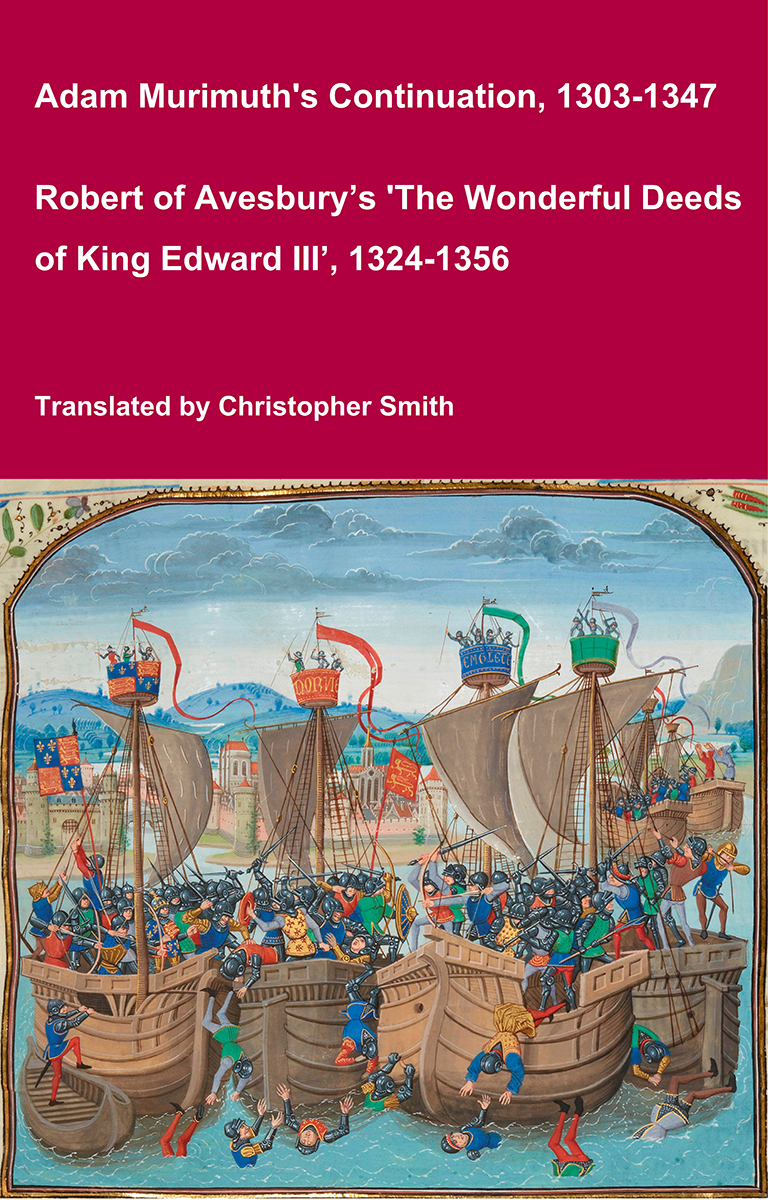
Adam Murimuth's Continuation and Robert of Avesbury’s 'The Wonderful Deeds of King Edward III'
This volume brings together two of the most important contemporary chronicles for the reign of Edward III and the opening phases of the Hundred Years’ War. Written in Latin by English clerical observers, these texts provide a vivid and authoritative window into the political, diplomatic, and military history of fourteenth-century England and its continental ambitions. Adam Murimuth Continuatio's Chronicarum continues an earlier chronicle into the mid-fourteenth century, offering concise but valuable notices on royal policy, foreign relations, and ecclesiastical affairs. Its annalistic structure makes it especially useful for establishing chronology and tracing the development of events year by year. Complementing it, Robert of Avesbury’s De gestis mirabilibus regis Edwardi tertii is a rich documentary chronicle preserving letters, treaties, and official records alongside narrative passages. It is an indispensable source for understanding Edward III’s claim to the French crown, the conduct of war, and the mechanisms of medieval diplomacy. Together, these works offer scholars, students, and enthusiasts a reliable and unembellished account of a transformative period in English and European history. Essential for anyone interested in medieval chronicles, the Hundred Years’ War, or the reign of Edward III.
Available at Amazon in eBook and Paperback format.
On 20th July 1618 [his brother] Bishop James Montagu [aged 50] died. He was buried at Bath Abbey [Map].
Letters of the Court of James I 1618. [13th August 1618]. The lord chief justice [aged 55], and all his brethren, go down on Monday toward Bath, to the burial of the [his brother] Bishop of Winchester [deceased].

Letters of John Chamberlain Volume 2.315. [30th January 1619] On Wensday divers were censured in the Star-chamber for building contrarie to the Kings proclamation; which was so far inforct that the Lord Cheife Justice [aged 56] saide that yt was in effect, and had the nature of an act of parliament: they were fined at a yeares true valew, and to pull downe theyre houses, or els to build them anew according to order: now that these have led the daunce, all the rest that have built since the first proclamation must follow, or compound, which wold prove too great a matter to graunt my Lord of Arundell (who is saide to have the penaltie) though he have need of yt. The same day there was some entrance into the Lady of Excesters busines and order taken to abbreviat and cut of superfluous and impertinent matter and so make yt more fit for the Kings hearing, in which course there was some contesting twixt Sir Ed: Cooke, and the two Cheife Justices, [Henry Montagu 1st Earl Manchester and Henry Hobart 1st Baronet [aged 59]] who are still observ'd to incline to the other side: the Lady of Excester went that day to the Star-chamber accompanied by the countesses of Arundell and Bedford, and a comitiva of I know not how many Ladies more to the number of almost thirty coaches, but whether she appeared in the court or no I cannot certainly learne. Secretarie Lake and his followers continue still confident, and some say the Lady Roos [aged 19] was there likewise with her litle troupe: the speach goes that she is to marrie with the Lord John Pawlet [aged 21] another grand-child of the earle of Excesters [aged 76], and heire in apparance to the marquis of Winchester.
In 1620 Henry Montagu 1st Earl Manchester [aged 57] was created 1st Viscount Mandeville, 1st Baron Montagu of Kimbolton.
In 1620 Henry Montagu 1st Earl Manchester [aged 57] was appointed Lord Treasurer.
On 26th April 1620 Henry Montagu 1st Earl Manchester [aged 57] and Margaret Crouch Countess Manchester [aged 15] were married. She by marriage Viscountess Mandeville. The difference in their ages was 42 years.
Autobiography Simon D'Ewes. 3rd October 1621. Having therefore spent some little time during this month in mine own private study and arriving at London upon Wednesday the 3rd day of October, with my father and the rest of his family, I understood that Sir Henry Montague [aged 58], Viscount Mandeville was, for some abuses in the place of Lord Treasurer, put out of the same, having not yet continued ten months in it, and was made Lord President of the Council.

Autobiography Simon D'Ewes. 9th October 1621. Michaelmas Term beginning upon Tuesday, the 9th day of October, John Williams [aged 39], Doctor of Divinity, Dean of Westminster and Bishop of Lincoln, took his place in the Chancery, as Lord Keeper of the Great Seal, Viscount Mandeville [aged 58], Lord President, administering the oath to him. Much talk there was of this divine's sudden rising, being a Welchman by birth, and, but a few years before, a poor subsizar in St. John's College in Cambridge of little regard or learniug. After he had taken his oath, he made a long, learned, and ho&est speech in the Chancery Court; but little practised it, as the sequel too plainly verified. I heard it confidently reported, that the old Lord Chancellor, Sir Thomas Egerton, Lord Ellesmere, prophesied of him, being then his household chaplain, that he would prove another Wolsey, which was as strangely verified many years after by his fall, as now by his rising.
On 28th July 1622 [his son] George Montagu was born to Henry Montagu 1st Earl Manchester [aged 59] and [his wife] Margaret Crouch Countess Manchester [aged 17]. He married in or before 1649 Elizabeth Irby and had issue.
On 6th February 1623 Edward Montagu 2nd Earl Manchester [aged 21] and Susannah Hill were married. He the son of Henry Montagu 1st Earl Manchester [aged 60] and Catherine Spencer.
On 16th February 1625 [his brother] Edward Montagu 1st Baron Montagu [aged 62] and [his sister-in-law] Anne Crouch Baroness Montagu [aged 52] were married. She by marriage Baroness Montagu of Boughton in Northamptonshire.

On 1st July 1625 Edward Montagu 2nd Earl Manchester [aged 23] and Anne Rich Viscountess Mandeville [aged 21] were married. She the daughter of Robert Rich 2nd Earl Warwick [aged 38] and Frances Hatton Countess Warwick. He the son of Henry Montagu 1st Earl Manchester [aged 62] and Catherine Spencer.
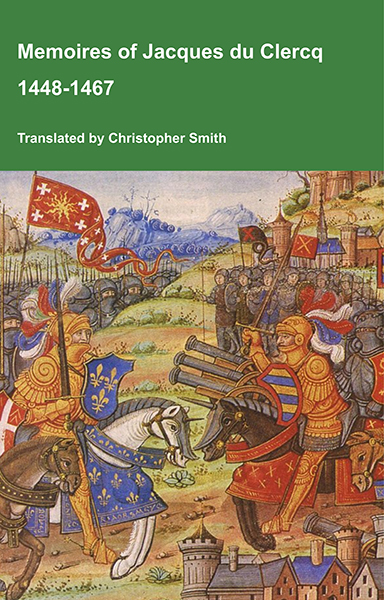
This is a translation of the 'Memoires of Jacques du Clercq', published in 1823 in two volumes, edited by Frederic, Baron de Reissenberg. In his introduction Reissenberg writes: 'Jacques du Clercq tells us that he was born in 1424, and that he was a licentiate in law and a counsellor to Philip the Good, Duke of Burgundy, in the castellany of Douai, Lille, and Orchies. It appears that he established his residence at Arras. In 1446, he married the daughter of Baldwin de la Lacherie, a gentleman who lived in Lille. We read in the fifth book of his Memoirs that his father, also named Jacques du Clercq, had married a lady of the Le Camelin family, from Compiègne. His ancestors, always attached to the counts of Flanders, had constantly served them, whether in their councils or in their armies.' The Memoires cover a period of nineteen years beginning in in 1448, ending in in 1467. It appears that the author had intended to extend the Memoirs beyond that date; no doubt illness or death prevented him from carrying out this plan. As Reissenberg writes the 'merit of this work lies in the simplicity of its narrative, in its tone of good faith, and in a certain air of frankness which naturally wins the reader’s confidence.' Du Clercq ranges from events of national and international importance, including events of the Wars of the Roses in England, to simple, everyday local events such as marriages, robberies, murders, trials and deaths, including that of his own father in Book 5; one of his last entries.
Available at Amazon in eBook and Paperback format.
In 1626 Henry Montagu 1st Earl Manchester [aged 63] was created 1st Earl Manchester. [his wife] Margaret Crouch Countess Manchester [aged 21] by marriage Countess Manchester.
On 25th August 1627 [his son-in-law] Lewis Mansel 2nd Baronet [aged 33] and Elizabeth Montagu Lady Sebright and Mansel [aged 20] were married. She the daughter of Henry Montagu 1st Earl Manchester [aged 64] and Catherine Spencer.
In 1632 [his son-in-law] Hugh Hare 1st Baron Coleraine [aged 26] and Lucy Montagu Baroness Coleraine [aged 22] were married. She by marriage Baroness Coleraine. She the daughter of Henry Montagu 1st Earl Manchester [aged 69] and Catherine Spencer.
On 11th November 1635 James Montagu [aged 33] and Mary Baynard [aged 30] were married. He the son of Henry Montagu 1st Earl Manchester [aged 72] and Catherine Spencer.
On 14th December 1637 [his son-in-law] George Brydges 6th Baron Chandos [aged 17] and Susan Montagu Baroness Chandos were married. She by marriage Baroness Chandos of Sudeley. She the daughter of Henry Montagu 1st Earl Manchester [aged 74] and Margaret Crouch Countess Manchester [aged 32]. He the son of Grey Brydges 5th Baron Chandos and Anne Stanley Countess Castlehaven [aged 57]. They were half fifth cousin once removed. He a great x 4 grandson of King Henry VII of England and Ireland.

On 13th April 1641 Thomas Wentworth 1st Earl Strafford [aged 48] was attainted by 204 votes to 59 ostensibly for his authoritarian rule as Lord Deputy of Ireland. Despite his promise not to King Charles I of England, Scotland and Ireland [aged 40] signed the death warrant on the 10th May 1641 in the light of increasing pressure from Parliament and the commons.
Wenceslaus Hollar [aged 33]. Engraving of the Trial of Thomas Wentworth 1st Earl Strafford with the following marked:
A. King Charles I of England, Scotland and Ireland.
C. Henrietta Maria Bourbon Queen Consort England [aged 31].
D. King Charles II of England Scotland and Ireland [aged 10].
E. Thomas Howard 14th or 21st Earl of Arundel 4th Earl of Surrey 1st Earl Norfolk [aged 55], Lord High Steward.
F. Henry Montagu 1st Earl Manchester [aged 78], Lord Keeper of the Great Seal.
G. John Paulet 5th Marquess Winchester [aged 43].
H. Robert Bertie 1st Earl Lindsey [aged 58], Lord Chamberlain.
I. Philip Herbert 4th Earl Pembroke 1st Earl Montgomery [aged 56], Lord Chamberlain of the Household.
V. Thomas Wentworth 1st Earl Strafford.
Z. Alethea Talbot Countess Arundel, Surrey and Norfolk [aged 56].
On 7th November 1642 Henry Montagu 1st Earl Manchester [aged 79] died. His son Edward [aged 40] succeeded 2nd Earl Manchester, 2nd Viscount Mandeville, 2nd Baron Montagu of Kimbolton.
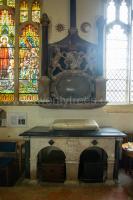
After 7th November 1642. Monument at St Andrew's Church, Kimbolton [Map] to Henry Montagu 1st Earl Manchester [deceased]
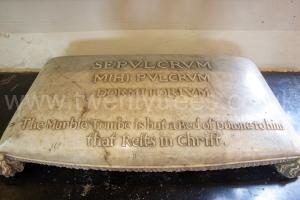
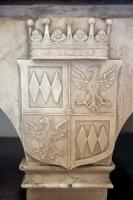
Before 29th December 1653, the date she was buried, [his former wife] Margaret Crouch Countess Manchester [aged 48] died.
Autobiography Simon D'Ewes. 31st December 1690. The four lords that came for it were Henry Viscount Mandeville, Lord Treasurer, Lodowick Stewart, Duke of Lennox, Lord Steward of the King's house-hold, William Herbert, Earl of Pembroke, Lord Chamberlain of the same household, and Thomas Earl of Arundel, Earl Marshal of England (whom I should have placed before Pembroke); they, coming to York House [Map] to him, where he lay, told him they were sorry to visit him upon such an occasion, and wished it had been better. "No, my lords," replied he, "the occasion is good;" and then delivering them the great seal, he added, "It was the King's favour that gave me this, and it is my fault that hath taken it away: Rex dedit, culpa abstulit" - or words to that effect. So leaving him, the said four lords carried the gage they had received to Whitehall, to the King, who was overheard by some near him to say upon their delivery of it to him, "Now, by my soul, I am pained at the heart where to bestow this; for as to my lawyers, I think they be all knaves." Which it seemeth his Majesty spake at that time to prepare a way to bestow it on a clergyman, as the Marquis of Buckingham had intended; for otherwise there were at this present divers able wise lawyers, very honest and religious men, fit for the place, in whom there might easily have been found as much integrity, and less fawning and flattery than in the clergy; and, accordingly, Doctor Williams, now Dean of Westminster, and before that time made Bishop of Lincoln, was sworn Lord Keeper, and had the great seal delivered to him. On October the 9th, next ensuing, being the first day of Michaelmas Term, one Lloyd, or Floud, a Papist, being of the Inner Temple, having spoken these buse and opprobrious words following of the distressed Prince Elector Palatine and his royal lady, to wit, - "What is now become of your goodman Palsgrave, and your goodwife Palsgrave?1 - they had, I think, as much right to the kingdom of Bohemia as I have to the principality of Wales," was censured by the House of Commons, to pay a fine to the King, to be imprisoned during the King's pleasure, to ride disgracefully two several days in the open street upon a horse, with his face to the tail of it, and each day to stand in the pillory. The execution was long deferred, his fine and imprisonment remitted, and himself and his fellow Romanists began to boast that nothing should be inflicted. But at last, tho two Houses of Parliament appearing stoutly in the cause, he underwent the first day's punishment on May the 30th, being Wednesday, and the second on Friday the 1st day of June, on which Midsummer Term began. These days' actions I have added a little before the due time, that I might at once finish the relation of this business; in which the faithful zealous affection of the whole state and kingdom, in their body representative, consisting of the two Houses of Parliament, was fully expressed to that royal Princess, our King's only daughter, amidst the many scorns and oppressions of her irreconcilable and bloody enemies.
Note 1. This exclamation is given somewhat differently by Meade in the Harl. MSS. He says, "On Tuesday, Floyd, a counsellor, steward and receiver in Shropshire to the old Lord Chancellor Ellesmere and the Earl of Suffolk, a papist, and prisoner in the Fleet, was censured to ride thrice with papers, and stand in the pillory, and first at Westminster, for saying, Goodman Palsgrave. and Goody Palsgrave may or must go pack their children at their backs and beg. On Wednesday should have been the first time, but his Majesty stayed it. Yesterday the King and House met; his Majesty thanked them for the care they had of his son-in-law, daughter, and grandchildren's honour; if it were in them to censure this prisoner, the censure should be executed, otherwise there should be a punishment equivalent to that they had set down; which gave good content."

State Trials and Proceedings for High Treason. After he had received the said Commission he commanded an O Yes to be made, by one of the Serjeants at Arms, for a general silence: and then delivered the said Commission to sir Thomas Fenshaw, Clerk of the Crown, to be openly read. Which being done, Mr. Maxwell kneeled down and presented his lordship with a white staff verge of state, which he gave to one of the Serjeants at Arms, who held the same up by the cloth of state on the right hand thereof. And after the Commission was read, and the staff received as aforesaid, his grace commanded a solemn O Yes to be made; and then gave leave to all the lords, the peers, and the judges, and to all privy counsellors there present, to be covered; and command was given, that none under that degree should keep on their hats upon pain of imprisonment. And then the peers were severally called by thieir names, and each of them answered particularly, viz. 1. Lord Weston, Lord High Treasurer of England; 2. Earl of Manchester, Lord Privy Seal; 3, Eari of Arundel and Surrey, Earl Marshal; 4. Earl of Pembroke and Montgomery Lord Chamberlain; 5. Earl of Kent; 6. Earl of Worcester; 7. Earl of Bedford; 8. Earl of Essex; 9. Earl of Dorset; 10. Earl of Salisbury; 11. Earl of Leicester; 12. Earl of Warwick; 18. Earl of Cariisle; 14. Earl of Holland; 15. Earl of Berks; 16. Earl of Denbigh;. 17. Viscount Wimbledon; 18. Visc. Conway; 19. Visc. Dorchester; 20. Visc. Wentworth; 21. Lord Percy; 22. Lord Strange; 23. Lord Clifford; 24. Lord Petre; 25. Lord North; 26. Lord Goring; 27. Lord Howard.
The Deeds of the Dukes of Normandy
The Gesta Normannorum Ducum [The Deeds of the Dukes of Normandy] is a landmark medieval chronicle tracing the rise and fall of the Norman dynasty from its early roots through the pivotal events surrounding the Norman Conquest of England. Originally penned in Latin by the monk William of Jumièges shortly before 1060 and later expanded at the behest of William the Conqueror, the work chronicles the deeds, politics, battles, and leadership of the Norman dukes, especially William’s own claim to the English throne. The narrative combines earlier historical sources with firsthand information and oral testimony to present an authoritative account of Normandy’s transformation from a Viking settlement into one of medieval Europe’s most powerful realms. William’s history emphasizes the legitimacy, military prowess, and governance of the Norman line, framing their expansion, including the conquest of England, as both divinely sanctioned and noble in purpose. Later chroniclers such as Orderic Vitalis and Robert of Torigni continued the history, extending the coverage into the 12th century, providing broader context on ducal rule and its impact. Today this classic work remains a foundational source for understanding Norman identity, medieval statesmanship, and the historical forces that reshaped England and Western Europe between 800AD and 1100AD.
Available at Amazon in eBook and Paperback format.
[his daughter] Susan Montagu Baroness Chandos was born to Henry Montagu 1st Earl Manchester and Margaret Crouch Countess Manchester. She married 14th December 1637 her half fifth cousin once removed George Brydges 6th Baron Chandos, son of Grey Brydges 5th Baron Chandos and Anne Stanley Countess Castlehaven.
Kings Wessex: Great x 17 Grand Son of King Edmund "Ironside" I of England
Kings Gwynedd: Great x 21 Grand Son of Maredudd ab Owain King Deheubarth King Powys King Gwynedd
Kings Seisyllwg: Great x 23 Grand Son of Hywel "Dda aka Good" King Seisyllwg King Deheubarth
Kings Powys: Great x 21 Grand Son of Maredudd ab Owain King Deheubarth King Powys King Gwynedd
Kings England: Great x 9 Grand Son of King Edward I of England
Kings Scotland: Great x 16 Grand Son of King Duncan I of Scotland
Kings Franks: Great x 23 Grand Son of Charles "Charlemagne aka Great" King of the Franks King Lombardy Holy Roman Emperor
Kings France: Great x 18 Grand Son of Hugh I King of the Franks
Kings Duke Aquitaine: Great x 21 Grand Son of Ranulf I Duke Aquitaine
Great x 4 Grandfather: Thomas Montagu  3 x Great Grand Son of King Edward I of England
Great x 3 Grandfather: John Montagu 4 x Great Grand Son of King Edward I of England
Great x 4 Grandmother: Christina Basset  10 x Great Grand Daughter of King Henry I "Beauclerc" England
Great x 2 Grandfather: William Ladde Montagu 5 x Great Grand Son of King Edward I of England
Great x 3 Grandmother: Alice Holcot
Great x 1 Grandfather: Thomas Montagu 6 x Great Grand Son of King Edward I of England
GrandFather: Edward Montagu 7 x Great Grand Son of King Edward I of England
Great x 4 Grandfather: Richard Dudley 
Great x 3 Grandfather: Richard Dudley
Great x 2 Grandfather: William Dudley
Great x 1 Grandmother: Agnes Dudley
Father: Edward Montagu 8 x Great Grand Son of King Edward I of England
Great x 3 Grandfather: Edmund Roper 
Great x 2 Grandfather: John Roper
Great x 1 Grandfather: John Roper of Well Hall
GrandMother: Helen Roper
Henry Montagu 1st Earl Manchester 9 x Great Grand Son of King Edward I of England
Great x 4 Grandfather: John Harrington 
Great x 3 Grandfather: Robert Harrington
Great x 4 Grandmother: Catherine Culpepper 
Great x 2 Grandfather: John Harrington
Great x 1 Grandfather: John Alexander Harrington
GrandFather: James Harrington
Great x 2 Grandfather: Robert Moton of Peckleton in Leicestershire
Great x 1 Grandmother: Elizabeth Moton
Mother: Elizabeth Harrington
Great x 3 Grandfather: William IV Sidney 
Great x 2 Grandfather: Nicholas Sidney
Great x 1 Grandfather: William Sidney
Great x 4 Grandfather: Robert Brandon 
Great x 3 Grandfather: William Brandon
Great x 4 Grandmother: Ada Calthorpe 
Great x 2 Grandmother: Anne Brandon
GrandMother: Lucy Sidney
Great x 3 Grandfather: John Pakenham
Great x 2 Grandfather: Hugh Pakenham
Great x 1 Grandmother: Anne Pakenham