

Chronicle of Walter of Guisborough
A canon regular of the Augustinian Guisborough Priory, Yorkshire, formerly known as The Chronicle of Walter of Hemingburgh, describes the period from 1066 to 1346. Before 1274 the Chronicle is based on other works. Thereafter, the Chronicle is original, and a remarkable source for the events of the time. This book provides a translation of the Chronicle from that date. The Latin source for our translation is the 1849 work edited by Hans Claude Hamilton. Hamilton, in his preface, says: 'In the present work we behold perhaps one of the finest samples of our early chronicles, both as regards the value of the events recorded, and the correctness with which they are detailed; Nor will the pleasing style of composition be lightly passed over by those capable of seeing reflected from it the tokens of a vigorous and cultivated mind, and a favourable specimen of the learning and taste of the age in which it was framed.'
Available at Amazon in eBook and Paperback format.
Paternal Family Tree: Pierrepoint
On 25th November 1532 [his father] George Pierrepont (age 22) and Elizabeth Babington (age 22) were married. They were fourth cousin once removed.
On 20th November 1544 [his father] George Pierrepont (age 34) and [his mother] Winifred Thwaites (age 19) were married.
In 1546 Henry Pierrepont was born to [his father] George Pierrepont (age 35) and [his mother] Winifred Thwaites (age 21).
After 1564 [his step-father] Gervase Clifton (age 47) and [his mother] Winifred Thwaites (age 39) were married.
On 21st May 1564 [his father] George Pierrepont (age 53) died at Holme Pierrepoint, Nottinghamshire [Map].
In 1568 [his daughter] Elizabeth Pierrepont Countess Kellie was born to Henry Pierrepont (age 22) and [his future wife] Frances Cavendish (age 19). She married (1) in or before 1595 her half fifth cousin once removed Richard Stapleton and had issue (2) 1604 Thomas Erskine 1st Earl Kellie.
In 1572 Henry Pierrepont (age 26) was elected MP Nottinghamshire.
Around 1573 Henry Pierrepont (age 27) was appointed Justice of the Peace Nottinghamshire.
In 1575 [his daughter] Grace Pierrepont was born to Henry Pierrepont (age 29) and [his future wife] Frances Cavendish (age 26). She married before 10th June 1604 George Manners and had issue.
In 1575 Henry Pierrepont (age 29) was appointed High Sheriff of Nottinghamshire.
Before 1584 Henry Pierrepont (age 37) and Frances Cavendish (age 35) were married. She the daughter of William Cavendish and Bess of Hardwick Countess Shrewsbury and Waterford (age 56). They were sixth cousins.
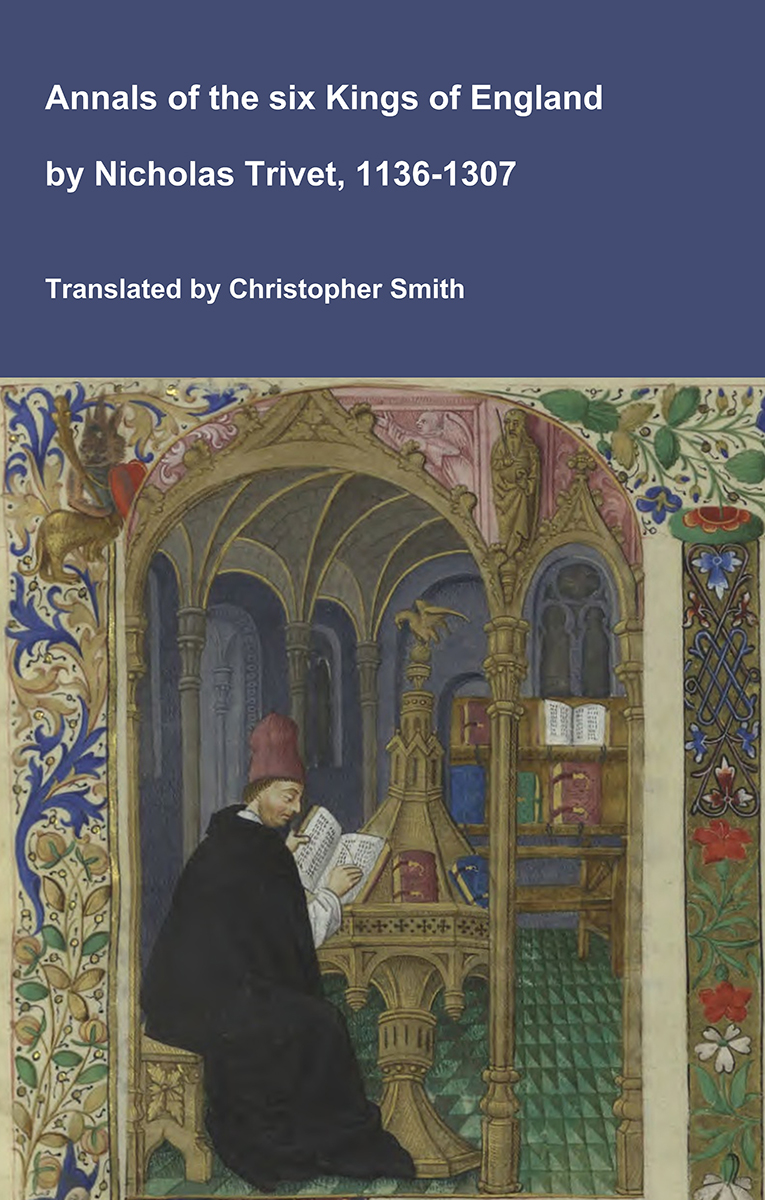
Annals of the six Kings of England by Nicholas Trivet
Translation of the Annals of the Six Kings of England by that traces the rise and rule of the Angevin aka Plantagenet dynasty from the mid-12th to early 14th century. Written by the Dominican scholar Nicholas Trivet, the work offers a vivid account of English history from the reign of King Stephen through to the death of King Edward I, blending political narrative with moral reflection. Covering the reigns of six monarchs—from Stephen to Edward I—the chronicle explores royal authority, rebellion, war, and the shifting balance between crown, church, and nobility. Trivet provides detailed insight into defining moments such as baronial conflicts, Anglo-French rivalry, and the consolidation of royal power under Edward I, whose reign he describes with particular immediacy. The Annals combines careful year-by-year reporting with thoughtful interpretation, presenting history not merely as a sequence of events but as a moral and political lesson. Ideal for readers interested in medieval history, kingship, and the origins of the English state, this chronicle remains a valuable and accessible window into the turbulent world of the Plantagenet kings.
Available at Amazon in eBook and Paperback format.
On 6th August 1584 [his son] Robert Pierrepont 1st Earl Kingston was born to Henry Pierrepont (age 38) and [his wife] Frances Cavendish (age 36). He married 8th January 1601 Gertrude Talbot Baroness Pierrepont Holme Pierrepoint and had issue.
On 18th November 1590 George Talbot 6th Earl of Shrewsbury (age 62) died. He was buried at Sheffield Cathedral [Map]. His son Gilbert (age 37) succeeded 7th Earl of Shrewsbury, 7th Earl Waterford, 12th Baron Furnivall, 16th Baron Strange Blackmere, 13th Baron Talbot. [his sister-in-law] Mary Cavendish Countess Shrewsbury and Waterford (age 34) by marriage Countess of Shrewsbury Countess Waterford.


Before 10th December 1591 [his mother] Winifred Thwaites (age 66) died.
In or before 1595 [his son-in-law] Richard Stapleton and [his daughter] Elizabeth Pierrepont Countess Kellie (age 26) were married. They were half fifth cousin once removed.
On 8th January 1601 [his son] Robert Pierrepont 1st Earl Kingston (age 16) and [his daughter-in-law] Gertrude Talbot Baroness Pierrepont Holme Pierrepoint (age 20) were married at Overton Longueville.
In 1603 Henry Pierrepont (age 57) was appointed Recorder of Nottingham.
In 1603 [his brother-in-law] William Cavendish 1st Earl Devonshire (age 50) was appointed Justice of the Peace Derbyshire.
After 1603 [his brother-in-law] William Cavendish 1st Earl Devonshire (age 50) and Elizabeth Boughton Countess Devonshire (age 35) were married. He the son of William Cavendish and [his mother-in-law] Bess of Hardwick Countess Shrewsbury and Waterford (age 76).
In April 1603 Henry Pierrepont (age 57) was knighted.
In 1604 [his son-in-law] Thomas Erskine 1st Earl Kellie (age 38) and [his daughter] Elizabeth Pierrepont Countess Kellie (age 36) were married. There is some uncertainty about whether this is the right Elizabeth Pierrepoint.
The History of William Marshal was commissioned by his son shortly after William’s death in 1219 to celebrate the Marshal’s remarkable life; it is an authentic, contemporary voice. The manuscript was discovered in 1861 by French historian Paul Meyer. Meyer published the manuscript in its original Anglo-French in 1891 in two books. This book is a line by line translation of the first of Meyer’s books; lines 1-10152. Book 1 of the History begins in 1139 and ends in 1194. It describes the events of the Anarchy, the role of William’s father John, John’s marriages, William’s childhood, his role as a hostage at the siege of Newbury, his injury and imprisonment in Poitou where he met Eleanor of Aquitaine and his life as a knight errant. It continues with the accusation against him of an improper relationship with Margaret, wife of Henry the Young King, his exile, and return, the death of Henry the Young King, the rebellion of Richard, the future King Richard I, war with France, the death of King Henry II, and the capture of King Richard, and the rebellion of John, the future King John. It ends with the release of King Richard and the death of John Marshal.
Available at Amazon in eBook and Paperback format.
Before 10th June 1604 [his son-in-law] George Manners (age 32) and [his daughter] Grace Pierrepont (age 29) were married.
In 1605 [his brother-in-law] William Cavendish 1st Earl Devonshire (age 52) was created 1st Baron Cavendish Hardwick. Elizabeth Boughton Countess Devonshire (age 37) by marriage Baroness Cavendish Hardwick.
On 13th February 1608 [his mother-in-law] Bess of Hardwick (age 81) died. She was buried in All Saints Church, Derby [Map]. Her monument, which she had constructed before her death, was designed by Robert Smythson (age 38). She left nothing in her will for her 'bad son' [his brother-in-law] Henry Cavendish (age 57). He did, however, inherit Chatsworth House, Derbyshire [Map] which he subsequently sold in 1609 to his brother [his brother-in-law] William Cavendish 1st Earl Devonshire (age 55) for £10,000.
The date of her funeral somewhat complicated. Rawsons 1910 book "Bess of Hardwick and her Circle" quotes Simpson's National Records of Derby for 1608: "The old Countess of Shrewsbury died about Candlemas this year, whose funeral was about Holy Thursday. A great frost this year. The witches of Bakewell hanged." Holy Thursday, the Feast of the Ascension, is thirty-nine days after Easter. Easter in 1608 was on the 6th of April, putting Holy Thursday on the 15th of May.
Ethel Carleton Williams "Bess of Hardwick", 1959, has a note: "9. The date of Bess of Hardwick's funeral is uncertain. The date on the coffin plate is said to be February 1608 (Cox and Hope, Chronicles of the Collegiate Church of All Saints, Derby), but on 31 March 1608 Gilbert Talbot wrote to Robert Cecil, excusing himself for not attending St George's Feast on the ground that his mother-in-law's funeral was to be on St George's Day (23 April). Later, on 3rd of April, the Earl of Arundel wrote to Gilbert (his father-in-law), 'the funeral at Derby is appointed to be either on the fourth or fifth of May, which Garter yet knoweth not, but rather thinketh on the fourth because the other is a holy day'".
Neither of which provide a definite answer. The former being around the 15th of May, the latter 'rather thinketh' the 4th of May. Are there any other contemporary sources available?


On 19th March 1616 Henry Pierrepont (age 70) died. Church of St Edmund, Holme Pierrepoint [Map]. Designed by John Smythson. Probably carved by Hugh Hall who also carved the monument to Thomas Smith originally at Wybynbury but since moved to Nantwich [Map]. Elizabethan Period. Armorials:
Top left  Cavendish Arms - he was married to [his wife] Frances Cavendish (age 67) daughter of William Cavendish and [his mother-in-law] Bess of Hardwick.
Top right  Pierrepoint Arms.
Centre Bottom: Quartered 1&4 Pierrepoint Arms 2&3 Unknown Arms impaled Quartered 1&4 Cavendish Arms 2&3 Unknown Arms.
Frances Cavendish: On 18th June 1548 she was born to William Cavendish and Bess of Hardwick. Before 1584 Henry Pierrepont and she were married. She the daughter of William Cavendish and Bess of Hardwick Countess Shrewsbury and Waterford. They were sixth cousins. In January 1632 Frances Cavendish died.


In January 1632 [his former wife] Frances Cavendish (age 83) died.
[his daughter] Elizabeth Pierrepont was born to Henry Pierrepont and Frances Cavendish.
Kings Wessex: Great x 16 Grand Son of King Edmund "Ironside" I of England
Kings Gwynedd: Great x 12 Grand Son of Owain "Great" King Gwynedd
Kings Seisyllwg: Great x 18 Grand Son of Hywel "Dda aka Good" King Seisyllwg King Deheubarth
Kings Powys: Great x 13 Grand Son of Maredudd ap Bleddyn King Powys
Kings England: Great x 10 Grand Son of King John of England
Kings Scotland: Great x 15 Grand Son of King Duncan I of Scotland
Kings Franks: Great x 22 Grand Son of Charles "Charlemagne aka Great" King of the Franks King Lombardy Holy Roman Emperor
Kings France: Great x 16 Grand Son of Hugh I King of the Franks
Kings Duke Aquitaine: Great x 20 Grand Son of Ranulf I Duke Aquitaine
Great x 4 Grandfather: Edmund Pierrepont
Great x 3 Grandfather: Henry Pierrepont
Great x 2 Grandfather: Henry Pierrepont 8 x Great Grand Son of King Henry "Curtmantle" II of England
Great x 4 Grandfather: Nicholas III Longford 6 x Great Grand Son of King Henry "Curtmantle" II of England
Great x 3 Grandmother: Ellen Longford 7 x Great Grand Daughter of King Henry "Curtmantle" II of England
Great x 4 Grandmother: Alice Cockayne 
Great x 1 Grandfather: Francis Pierrepont 7 x Great Grand Son of King John of England
Great x 4 Grandfather: William Ricardus Melton
Great x 3 Grandfather: John Melton
Great x 2 Grandmother: Thomasine Melton 6 x Great Grand Daughter of King John of England
Great x 4 Grandfather: Roger Clifford 5th Baron Clifford  4 x Great Grand Son of King John of England
Great x 3 Grandmother: Margaret Clifford 5 x Great Grand Daughter of King John of England
Great x 4 Grandmother: Maud Beauchamp Baroness Clifford  5 x Great Grand Daughter of King John of England
GrandFather: William Pierrepont 8 x Great Grand Son of King John of England
Father: George Pierrepont 9 x Great Grand Son of King John of England
Great x 3 Grandfather: Francis Empson
Great x 2 Grandfather: Peter Empson
Great x 1 Grandfather: Richard Empson
GrandMother: Joan Empson
Henry Pierrepont 10 x Great Grand Son of King John of England
GrandFather: William Thwaites
Mother: Winifred Thwaites