


Text this colour links to Pages. Text this colour links to Family Trees. Text this colour are links that disabled for Guests.
Place the mouse over images to see a larger image. Click on paintings to see the painter's Biography Page.
Mouse over links for a preview. Move the mouse off the painting or link to close the popup.
John Constable is in Painters.

On 11th June 1776 John Constable was born to [his father] Golding Constable and [his mother] Ann Constable nee Watts.

1810. Ramsay Richard Reinagle (age 33). Portrait of John Constable (age 33).

1816. John Constable (age 39). Portrait of the artist's wife [his future wife] Maria Bicknell around the time of their marriage.
Maria Bicknell: In October 1816 John Constable and she were married by Bishop John Fisher at St Martin in the Fields Church [Map]. They had seven children. On 23rd November 1828 she died.
In October 1816 John Constable (age 40) and Maria Bicknell were married by Bishop John Fisher (age 68) at St Martin in the Fields Church [Map]. They had seven children.

1825. John Constable (age 48). "Salisbury Cathedral [Map] from the Bishop's Grounds".

1825. John Constable (age 48). "The Cornfield". As a gesture of appreciation for John Fisher (age 77), the Bishop of Salisbury, who commissioned this painting, Constable included the Bishop and his wife in the bottom left corner.
On 23rd November 1828 [his wife] Maria Bicknell died.
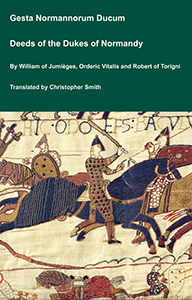
The Deeds of the Dukes of Normandy
The Gesta Normannorum Ducum [The Deeds of the Dukes of Normandy] is a landmark medieval chronicle tracing the rise and fall of the Norman dynasty from its early roots through the pivotal events surrounding the Norman Conquest of England. Originally penned in Latin by the monk William of Jumièges shortly before 1060 and later expanded at the behest of William the Conqueror, the work chronicles the deeds, politics, battles, and leadership of the Norman dukes, especially William’s own claim to the English throne. The narrative combines earlier historical sources with firsthand information and oral testimony to present an authoritative account of Normandy’s transformation from a Viking settlement into one of medieval Europe’s most powerful realms. William’s history emphasizes the legitimacy, military prowess, and governance of the Norman line, framing their expansion, including the conquest of England, as both divinely sanctioned and noble in purpose. Later chroniclers such as Orderic Vitalis and Robert of Torigni continued the history, extending the coverage into the 12th century, providing broader context on ducal rule and its impact. Today this classic work remains a foundational source for understanding Norman identity, medieval statesmanship, and the historical forces that reshaped England and Western Europe between 800AD and 1100AD.
Available at Amazon in eBook and Paperback format.

1829. John Constable (age 52). "Hadleigh Castle [Map]".
1831. John Constable (age 54). "Salisbury Cathedral [Map] from the Meadows".
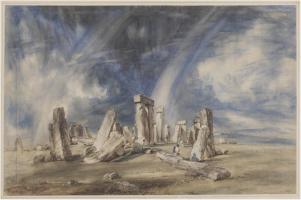
1835. John Constable (age 58). Stonehenge. When he exhibited it in 1836, Constable appended a text to the title: "The mysterious monument of Stonehenge, standing remote on a bare and boundless heath, as much unconnected with the events of past ages as it is with the uses of the present, carries you back beyond all historical records into the obscurity of a totally unknown period."
On 31st March 1837 John Constable (age 60) died.