

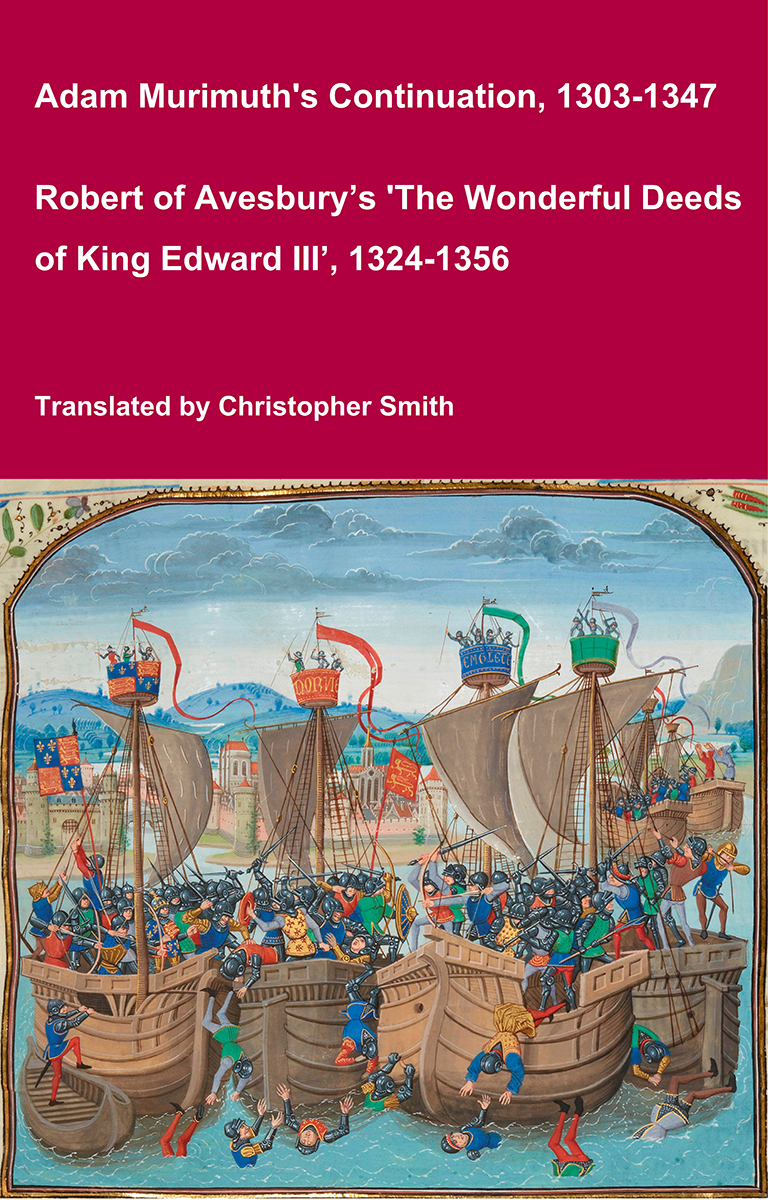
Adam Murimuth's Continuation and Robert of Avesbury’s 'The Wonderful Deeds of King Edward III'
This volume brings together two of the most important contemporary chronicles for the reign of Edward III and the opening phases of the Hundred Years’ War. Written in Latin by English clerical observers, these texts provide a vivid and authoritative window into the political, diplomatic, and military history of fourteenth-century England and its continental ambitions. Adam Murimuth Continuatio's Chronicarum continues an earlier chronicle into the mid-fourteenth century, offering concise but valuable notices on royal policy, foreign relations, and ecclesiastical affairs. Its annalistic structure makes it especially useful for establishing chronology and tracing the development of events year by year. Complementing it, Robert of Avesbury’s De gestis mirabilibus regis Edwardi tertii is a rich documentary chronicle preserving letters, treaties, and official records alongside narrative passages. It is an indispensable source for understanding Edward III’s claim to the French crown, the conduct of war, and the mechanisms of medieval diplomacy. Together, these works offer scholars, students, and enthusiasts a reliable and unembellished account of a transformative period in English and European history. Essential for anyone interested in medieval chronicles, the Hundred Years’ War, or the reign of Edward III.
Available at Amazon in eBook and Paperback format.
Paternal Family Tree: Coventry
Before 1636 [his father] John Coventry and [his mother] Elizabeth Coles were married.
Around 1636 John Coventry was born to [his father] John Coventry and [his mother] Elizabeth Coles.
In 1652 [his father] John Coventry died.
In 1667 John Coventry (age 31) was elected MP Weymouth.
Samuel Pepys' Diary. 27th July 1667. At the office all the morning; and at noon to the 'Change [Map], where I met Fenn; and he tells me that Sir John Coventry (age 31) do bring the confirmation of the peace; but I do not find the 'Change [Map] at all glad of it, but rather the worse, they looking upon it as a peace made only to preserve the King (age 37) for a time in his lusts and ease, and to sacrifice trade and his kingdoms only to his own pleasures: so that the hearts of merchants are quite down. He tells me that the King and my Baroness Castlemayne (age 26) are quite broke off, and she is gone away, and is with child, and swears the King shall own it; and she will have it christened in the Chapel at White Hall so, and owned for the King's, as other Kings have done; or she will bring it into White Hall gallery, and dash the brains of it out before the King's face1.
Note 1. Charles owned only four children by Baroness Castlemaine's - Anne, Countess of Sussex (age 6), and the Dukes of Southampton (age 5), Grafton (age 3), and Northumberland (age 1). The last of these was born in 1665. The paternity of all her other children was certainly doubtful. See pp. 50,52.


Samuel Pepys' Diary. 27th July 1667. Up and to the office, where I hear that Sir John Coventry (age 31) is come over from Bredah, a nephew, I think, of [his uncle] Sir W. Coventry's (age 39): but what message he brings I know not.
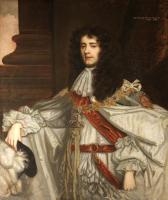
On 21st December 1670, owing to a jest made by Coventry (age 34) in the House of Commons on the subject of the King's amours, Sir Thomas Sandys, an officer of the guards, with other accomplices, by the order of Monmouth (age 21), and (it was said) with the approval of the king himself, waylaid him as he was returning home to Suffolk Street and slit his nose to the bone. The outrage created an extraordinary sensation in the Commons, and in consequence Parliament debated a bill 'to prevent malicious maiming and wounding' (22 & 23 Chas. II, c.1), a measure known as the "Coventry Act" was passed, declaring assaults accompanied by personal mutilation a felony without benefit of clergy, an Act not repealed until 1828.

In 1678 John Coventry (age 42) was elected MP Weymouth.
In 1679 John Coventry (age 43) was elected MP Weymouth.
Chronicle of Walter of Guisborough
A canon regular of the Augustinian Guisborough Priory, Yorkshire, formerly known as The Chronicle of Walter of Hemingburgh, describes the period from 1066 to 1346. Before 1274 the Chronicle is based on other works. Thereafter, the Chronicle is original, and a remarkable source for the events of the time. This book provides a translation of the Chronicle from that date. The Latin source for our translation is the 1849 work edited by Hans Claude Hamilton. Hamilton, in his preface, says: 'In the present work we behold perhaps one of the finest samples of our early chronicles, both as regards the value of the events recorded, and the correctness with which they are detailed; Nor will the pleasing style of composition be lightly passed over by those capable of seeing reflected from it the tokens of a vigorous and cultivated mind, and a favourable specimen of the learning and taste of the age in which it was framed.'
Available at Amazon in eBook and Paperback format.
In 1681 John Coventry (age 45) was elected MP Weymouth.
In 1685 John Coventry (age 49) died unmarried.
Great x 1 Grandfather: Thomas Coventry 
GrandFather: Thomas Coventry 1st Baron Coventry
Father: John Coventry
Great x 1 Grandfather: John Aldersley of Spurstow in Cheshire
GrandMother: Elizabeth Aldersley Baroness Coventry
GrandFather: John Coles of Barton in Somerset
Mother: Elizabeth Coles