

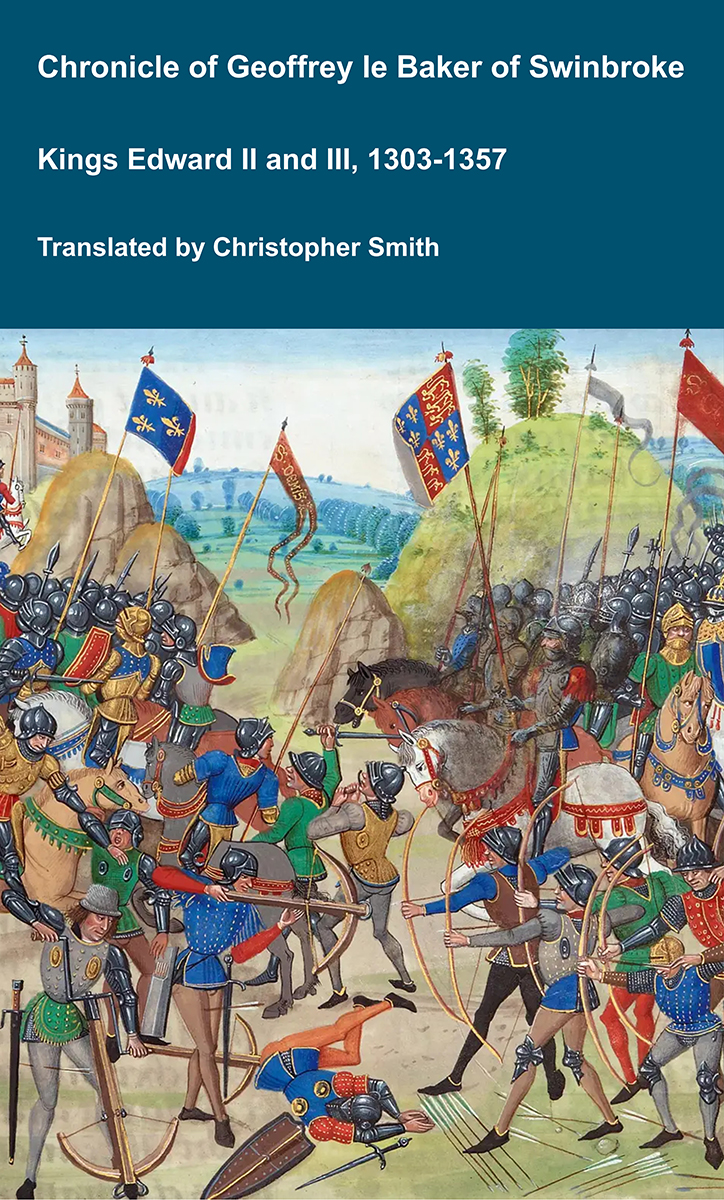
Chronicle of Geoffrey le Baker of Swinbroke
Baker was a secular clerk from Swinbroke, now Swinbrook, an Oxfordshire village two miles east of Burford. His Chronicle describes the events of the period 1303-1356: Gaveston, Bannockburn, Boroughbridge, the murder of King Edward II, the Scottish Wars, Sluys, Crécy, the Black Death, Winchelsea and Poitiers. To quote Herbert Bruce 'it possesses a vigorous and characteristic style, and its value for particular events between 1303 and 1356 has been recognised by its editor and by subsequent writers'. The book provides remarkable detail about the events it describes. Baker's text has been augmented with hundreds of notes, including extracts from other contemporary chronicles, such as the Annales Londonienses, Annales Paulini, Murimuth, Lanercost, Avesbury, Guisborough and Froissart to enrich the reader's understanding. The translation takes as its source the 'Chronicon Galfridi le Baker de Swynebroke' published in 1889, edited by Edward Maunde Thompson.
Available at Amazon in eBook and Paperback format.
In 1615 John Denham was born.
On 25th June 1634 John Denham [aged 19] and Ann Cotton were married at St Bride's Church, Fleet Street.
After 25th June 1634 [his daughter] Anne Denham was born to John Denham [aged 19] and [his wife] Ann Cotton. She married William Morley and had issue.
In 1646 [his wife] Ann Cotton died.
John Evelyn's Diary. 5th January 1656. Came to visit me my Lord Lisle [aged 36], son to the Earl of Leicester [aged 60], with Sir Charles Ouseley, two of the Usurper's council; Mr. John Hervey, and John Denham [aged 41], the poet.


In 1661 John Denham [aged 46] was elected MP Old Sarum.
John Evelyn's Diary. 19th October 1661. I went to London to visit my Lord of Bristol [aged 48], having been with Sir John Denham [aged 46] his Majesty's [aged 31] surveyor) to consult with him about the placing of his palace at Greenwich, Kent [Map], which I would have had built between the river and the Queen's House, Greenwich, so as a large square cut should have let in the Thames like a bay; but Sir John was for setting it on piles at the very brink of the water, which I did not assent to; and so came away, knowing Sir John to be a better poet than architect, though he had Mr. Webb (Inigo Jones's man) to assist him.


On 20th May 1663 John Denham [aged 48] was elected Fellow of the Royal Society.

Samuel Pepys' Diary. 29th December 1663. Anon came Sir W. Warren, and after talking of his business of the masts and helping me to understand some foul dealing in the business of Woods we fell to other talk, and particularly to speak of some means how to part this great familiarity between Sir W. Batten [aged 62] and Sir J. Minnes [aged 64], and it is easy to do by any good friend of Sir J. Minnes to whom it will be a good service, and he thinks that Sir J. Denham [aged 48] will be a proper man for it, and so do I. So after other discourse we parted, and I home and to bed.
Samuel Pepys' Diary. 4th March 1664. At Woolwich, Kent [Map] discoursed with him and Mr. Pett [aged 53] about iron worke and other businesses, and then walked home, and at Greenwich, Kent [Map] did observe the foundation laying of a very great house for the King [aged 33], which will cost a great deale of money1.
Note 1. Building by John Webb; now a part of Greenwich, Kent [Map] Hospital. Evelyn wrote in his Diary, October 19th, 1661: "I went to London to visite my Lord of Bristol [aged 51], having been with Sir John Denham [aged 49] (his Mates surveyor) to consult with him about the placing of his palace at Greenwich, Kent [Map], which I would have had built between the river and the Queene's [aged 54] house, so as a large cutt should have let in ye Thames like a bay; but Sir John was for setting it in piles at the very brink of the water, which I did not assent to and so came away, knowing Sir John to be a better poet than architect, tho' he had Mr. Webb (Inigo Jones's man) to assist him".


Chronicle of a Bourgeois of Valenciennes
Récits d’un bourgeois de Valenciennes aka The Chronicle of a Bourgeois of Valenciennes is a vivid 14th-century vernacular chronicle written by an anonymous urban chronicler from Valenciennes in the County of Hainaut. It survives in a manuscript that describes local and regional history from about 1253 to 1366, blending chronology, narrative episodes, and eyewitness-style accounts of political, military, and social events in medieval France, Flanders, and the Low Countries. The work begins with a chronological framework of events affecting Valenciennes and its region under rulers such as King Philip VI of France and the shifting allegiances of local nobility. It includes accounts of conflicts, sieges, diplomatic manoeuvres, and the impact of broader struggles like the Hundred Years’ War on urban life in Hainaut. Written from the perspective of a burgher (bourgeois) rather than a monastery or royal court, the chronicle offers a rare lay viewpoint on high politics and warfare, reflecting how merchants, townspeople, and civic institutions experienced the turbulence of the 13th and 14th centuries. Its narrative style combines straightforward reporting of events with moral and civic observations, making it a valuable source for readers interested in medieval urban society, regional politics, and the lived experience of war and governance in pre-modern Europe.
Available at Amazon in eBook and Paperback format.
Samuel Pepys' Diary. 15th August 1664. Thence home with him again, in our way he talking of his cures abroad, while he was with the King [aged 34] as a doctor, and above all men the pox. And among others, Sir J. Denham [aged 49] he told me he had cured, after it was come to an ulcer all over his face, to a miracle.
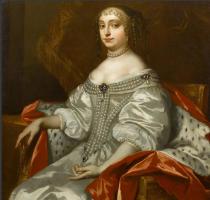
In 1665 John Denham [aged 50] and Margaret Brooke Lady Denham [aged 25] were married. She, thereafter, conducted a very public affair with the future King James II [aged 31]. To her husband's mortification, she insisted on being acknowledged publicly as a Royal mistress, saying that she would not, unlike her predecessor Goditha Price "go up and down the back stairs". The difference in their ages was 25 years.


Samuel Pepys' Diary. 20th February 1665. Up, and with Sir J. Minnes [aged 65] to attend the Duke [aged 31], and then we back again and rode into the beginning of my Chancellor's [aged 56] new house, near St. James's; which common people have already called Dunkirke-house, from their opinion of his having a good bribe for the selling of that towne. And very noble I believe it will be. Near that is my Lord Barkeley [aged 63] beginning another on one side, and Sir J. Denham [aged 50] on the other.


Samuel Pepys' Diary. 19th August 1665. Slept till 8 o'clock, and then up and met with letters from the King [aged 35] and Lord Arlington [aged 47], for the removal of our office to Greenwich, Kent [Map]. I also wrote letters, and made myself ready to go to Sir G. Carteret [aged 55], at Windsor; and having borrowed a horse of Mr. Blackbrough, sent him to wait for me at the Duke of Albemarle's [aged 56] door: when, on a sudden, a letter comes to us from the Duke of Albemarle, to tell us that the fleete is all come back to Solebay [Map], and are presently to be dispatched back again. Whereupon I presently by water to the Duke of Albemarle to know what news; and there I saw a letter from my Lord Sandwich [aged 40] to the Duke of Albemarle, and also from Sir W. Coventry [aged 37] and Teddiman; how my Lord having commanded Teddiman with twenty-two ships1.
Note 1. A news letter of August 19th (Salisbury), gives the following account of this affair:-"The Earl of Sandwich being on the Norway coast, ordered Sir Thomas Teddeman with 20 ships to attack 50 Dutch merchant ships in Bergen harbour; six convoyers had so placed themselves that only four or five of the ships could be reached at once. The Governor of Bergen fired on our ships, and placed 100 pieces of ordnance and two regiments of foot on the rocks to attack them, but they got clear without the loss of a ship, only 500 men killed or wounded, five or six captains among them. The fleet has gone to Sole Bay to repair losses and be ready to encounter the Dutch fleet, which is gone northward" (Calendar of State Papers, 1664-65, pp. 526, 527). Medals were struck in Holland, the inscription in Dutch on one of these is thus translated: "Thus we arrest the pride of the English, who extend their piracy even against their friends, and who insulting the forts of Norway, violate the rights of the harbours of King Frederick; but, for the reward of their audacity, see their vessels destroyed by the balls of the Dutch" (Hawkins's "Medallic Illustrations of the History of Great Britain and Ireland", ed. Franks and Grueber, 1885, vol. i., p. 508). Sir Gilbert Talbot's "True Narrative of the Earl of Sandwich's Attempt upon Bergen with the English Fleet on the 3rd of August, 1665, and the Cause of his Miscarriage thereupon", is in the British Museum (Harl. MS., No. 6859). It is printed in "Archaeologia", vol. xxii., p. 33. The Earl of Rochester, Kent [Map] also gave an account of the action in a letter to his mother (Wordsworth's "Ecclesiastical Biography", fourth edition, vol. iv., p. 611). Sir John Denham [aged 50], in his "Advice to a Painter", gives a long satirical account of the affair. A coloured drawing of the attack upon Bergen, on vellum, showing the range of the ships engaged, is in the British Museum. Shortly after the Bergen affair forty of the Dutch merchant vessels, on their way to Holland, fell into the hands of the English, and in Penn's "Memorials of Sir William Pen [aged 44]", vol. ii., p. 364, is a list of the prizes taken on the 3rd and 4th September. The troubles connected with these prizes and the disgrace into which Lord Sandwich fell are fully set forth in subsequent pages of the Diary. Evelyn writes in his Diary (November 27th, 1665): "There was no small suspicion of my Lord Sandwich having permitted divers commanders who were at ye taking of ye East India prizes to break bulk and take to themselves jewels, silkes, &c., tho' I believe some whom I could name fill'd their pockets, my Lo. Sandwich himself had the least share. However, he underwent the blame, and it created him enemies, and prepossess'd ye Lo. Generall (Duke of Albemarle), for he spake to me of it with much zeale and concerne, and I believe laid load enough on Lo. Sandwich at Oxford". (of which but fifteen could get thither, and of those fifteen but eight or nine could come up to play) to go to Bergen; where, after several messages to and fro from the Governor of the Castle, urging that Teddiman ought not to come thither with more than five ships, and desiring time to think of it, all the while he suffering the Dutch ships to land their guns to their best advantage; Teddiman on the second pretence, began to play at the Dutch ships, (wherof ten East India-men,) and in three hours' time (the town and castle, without any provocation, playing on our ships,) they did cut all our cables, so as the wind being off the land, did force us to go out, and rendered our fire-ships useless; without doing any thing, but what hurt of course our guns must have done them: we having lost five commanders, besides Mr. Edward Montagu, and Mr. Windham. This Mr. Windham had entered into a formal engagement with the Earl of Rochester, Kent [Map], "not without ceremonies of religion, that if either of them died, he should appear, and give the other notice of the future state, if there was any". He was probably one of the brothers of Sir William Wyndham, Bart. See Wordsworth's "Ecclesiastical Biography", fourth. edition, vol. iv., p. 615. B.


Samuel Pepys' Diary. 8th October 1666. Thence with Sir W. Coventry [aged 38] when the House rose and Sir W. Batten [aged 65] to St. James's, and there agreed of and signed our paper of extraordinaries, and there left them, and I to Unthanke's, where Mr. Falconbridge's girle is, and by and by comes my wife, who likes her well, though I confess I cannot (though she be of my finding out and sings pretty well), because she will be raised from so mean a condition to so high all of a sudden; but she will be much to our profit, more than Mercer, less expense. Here we bespoke anew gowne for her, and to come to us on Friday. She being gone, my wife and I home by coach, and then I presently by water with Mr. Pierce to Westminster Hall [Map], he in the way telling me how the Duke of York [aged 32] and Duke of Albemarle [aged 57] do not agree. The Duke of York is wholly given up to this bitch [aged 26] of Denham [aged 51]. The Duke of Albemarle and Prince Rupert [aged 46] do less agree. So that we are all in pieces, and nobody knows what will be done the next year.
On 6th January 1667 Margaret Brooke Lady Denham [aged 27] died. She was rumoured to have been poisoned by her husband John Denham [aged 52] by giving her a poisoned cup of chocolate. In any case rumour named several other possible poisoners, including her former lover James [aged 33], his wife Anne Hyde [aged 29] and his sister-in-law, Lady Rochester [aged 21].




Samuel Pepys' Diary. 8th January 1667. So home and to supper, and then saw the catalogue of my books, which my brother had wrote out, now perfectly alphabeticall, and so to bed. Sir Richard Ford [aged 53] did this evening at Sir W. Batten's [aged 66] tell us that upon opening the body of my [his former wife] Lady Denham [deceased] it is said that they found a vessel about her matrix which had never been broke by her husband [aged 52], that caused all pains in her body. Which if true is excellent invention to clear both the Duchesse [aged 29] from poison or the Duke [aged 33] from lying with her.
Samuel Pepys' Diary. 10th August 1667. After dinner I to the office, and there wrote as long as my eyes would give me leave, and then abroad and to the New Exchange, to the bookseller's there, where I hear of several new books coming out-Mr. Spratt's History of the Royal Society, and Mrs. Phillips's' poems. Sir John Denham's [aged 52] poems are going to be all printed together; and, among others, some new things; and among them he showed me a copy of verses of his upon Sir John Minnes's [aged 68] going heretofore to Bullogne to eat a pig1. Cowley [deceased], he tells me, is dead; who, it seems, was a mighty civil, serious man; which I did not know before. Several good plays are likely to be abroad soon, as Mustapha and Henry the 5th. Here having staid and divertised myself a good while, I home again and to finish my letters by the post, and so home, and betimes to bed with my wife because of rising betimes to-morrow.
Note 1. The collected edition of Denham's poems is dated 1668. The verses referred to are inscribed "To Sir John Mennis being invited from Calice to Bologne to eat a pig", and two of the lines run "Little Admiral John To Bologne is gone"..

Samuel Pepys' Diary. 18th February 1668. Up by break of day, and walked down to the old Swan [Map], where I find little Michell building, his booth being taken down, and a foundation laid for a new house, so that that street is like to be a very fine place. I drank, but did not see Betty, and so to Charing Cross [Map] stairs, and thence walked to Sir W. Coventry's [aged 40]1, and talked with him, who tells me how he hath been persecuted, and how he is yet well come off in the business of the dividing of the fleete, and the sending of the letter. He expects next to be troubled about the business of bad officers in the fleete, wherein he will bid them name whom they call bad, and he will justify himself, having never disposed of any but by the Admiral's liking. And he is able to give an account of all them, how they come recommended, and more will be found to have been placed by the Prince and Duke of Albemarle [aged 59] than by the Duke of York [aged 34] during the war, and as no bad instance of the badness of officers he and I did look over the list of commanders, and found that we could presently recollect thirty-seven commanders that have been killed in actuall service this war. He tells me that Sir Fr. Hollis [aged 25] is the main man that hath persecuted him hitherto, in the business of dividing the fleete, saying vainly that the want of that letter to the Prince hath given him that, that he shall remember it by to his grave, meaning the loss of his arme; when, God knows! he is as idle and insignificant a fellow as ever come into the fleete. He tells me that in discourse on Saturday he did repeat Sir Rob. Howard's [aged 42] words about rowling out of counsellors, that for his part he neither cared who they rowled in, nor who they rowled out, by which the word is become a word of use in the House, the rowling out of officers. I will remember what, in mirth, he said to me this morning, when upon this discourse he said, if ever there was another Dutch war, they should not find a Secretary; "Nor", said I, "a Clerk of the Acts, for I see the reward of it; and, thanked God! I have enough of my own to buy me a good book and a good fiddle, and I have a good wife";-"Why", says he, "I have enough to buy me a good book, and shall not need a fiddle, because I have never a one of your good wives". I understand by him that we are likely to have our business of tickets voted a miscarriage, but (he) cannot tell me what that will signify more than that he thinks they will report them to the King [aged 37] and there leave them, but I doubt they will do more.
Note 1. Sir William Coventry's love of money is said by Sir John Denham [aged 53] to have influenced him in promoting naval officers, who paid him for their commissions. "Then Painter! draw cerulian Coventry Keeper, or rather Chancellor o' th' sea And more exactly to express his hue, Use nothing but ultra-mariuish blue. To pay his fees, the silver Trumpet spends, And boatswain's whistle for his place depends. Pilots in vain repeat their compass o'er, Until of him they learn that one point more The constant magnet to the pole doth hold, Steel to the magnet, Coventry to gold. Muscovy sells us pitch, and hemp, and tar; Iron and copper, Sweden; Munster, war; Ashley, prize; Warwick, custom; Cart'ret, pay; But Coventry doth sell the fleet away". B.


Samuel Pepys' Diary. 28th September 1668. Thence to my Lord Burlington's [aged 55] houses the first time I ever was there, it being the house built by Sir John Denham [aged 53], next to Clarendon House; and here I visited my Lord Hinchingbrooke [aged 20] and his lady; Mr. Sidney Montagu [aged 18] being come last night to town unexpectedly from Mount's Bay, where he left my Lord well, eight days since, so as we may now hourly expect to hear of his arrival at Portsmouth, Hampshire [Map]. Sidney is mighty grown; and I am glad I am here to see him at his first coming, though it cost me dear, for here I come to be necessitated to supply them with £500 for my Lord. He sent him up with a declaration to his friends, of the necessity of his being presently supplied with £2000; but I do not think he will get one. However, I think it becomes my duty to my Lord to do something extraordinary in this, and the rather because I have been remiss in writing to him during this voyage, more than ever I did in my life, and more indeed than was fit for me.
In 1669 John Denham [aged 54] died.
Jean de Waurin's Chronicle of England Volume 6 Books 3-6: The Wars of the Roses
Jean de Waurin was a French Chronicler, from the Artois region, who was born around 1400, and died around 1474. Waurin’s Chronicle of England, Volume 6, covering the period 1450 to 1471, from which we have selected and translated Chapters relating to the Wars of the Roses, provides a vivid, original, contemporary description of key events some of which he witnessed first-hand, some of which he was told by the key people involved with whom Waurin had a personal relationship.
Available at Amazon in eBook and Paperback format.
Samuel Pepys' Diary. 21st March 1669. Thence up and down the House. Met with Mr. May [aged 47], who tells me the story of his being put by Sir John Denham's place, of Surveyor of the King's Works, who it seems, is lately dead, by the unkindness of the Duke Buckingham [aged 41], who hath brought in Dr. Wren [aged 45]: though, he tells me, he hath been his servant for twenty years together in all his wants and dangers, saving him from want of bread by his care and management, and with a promise of having his help in his advancement, and an engagement under his hand for £1000 not yet paid, and yet the Duke of Buckingham so ungrateful as to put him by: which is an ill thing, though Dr. Wren is a worthy man. But he tells me that the King [aged 38] is kind to him, and hath promised him a pension of £300 a-year out of the Works; which will be of more content to him than the place, which, under their present wants of money, is a place that disobliges most people, being not able to do what they desire to their lodgings. Here meeting with Sir H. Cholmly [aged 36] and Povy [aged 55], that tell me that my Lord Middleton [aged 61] is resolved in the Cabal that he shall not go to Tangier; and that Sir Edward Harlow [Harley], whom I know not, is propounded to go, who was Governor of Dunkirke, and, they say, a most worthy brave man, which I shall be very glad of.


Grammont. Sir John Denham, loaded with wealth as well as years, had passed his youth in the midst of those pleasures which people at that age indulge in without restraint: he was one of the brightest geniuses England ever produced for wit and humour, and for brilliancy of composition: satirical and free in his poems, he spared neither frigid writers, nor jealous husbands, nor even their wives: every part abounded with the most poignant wit, and the most entertaining stories; but his most delicate and spirited raillery turned generally against matrimony; and, as if he wished to confirm, by his own example, the truth of what he had written in his youth, he married, at the age of seventy-nine, this Miss Brook of whom we are speaking, who was only eighteen.
The Duke of York had rather neglected her for some time before; but the circumstance of so unequal a match rekindled his ardour; and she, on her part, suffered him to entertain hopes of an approaching bliss, which a thousand considerations had opposed before her marriage: she wished to belong to the court; and for the promise of being made lady of the bedchamber to the duchess, she was upon the point of making him another promise, or of immediately performing it, if required, when, in the middle of this treaty, Lady Chesterfield was tempted by her evil genius to rob her of her conquest, in order to disturb all the world.
However, as Lady Chesterfield could not see the Duke of York, except in public assemblies, she was under the necessity of making the most extravagant advances, in order to seduce him from his former connection; and as he was the most unguarded ogler of his time, the whole court was informed of the intrigue before it was well begun.