

William of Worcester's Chronicle of England
William of Worcester, born around 1415, and died around 1482 was secretary to John Fastolf, the renowned soldier of the Hundred Years War, during which time he collected documents, letters, and wrote a record of events. Following their return to England in 1440 William was witness to major events. Twice in his chronicle he uses the first person: 1. when writing about the murder of Thomas, 7th Baron Scales, in 1460, he writes '… and I saw him lying naked in the cemetery near the porch of the church of St. Mary Overie in Southwark …' and 2. describing King Edward IV's entry into London in 1461 he writes '… proclaimed that all the people themselves were to recognize and acknowledge Edward as king. I was present and heard this, and immediately went down with them into the city'. William’s Chronicle is rich in detail. It is the source of much information about the Wars of the Roses, including the term 'Diabolical Marriage' to describe the marriage of Queen Elizabeth Woodville’s brother John’s marriage to Katherine, Dowager Duchess of Norfolk, he aged twenty, she sixty-five or more, and the story about a paper crown being placed in mockery on the severed head of Richard, 3rd Duke of York.
Available at Amazon in eBook and Paperback format.
In 1643 John Ellis was born to [his father] Reverend John Ellis (age 37).
In 1681 [his father] Reverend John Ellis (age 75) died.
In 1696 [his brother] Bishop Welbore Ellis (age 45) was appointed Prebendary of Winchester.
On 22nd September 1705 [his brother] Prebendary Welbore Ellis (age 54) was appointed Bishop of Kildare with the deanery of Christ Church Cathedral, Dublin in commendam.
On 22nd September 1705 [his brother] Bishop Welbore Ellis (age 54) was translated to Bishop of Meath, with a seat on the Irish privy council.
Before 26th June 1707 [his brother] Bishop Welbore Ellis (age 56) and [his sister-in-law] Diana Briscoe were married.
In 1734 John Ellis (age 91) and Elizabeth Stanhope were married.
On 1st January 1734 [his brother] Bishop Welbore Ellis (age 83) died. He was buried at Christ Church Cathedral, Dublin [Map].
In 1738 John Ellis (age 95) died. His nephew [his nephew] Welbore Ellis 1st Baron Mendip (age 24) inherited his considerable fortune.
In November 1747 [his nephew] Welbore Ellis 1st Baron Mendip (age 33) and [his former wife] Elizabeth Stanhope were married.
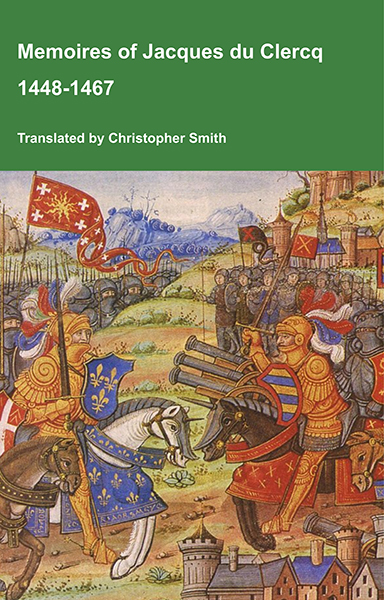
This is a translation of the 'Memoires of Jacques du Clercq', published in 1823 in two volumes, edited by Frederic, Baron de Reissenberg. In his introduction Reissenberg writes: 'Jacques du Clercq tells us that he was born in 1424, and that he was a licentiate in law and a counsellor to Philip the Good, Duke of Burgundy, in the castellany of Douai, Lille, and Orchies. It appears that he established his residence at Arras. In 1446, he married the daughter of Baldwin de la Lacherie, a gentleman who lived in Lille. We read in the fifth book of his Memoirs that his father, also named Jacques du Clercq, had married a lady of the Le Camelin family, from Compiègne. His ancestors, always attached to the counts of Flanders, had constantly served them, whether in their councils or in their armies.' The Memoires cover a period of nineteen years beginning in in 1448, ending in in 1467. It appears that the author had intended to extend the Memoirs beyond that date; no doubt illness or death prevented him from carrying out this plan. As Reissenberg writes the 'merit of this work lies in the simplicity of its narrative, in its tone of good faith, and in a certain air of frankness which naturally wins the reader’s confidence.' Du Clercq ranges from events of national and international importance, including events of the Wars of the Roses in England, to simple, everyday local events such as marriages, robberies, murders, trials and deaths, including that of his own father in Book 5; one of his last entries.
Available at Amazon in eBook and Paperback format.
In August 1761 [his former wife] Elizabeth Stanhope died.
Sober Advice from Horace Page 5. But here's his point; A Wench (he cries) for me!
"I never touch a Dame of Quality.
To P [...]l [...]r's Bed no Actress comes amiss,
He courts the whole Personae Dramatis:
He too can say, "With Wives I never sin."
But Singing-Girls and Mimicks draw him in.
Sure, worthy Sir, the Diff'rence is not great,
With whom you lose your Credit and Estate?
This, or that Person, what avails to shun?
What's wrong is wrong, wherever it be done:
The Ease, Support, and Lustre of your Life,
Destroy'd alike with Strumpet, Maid, or Wife.
What push'd poor E[...]s on th' Imperial Whore?
'Twas but to be where CHARLES had been before.
The fatal Steel unjustly was apply'd,
When not his Lust offended, but his Pride:
Too hard a Penance for defeated Sin,
Himself shut out, and Jacob Hall let in.
Suppose that honest Part that rules us all,
Should rise, and say-"Sir Robert! or Sir Paul!


The Affairs of State Volume 3 The Session of the Poets. 36. Ellis in great Discontent went away,
Whilft D'Avenant against Apollo did rage
Because he declar'd the Secrets a Play,
Fitting for none but a Mountebank Stage.
The Affairs of State Volume 3 The Town Life. Warwick, North, Paget, Hinton, Martin, Willis,
And that Eqitome of Lewdness, Ellys:
I'll not turn that way, but obferve the Play
Pox, 'tis a tragick Farce of Banks to Day:
Besides, some Irish Wits the Pit invade
With a worse Din than Cat-call Serenade.
I must be gone, let's to Hide-Park repair,
If not good Company, we'll find good Air.
Here with affected Bow and Side-Glass look,
The self-conceited Fool is eas'ly took.
There comes a Spark with fix inTarsels drest,
Charming the Ladies Hearts with dint of Beast
Like Scullers on the Themes with frequent Bow,
They labour, tug, and in their Coaches row;
To meet some fair one, still they wheel about, Till he retires, and then they hurry out.