

The History of William Marshal was commissioned by his son shortly after William’s death in 1219 to celebrate the Marshal’s remarkable life; it is an authentic, contemporary voice. The manuscript was discovered in 1861 by French historian Paul Meyer. Meyer published the manuscript in its original Anglo-French in 1891 in two books. This book is a line by line translation of the first of Meyer’s books; lines 1-10152. Book 1 of the History begins in 1139 and ends in 1194. It describes the events of the Anarchy, the role of William’s father John, John’s marriages, William’s childhood, his role as a hostage at the siege of Newbury, his injury and imprisonment in Poitou where he met Eleanor of Aquitaine and his life as a knight errant. It continues with the accusation against him of an improper relationship with Margaret, wife of Henry the Young King, his exile, and return, the death of Henry the Young King, the rebellion of Richard, the future King Richard I, war with France, the death of King Henry II, and the capture of King Richard, and the rebellion of John, the future King John. It ends with the release of King Richard and the death of John Marshal.
Available at Amazon in eBook and Paperback format.
John Flaxman is in Sculptors.

After 22nd September 1773. Church of St Edmund, Holme Pierrepoint [Map]. Monument to Evelyn Pierrepont 2nd Duke Kingston upon Hull [deceased]. Probably sculpted by John Flaxman [aged 18].

1779. John Flaxman [aged 23]. Self-portrait.

In 1782 John Flaxman [aged 26] and Anne Denman [aged 22] were married. They lived at Wardour Street Soho [Map].
In 1787 John Flaxman [aged 31] and [his wife] Anne Denman [aged 27] moved to Rome, Italy [Map] where they lived until 1794 when they re-settled at 7 Buckingham Street Fitzroy Square.
In March 1791 Henry Howard [aged 22] travelled to Rome, Italy [Map] where he met and studied scuplture with John Flaxman [aged 35].
On 17th July 1793 Richard Aldworth aka Neville aka Griffin [aged 75] died at Billinghbear House. He is buried nearby at Ruscombe with a monument sculpted by John Flaxman [aged 38].
After 1796 . Memorial at Bradford Cathedral [Map] to Abraham Balme main promoter of the Bradford Canal, sculpted by John Flaxman [aged 40].


Around 1797. Henry Howard [aged 27]. Portrait of John Flaxman [aged 41].
William of Worcester's Chronicle of England
William of Worcester, born around 1415, and died around 1482 was secretary to John Fastolf, the renowned soldier of the Hundred Years War, during which time he collected documents, letters, and wrote a record of events. Following their return to England in 1440 William was witness to major events. Twice in his chronicle he uses the first person: 1. when writing about the murder of Thomas, 7th Baron Scales, in 1460, he writes '… and I saw him lying naked in the cemetery near the porch of the church of St. Mary Overie in Southwark …' and 2. describing King Edward IV's entry into London in 1461 he writes '… proclaimed that all the people themselves were to recognize and acknowledge Edward as king. I was present and heard this, and immediately went down with them into the city'. William’s Chronicle is rich in detail. It is the source of much information about the Wars of the Roses, including the term 'Diabolical Marriage' to describe the marriage of Queen Elizabeth Woodville’s brother John’s marriage to Katherine, Dowager Duchess of Norfolk, he aged twenty, she sixty-five or more, and the story about a paper crown being placed in mockery on the severed head of Richard, 3rd Duke of York.
Available at Amazon in eBook and Paperback format.
Between 1798 and 1802 Joseph Gott [aged 12] was apprenticed to John Flaxman [aged 42].
Before 1799 Joseph Theakston [aged 26] was a pupil of John "The Elder" Bacon [aged 58]. He also studied under John Flaxman [aged 43].
On 16th August 1800 Admiral Samuel Barrington [aged 69] died. He has a monument sculpted by John Flaxman [aged 45] at St Andrew's Church, Shrivenham.


In 1803 [his father] John Flaxman [aged 77] died.
After 1804. All Saints Church, Thirkleby, North Yorkshire [Map]. Memorial to four of the children of Thomas Frankland 6th Baronet [aged 53] and Dorothy Smelt Lady Thirkleby [aged 54] who died young. Sculpted by John Flaxman [aged 48].


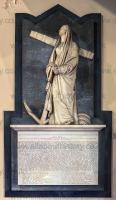
On 13th January 1808 Margaret Cunynghame [aged 62] died. She was buried at the Church of St Leonard, Wortley [Map]. Memorial sculpted by John Flaxman [aged 52].
Margaret Cunynghame: On 13th December 1745 she was born to David Cunynghame 3rd Baronet. On 8th June 1767 James Archibald Stuart-Wortley-Mackenzie and she were married. He the son of John Stuart 3rd Earl Bute and Mary Wortley-Montagu Countess Bute.


On 28th July 1809 Captain Richard Beckett [aged 27] was killed in action at the Battle of Talavera. He has a monument by John Flaxman [aged 54] at the Minster and Parish Church of Saint Peter-at-Leeds [Map].
In 1810 [his sister] Mary Ann Flaxman [aged 42] moved into the home of her brother John Flaxman [aged 54] at 7 Buckingham Street Fitzroy Square.

On 10th January 1811 William Saltren [aged 29] died while ice skating on a lake at Thoresby. Church of St Edmund, Holme Pierrepoint [Map]. Sculpted by John Flaxman [aged 55].
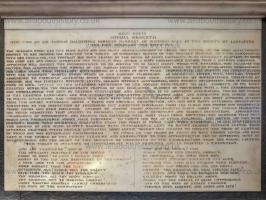
Inscription: "Sacred to the memory of the Reverend William Saltren Rector of Cotgrave, in the county of Nottingham, he was a pious christian, an affectionate son, a sincere friend and a benevolent man: died January 10th 1811, aged 29 years. this monument is erected by his mother Elizabeth Saltren, in testimony of his virtues, and her grateful and affectionate remembrance.
William Saltren: Around 1782 he was born.
On 16th April 1813 Matthew White Ridley 2nd Baronet [aged 67] died. His son Matthew [aged 34] succeeded 3rd Baronet Ridley of Blagdon in Northumberland.
Monument at the Cathedral Church St Nicholas, Newcastle upon Tyne [Map] sculpted by John Flaxman [aged 57].
Matthew White Ridley 2nd Baronet: On 28th October 1745 he was born to Matthew Ridley and Elizabeth White. In 1763 Matthew White 1st Baronet died. His nephew Matthew succeeded 2nd Baronet Ridley of Blagdon in Northumberland.
Matthew White Ridley 3rd Baronet: On 18th April 1778 he was born to Matthew White Ridley 2nd Baronet. In 1813 Matthew White Ridley 3rd Baronet was elected MP Newcastle upon Tyne. On 14th July 1836 Matthew White Ridley 3rd Baronet died. His son Matthew succeeded 4th Baronet Ridley of Blagdon in Northumberland.


On 4th September 1815 Harriet Susan Dashwood [aged 32] died. Memorial in Christchurch Priory [Map] sculpted by John Flaxman [aged 60].
Harriet Susan Dashwood: In 1783 she was born to Francis Bateman Dashwood. On 17th June 1806 James Edward Harris 2nd Earl Malmesbury and she were married. He the son of James Harris 1st Earl Malmesbury and Harriet Maria Amyand Countess Malmesbury.


On 6th February 1817 Sophia Hinde Lady Hesketh [aged 39] died. She was buried at St Mary The Virgin Church, Rufford [Map]. Monument by John Flaxman [aged 61].
Sophia Hinde Lady Hesketh: In 1778 she was born. On 1st February 1798 Thomas Dalrymple Hesketh 3rd Baronet and she were married. She by marriage Lady Hesketh of Rufford in Lancashire.
Chronicle of Walter of Guisborough
A canon regular of the Augustinian Guisborough Priory, Yorkshire, formerly known as The Chronicle of Walter of Hemingburgh, describes the period from 1066 to 1346. Before 1274 the Chronicle is based on other works. Thereafter, the Chronicle is original, and a remarkable source for the events of the time. This book provides a translation of the Chronicle from that date. The Latin source for our translation is the 1849 work edited by Hans Claude Hamilton. Hamilton, in his preface, says: 'In the present work we behold perhaps one of the finest samples of our early chronicles, both as regards the value of the events recorded, and the correctness with which they are detailed; Nor will the pleasing style of composition be lightly passed over by those capable of seeing reflected from it the tokens of a vigorous and cultivated mind, and a favourable specimen of the learning and taste of the age in which it was framed.'
Available at Amazon in eBook and Paperback format.
On 7th February 1820 [his wife] Anne Denman [aged 60] died. Her sister [his sister-in-law] Maria Denman [aged 44] continued to live with Anne's husband John Flaxman [aged 64] as did John Flaxman's sister Mary Ann Flaxman [aged 52].
On 30th December 1820 Agneta Johnson [aged 80] died. Buried at St Andrew's Church, Wimpole [Map].
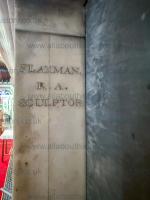
Inscription tablet flanked by pilasters with figures of her husband in robes of state and of two sons, and with medallion portrait at the head, all in white marble, signed 'J. FLAXMAN [aged 65], R.A. Sculptor'
Agneta Johnson: On 11th November 1740 she was born to Henry Johnson of Berkhamstead in Hertfordshire. On 30th December 1762 Charles Yorke and she were married. He the son of Philip Yorke 1st Earl of Hardwicke and Margaret Cocks Countess Hardwicke.


Before 1826 . John Jackson [aged 47]. Portrait of John Flaxman [aged 70].

Before 7th December 1826. Henry Howard [aged 57]. Portrait of John Flaxman [aged 71].
On 7th December 1826 John Flaxman [aged 71] died. His sister-in-law [his former wife] Anne Denman and half-sister Mary Ann Flaxman [aged 58] were co-executors of his estate.
In 1827 Richard Westmacott [aged 51] was appointed Royal Academy professor of sculpture succeeding John Flaxman.
Cansick's Monumental Inscriptions Volume 2 St Giles' Cemetery, Kings Road. Here rest the mortal remains of Ann Flaxman, The virtuous and beloved wife of John Flaxman, R.A.P.S., Whose soul returned to the Almighty Creator and Blessed Redeemer On the 7th of February, In the year of Our Lord, 1820, And the 60th year of her age. Under the same stone Is interred her husband, John Flaxman, R.A.P.S.1, Whose mortal life Was a constant preparation For a blessed immortality. His angelic spirit returned to the Divine Giver On the 7th of December, 1826, In the 72nd year of his age.
Also in the same vault Are deposited the mortal remains of Mary Ann Flaxman [deceased], Sister of the above John Flaxman, Whose gentle spirit returned to the Divine Giver On the 17th of April, 1833, in the 65th year of her age.
Note 1. Mr. John Flaxman, was born at York, 1755. From boyhood lie displayed a remarkable genius for modelling in clay.
In 1787 he visited Rome, where, during a residence of seven years, he executed his celebrated designs in outline from Homer, Æschylus and Danté.
These were engraved and published, as were some which he made from Hesiod.
Whilst at Rome he also executed the splendid group from Ovid's Metamorphoses entitled "The Fury of Athamas;" consisting of four figures larger than life. For this work he received only £6oo; an amount very much below the cost. It was executed for the Earl of Bristol. In 1794 he returned to England and executed the monument for Lord Mansfield, now in Westminster Abbey. For this he received £2,500. After this he produced a large number of fine works, and was considered the greatest of modem sculptors. His collections of drawings and models he bequeathed to the University of London, to form a Flaxman Gallery.
St Mary's Church, Old Basing [Map]. There are several large and small wall monuments (one by John Flaxman 1784), hatchments (one with the Royal Coat of Arms of 1660).
St Mary's Church, Kirkby, Fleetham [Map]. Monuments:
Cross-legged effigy of Sir Nicholas Stapleton, died 1290, in good condition, lion at feet, sword, shield and chainmail helmet. Now resting in C19 pointed-arched niche on blind quatrefoiled chest.
William Lawrence, died 1785, by Flaxman. A bust of a young man on a round pillar, with mourning woman to one side, his wife Anne Sophie, heiress to the Studley Royal estate. This is set against a grey marble slab with a pointed-arched top..
Church of St Peter Kirkthorpe [Map]. The chief merit of the church is a fine collection of C18 wall monuments. The most important of these is the Stringer Monument by Guelfi: 2 detached busts on a sarcophagus with straight tapering sides; background by Kent with inscription, a frame starting from 2 big volutes and crowned by an open-segmental pediment carved coat-or-arms with putti. The Smyth chapel has numerous monuments dating from 1731; including that to John Smyth of 2 putti uncovering his portrait on an oval medallion, that to Lady Georgina Smyth and others signed by Flaxman; 1799.
St Michael and Our Lady's Church, Wragby [Map]. Wall monument to Sir Rowland Winn 4th baronet by John Flaxman, 1806.
St Giles' Church, Badger [Map]:
Memorial to Isaac Hawkins Browne and his second wife, Elizabeth, by Francis Leggatt Chantrey.
Memorial to Browne's mother and first wife by John Flaxman.
Memorial to Elizabeth Kynnersley, who died in 1649.
Abbot John Whethamstede’s Chronicle of the Abbey of St Albans
Abbot John Whethamstede's Register aka Chronicle of his second term at the Abbey of St Albans, 1451-1461, is a remarkable text that describes his first-hand experience of the beginning of the Wars of the Roses including the First and Second Battles of St Albans, 1455 and 1461, respectively, their cause, and their consequences, not least on the Abbey itself. His text also includes Loveday, Blore Heath, Northampton, the Act of Accord, Wakefield, and Towton, and ends with the Coronation of King Edward IV. In addition to the events of the Wars of the Roses, Abbot John, or his scribes who wrote the Chronicle, include details in the life of the Abbey such as charters, letters, land exchanges, visits by legates, and disputes, which provide a rich insight into the day-to-day life of the Abbey, and the challenges faced by its Abbot.
Available at Amazon in eBook and Paperback format.
St Michael and All Angels Church, Ledbury [Map]. Monument to William Miles (d.1803) by John Flaxman. A small unnamed boy apparently asleep lies under the watchful care of two angels at Ledbury. Sculptors Thomas and Mary Thorneycroft.
