

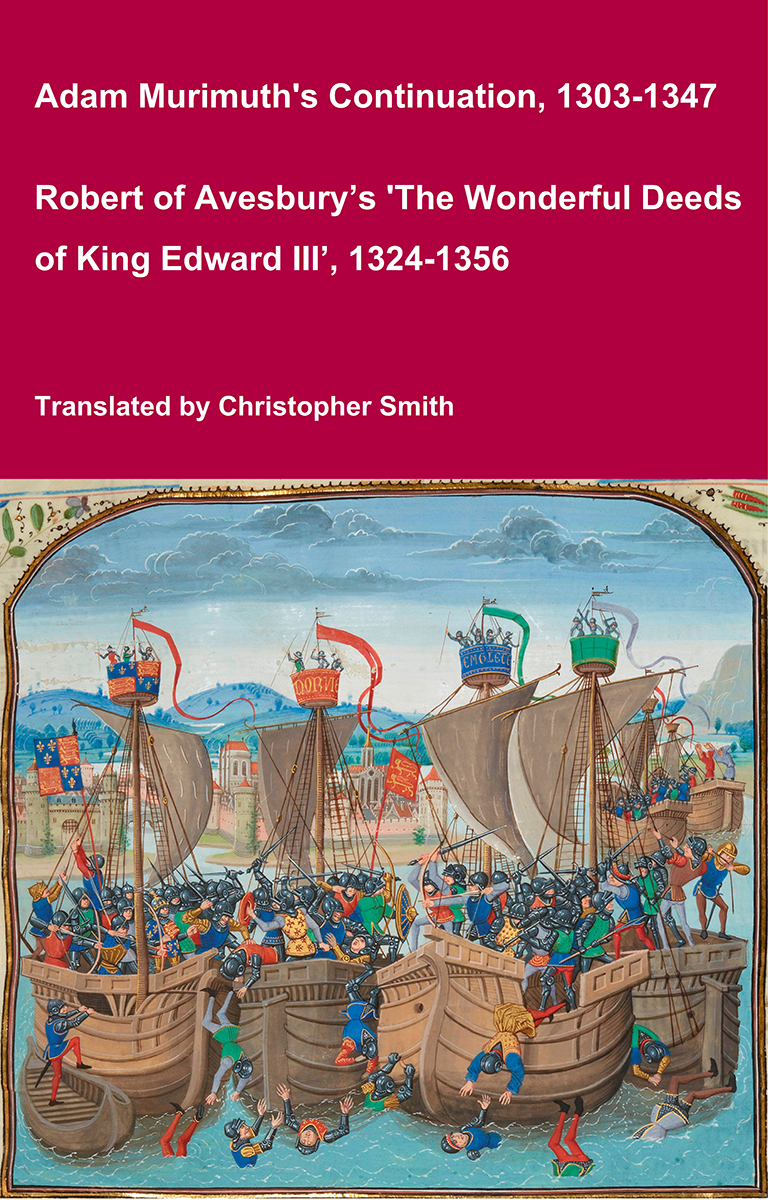
Adam Murimuth's Continuation and Robert of Avesbury’s 'The Wonderful Deeds of King Edward III'
This volume brings together two of the most important contemporary chronicles for the reign of Edward III and the opening phases of the Hundred Years’ War. Written in Latin by English clerical observers, these texts provide a vivid and authoritative window into the political, diplomatic, and military history of fourteenth-century England and its continental ambitions. Adam Murimuth Continuatio's Chronicarum continues an earlier chronicle into the mid-fourteenth century, offering concise but valuable notices on royal policy, foreign relations, and ecclesiastical affairs. Its annalistic structure makes it especially useful for establishing chronology and tracing the development of events year by year. Complementing it, Robert of Avesbury’s De gestis mirabilibus regis Edwardi tertii is a rich documentary chronicle preserving letters, treaties, and official records alongside narrative passages. It is an indispensable source for understanding Edward III’s claim to the French crown, the conduct of war, and the mechanisms of medieval diplomacy. Together, these works offer scholars, students, and enthusiasts a reliable and unembellished account of a transformative period in English and European history. Essential for anyone interested in medieval chronicles, the Hundred Years’ War, or the reign of Edward III.
Available at Amazon in eBook and Paperback format.
John Merewether is in Antiquaries.
In 1797 John Merewether was born.
In 1836 John Merewether [aged 39] was elected Fellow of the Society of Antiquaries of London.
Archaeologia Volume V32 1847 Section VII. Account of the Opening of the Coffin of Joanna de Bohun, in the Lady Chapel of Hereford Cathedral [Map]. By the Very Rev. John Merewether [aged 49], D.D. Dean of Hereford. Read llth June, 1846.
Diary of a Dean by Merewether. July 1849. Diary Of The Examination Of Barrows And Other Earthworks In The Neighbourhood Of Silbury Hill [Map] And Avebury, Wilts, In July And August 1849 by John Merewether [aged 52].
Diary of a Dean by Merewether. July 1849. Diary Of A Dean. Being An Account Of The Examination Of Silbury Hill [Map], And Of Various Barrows And Other Earthworks On The Downs Of North Wilts, Opened And Investigated In The Months Of July And August 1849. With Illustrations. By The Late John Merewether [aged 52], D.D. F.S.A. Dean Of Hereford.
"Ducere Sollicitæ Jucunda Oblivia Vitæ." Hor. ["the pleasing oblivion of a life full of solicitude" Horace Satires Book 2 Saties VI]
London: George Bell, 186 Fleet Street. 1851.
On 4th April 1850 John Merewether [aged 53] died. He was buried in the Lady Chapel of Hereford Cathedral [Map]. The five lancet windows at the east end of the minster were fitted with stained glass to his memory with the inscription In Memoriam Johannis Merewether, S.T.P. ecclesiæ Heref. decani, quo strenuo fautore huius sacræ ædis restitutio feliciter est inchoata ie. In Memory of John Mereweather dean of Hereford whose energetic support the restoration of this sacred edifice was successfully begun.
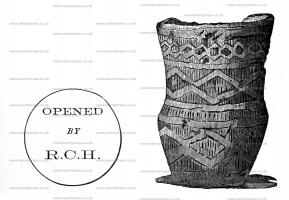
Wiltshire Archaeological Magazine 1859 V6 Pages 317-336. A small low barrow on Pound Down, within a short distance of the last group and nearly opposite the fifth mile-stone from Devizes, was also examined. This proved to be the one opened by Sir R. C. Hoare August 11th, 18141, which was the subject of a lengthy poem, entitled "Beth Pennard, or the British Chieftain's Grave,"2 by the Rev. John Skinner, who with Dean Merewether3, was present at the opening. From the terms in which Sir Richard Hoare describes the situation of this barrow (in which the richly ornamented earthen drinking cup, here figured4, was found near the head of a skeleton) it was at first by no means clear to which he refers. Its identity with that which we re-opened was however proved by the discovery of a brass medal, inscribed OPENED by R.C.H. with the fragments of a skeleton in a cist, which had been excavated to some depth in the chalk. Much poetical merit cannot be claimed for Mr. Skinner's unpublished verses; from which, however, as referring to the opening of this particular barrow, and as containing a complimentary allusion to Sir Richard Hoare, the following lines may be quoted.
Note. Poem Inserted Here.
Note 1. Ancient Wilts, vol. ii. p. 92, No. 4.
Note 2. Wilts Arehæological and Natural History Magazine, vol. iv. p. 361, note.
Note 3. Proceedings Archæologieal Institute, at Salisbury," 1849, p. 109. The Dean's description of the locality is also ambiguous; but one of Sir Richard's pioneers," the octogenarian John Parker, perfectly remembers the barrow as the one we re-opened. Dr. Stukeley says Sir R. C. Hoare, "has recorded the merits of Reuben Horsall, the Town Clerk of Abury: and why should I not do equal justice to those of our Heytesbury pioneers John Parker and his father Stephen, to the former of whom we feel much indebted for many interesting discoveries". Ancient Wilts, vol. i. p. 97.
Note 4. For the use of the wood-cut of this cup, from the Catalogue of the Museum at Stourhead, we are indebted to Messrs. Nichols and Sons, of Parliament Street. The vase is here represented of about one-third its actual size.
Longstones Long Barrow [Map]. Historic England:
The monument includes a Neolithic Long Barrow aligned north east to south west and situated on a gentle east-facing slope, 300m south west of the South Street long barrow [Map].The barrow mound has been slightly disturbed by cultivation in the past but survives as an impressive earthwork which measures 84m long and 35m wide. The mound stands up to 6m high and is flanked to the north and south by quarry ditches which provided material for the construction of the mound. These have become partially infilled over the years owing to cultivation but survive as slight earthworks c.24m wide and 84m long with a depth of c.0.6m. The barrow was partially excavated by Merewether between 1820 and 1850. He discovered evidence of a Bronze Age cremation burial contained in a 'Deverel Rimbury' style pottery urn and a piece of bronze which was probably part of a dagger. The urn is now located in the [Map].