

Annals of the six Kings of England by Nicholas Trivet
Translation of the Annals of the Six Kings of England by that traces the rise and rule of the Angevin aka Plantagenet dynasty from the mid-12th to early 14th century. Written by the Dominican scholar Nicholas Trivet, the work offers a vivid account of English history from the reign of King Stephen through to the death of King Edward I, blending political narrative with moral reflection. Covering the reigns of six monarchs—from Stephen to Edward I—the chronicle explores royal authority, rebellion, war, and the shifting balance between crown, church, and nobility. Trivet provides detailed insight into defining moments such as baronial conflicts, Anglo-French rivalry, and the consolidation of royal power under Edward I, whose reign he describes with particular immediacy. The Annals combines careful year-by-year reporting with thoughtful interpretation, presenting history not merely as a sequence of events but as a moral and political lesson. Ideal for readers interested in medieval history, kingship, and the origins of the English state, this chronicle remains a valuable and accessible window into the turbulent world of the Plantagenet kings.
Available at Amazon in eBook and Paperback format.
John Opie is in Painters.
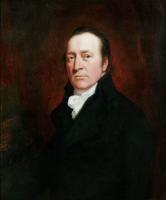
. John Opie. Portrait of the artist's father-in-law James Alderson.
James Alderson: In 1742 he was born to J Alderson. In October 1825 he died.
On 16th May 1761 John Opie was born.
On 4th December 1782 John Opie [aged 21] and Mary Bunn were married at St Martin in the Fields Church [Map].
Dictionary of National Biography: Opie's first cares in his new prosperity were to surround his mother with comfort, and to provide himself with a wife. On 4 December 1782 he married Mary Bunn at the church of St. Martin-in-the-Fields. She was a daughter of Benjamin Bunn of St. Botolpn's, Aldgate, who combined the business of a solicitor with that of a money-lender. The match was unhappy. In 1795 the lady eloped with one John Edwards, and in the following year Opie obtained a divorce.
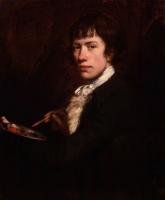
1785. John Opie [aged 23]. Self-portrait.
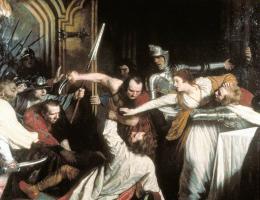
1787. John Opie [aged 25]. "The Murder of Rizzio".

Around 1790. John Opie [aged 28]. Portrait of Mary Wollstonecraft [aged 30].
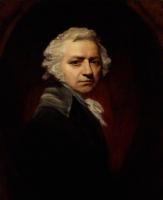
1794. John Opie [aged 32]. Portrait of Henry Fuseli [aged 52].
In 1796 John Opie [aged 34] and Mary Bunn were divorced.

Around 1797. John Opie [aged 35]. Portrait of Mary Wollstonecraft [aged 37].
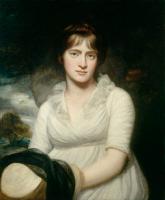
1798. John Opie [aged 36]. Portrait of the artist's wife Amelia Alderson [aged 28].
Amelia Alderson: On 12th November 1769 she was born to James Alderson and Amelia Briggs. On 2nd December 1853 she died at midnight. She was buried in the same grave as her father, in the Friends* burying-ground at Norwich.
Chronicle of Abbot Ralph of Coggeshall
The Chronicle of Abbot Ralph of Coggeshall (Chronicon Anglicanum) is an indispensable medieval history that brings to life centuries of English and European affairs through the eyes of a learned Cistercian monk. Ralph of Coggeshall, abbot of the Abbey of Coggeshall in Essex in the early 13th century, continued and expanded his community’s chronicle, documenting events from the Norman Conquest of 1066 into the tumultuous reign of King Henry III. Blending eyewitness testimony, careful compilation, and the monastic commitment to record-keeping, this chronicle offers a rare narrative of political intrigue, royal power struggles, and social upheaval in England and beyond. Ralph’s work captures the reigns of pivotal figures such as Richard I and King John, providing invaluable insights into their characters, decisions, and the forces that shaped medieval rule. More than a simple annal, Chronicon Anglicanum conveys the texture of medieval life and governance, making it a rich source for scholars and readers fascinated by English history, monastic authorship, and the shaping of the medieval world.
Available at Amazon in eBook and Paperback format.
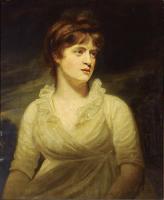
After 1798. John Opie [aged 36]. Portrait of the artist's wife Amelia Alderson [aged 28].
On 8th May 1798 John Opie [aged 36] and Amelia Alderson [aged 28] were married at St Marylebone Church.
Dictionary of National Biography: Meanwhile he had married again, and this time his choice was very fortunate. It was at an evening party at Norwich that he first met Amelia Alderson, the daughter of a doctor of that town, and cousin of Baron Alderson [aged 10]. He fell in love at first sight. They were married at Marylebone Church on 8 May 1798, and lived till his death at 8 Berners Street, whither he had moved in 1791. They were thoroughly suited to each other; she appreciated liis genius and character. A grace was afterwards observed in his works, especially his female portraits, which they had lacked before. At first fortune did not seem to favour them, and there was a short period at the end of 1801 and the beginning of 1802 when he was wholly without employment; Mrs. Opie considered these ' three alarming months ' as the severest trial in her married life. Then a ' torrent of business ' came, and never ceased to flow till the day of his death.
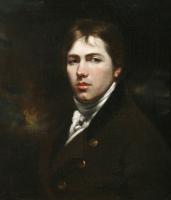
Around 1804. John Opie [aged 42]. Self-Portrait.

Around 1804. John Opie [aged 42]. Portrait of William Henry Hanover 1st Duke Gloucester and Edinburgh [aged 60].
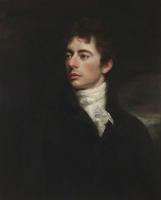
. 1805. John Opie [aged 43]. Portrait of Robert Southey [aged 30].
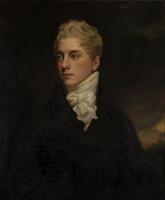
. 1805. John Opie [aged 43]. Portrait of Edward Boscawen [aged 17].
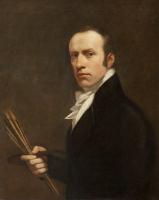
1805. John Opie [aged 43]. Self-portrait.

1805. John Opie [aged 43]. Portrait of Bishop Shute Barrington [aged 70].
On 9th April 1817 John Opie [aged 55] died. He was buried at St Paul's Cathedral [Map].
On 2nd December 1853 [his former wife] Amelia Alderson [aged 84] died at midnight. She was buried in the same grave as her father, in the Friends* burying-ground at Norwich.