

Abbot John Whethamstede’s Chronicle of the Abbey of St Albans
Abbot John Whethamstede's Register aka Chronicle of his second term at the Abbey of St Albans, 1451-1461, is a remarkable text that describes his first-hand experience of the beginning of the Wars of the Roses including the First and Second Battles of St Albans, 1455 and 1461, respectively, their cause, and their consequences, not least on the Abbey itself. His text also includes Loveday, Blore Heath, Northampton, the Act of Accord, Wakefield, and Towton, and ends with the Coronation of King Edward IV. In addition to the events of the Wars of the Roses, Abbot John, or his scribes who wrote the Chronicle, include details in the life of the Abbey such as charters, letters, land exchanges, visits by legates, and disputes, which provide a rich insight into the day-to-day life of the Abbey, and the challenges faced by its Abbot.
Available at Amazon in eBook and Paperback format.
In or before 1423 [his father] William Scott and [his step-mother] Isabel Finch were married.
Around 1423 John Scott was born to [his father] William Scott.
In 1434 [his father] William Scott died.
In or before 1453 John Scott [aged 29] and Agnes Beaufitz were married.
Around 1453 [his daughter] Margaret Scott was born to John Scott [aged 30] and [his wife] Agnes Beaufitz. She married 1470 Edmund Bedingfield and had issue.
In 1458 John Scott [aged 35] was appointed Justice of the Peace Kent.
In 1459 [his son] William Scott was born to John Scott [aged 36] and [his wife] Agnes Beaufitz. He married before 24th August 1524 Sibyl Lewknor.
In 1460 John Scott [aged 37] was appointed High Sheriff of Kent.
Patent Rolls. 2nd July 1464. Grant to John Scot [aged 41], knight, controller of the king's household, or his executors after his death of all moneys arising from the subsidy called 'tonnage and poundage,'viz, the 3s. in the tun and the 12d. in the pound, in the port of the city of London at the hands of the collectors immediately after the full repayment of £1938 12s. 3d. to the king's kinsman John, Earl of Worcester [aged 37], and £960 6s. iid. to Robert Styllington [aged 44], king's clerk, keeper of the privy seal, from the said subsidy in the ports of London, Southampton and Sandwich, as granted to them by letters patent dated 30 June, 3 Edward IV., until he shall be fully satisfied of the sum of £256 3s. 6d. in which the king is indebted to him for having prepared divers ships in the port of Sandwich at the king's command and taken them to the north with victuals and soldiers on the defence of the realm. And until he be thus fully satisfied he shall ns often as he pleases nominate a suitable person to the treasurer of England to be appointed one of the collectors of the said subsidy. By K.
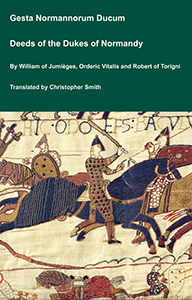
The Deeds of the Dukes of Normandy
The Gesta Normannorum Ducum [The Deeds of the Dukes of Normandy] is a landmark medieval chronicle tracing the rise and fall of the Norman dynasty from its early roots through the pivotal events surrounding the Norman Conquest of England. Originally penned in Latin by the monk William of Jumièges shortly before 1060 and later expanded at the behest of William the Conqueror, the work chronicles the deeds, politics, battles, and leadership of the Norman dukes, especially William’s own claim to the English throne. The narrative combines earlier historical sources with firsthand information and oral testimony to present an authoritative account of Normandy’s transformation from a Viking settlement into one of medieval Europe’s most powerful realms. William’s history emphasizes the legitimacy, military prowess, and governance of the Norman line, framing their expansion, including the conquest of England, as both divinely sanctioned and noble in purpose. Later chroniclers such as Orderic Vitalis and Robert of Torigni continued the history, extending the coverage into the 12th century, providing broader context on ducal rule and its impact. Today this classic work remains a foundational source for understanding Norman identity, medieval statesmanship, and the historical forces that reshaped England and Western Europe between 800AD and 1100AD.
Available at Amazon in eBook and Paperback format.
In 1467 John Scott [aged 44] was elected MP Kent.
On 3rd July 1468 Charles "Bold" Valois Duke Burgundy [aged 34] and Margaret of York Duchess of Burgundy [aged 22] were married at Bruges [Map]. She the daughter of Richard Plantagenet 3rd Duke of York and Cecily "Rose of Raby" Neville Duchess York [aged 53]. He the son of Philip "Good" Valois III Duke Burgundy and Isabella Aviz Duchess Burgundy [aged 71]. They were half second cousins. He a great x 2 grandson of King Edward III of England. She a great x 2 granddaughter of King Edward III of England.
John Paston [aged 24] and John Scott [aged 45] travelled with Margaret. The marriage re-enforced King Edward IV's connection with the Low Countries.
Around 1470 [his son-in-law] Edmund Bedingfield [aged 20] and [his daughter] Margaret Scott [aged 17] were married.
In April 1470 John Scott [aged 47] was appointed Lieutenant of the Cinque Ports.
On 14th April 1471 Edward IV [aged 28] commanded at the Battle of Barnet supported by his brothers George [aged 21] and Richard [aged 18], John Babington [aged 48], Wiliam Hastings [aged 40] (commanded), Ralph Hastings, William Norreys [aged 30], William Parr [aged 37], John Savage [aged 49], William Bourchier Viscount Bourchier [aged 41], Thomas St Leger [aged 31], John Tuchet 6th Baron Audley, 3rd Baron Tuchet [aged 45], Thomas Burgh 1st Baron Burgh of Gainsborough [aged 40], John Scott [aged 48] and Thomas Strickland.
The Yorkists William Blount [aged 29], Humphrey Bourchier [aged 36], Henry Stafford [aged 46] and Thomas Parr were killed.
Humphrey Bourchier 1st Baron Cromwell [aged 40], was killed. Baron Cromwell extinct.
The Lancastrians...
Warwick the Kingmaker [aged 42] was killed. Earl Salisbury, Baron Montagu, Baron Montagu and Baron Monthermer forfeit on the assumption he was attainted either before or after his death; the date of his attainder is unknown. If not attainted the titles may have been abeyant between his two daughters Isabel Neville Duchess Clarence [aged 19] and Anne Neville Queen Consort England [aged 14].
John Neville 1st Marquess Montagu [aged 40] was killed. Marquess Montagu, Baron Montagu forfeit; unclear as to when he was attainted. He was buried at Bisham Abbey [Map].
William Tyrrell was killed.
William Fiennes 2nd Baron Saye and Sele [aged 43] was killed. His son Henry [aged 25] succeeded 3rd Baron Saye and Sele. Anne Harcourt Baroness Saye and Sele by marriage Baroness Saye and Sele.
Henry Holland 3rd Duke Exeter [aged 40] commanded the left flank, was badly wounded and left for dead, Henry Stafford and John Paston [aged 27] were wounded, John de Vere 13th Earl of Oxford [aged 28] commanded, and John Paston [aged 29] and William Beaumont 2nd Viscount Beaumont [aged 33] fought.
Robert Harleston [aged 36] was killed.
Thomas Hen Salusbury [aged 62] was killed.
Thomas Tresham [aged 51] escaped but was subsequently captured and executed on the 6th of May 1471.
 Become a Member via our Buy Me a Coffee page to read more.
Before 1485 [his son-in-law] Edward Poynings [aged 25] and [his daughter] Elizabeth Scott were married.
On 17th October 1485 John Scott [aged 62] died. He was buried in the north wall of the chancel of St Mary the Virgin's Church, Brabourne [Map].
In 1487 [his former wife] Agnes Beaufitz died. She was buried at St Mary the Virgin's Church, Brabourne [Map].
[his daughter] Elizabeth Scott was born to John Scott. She married before 1485 Edward Poynings and had issue.