

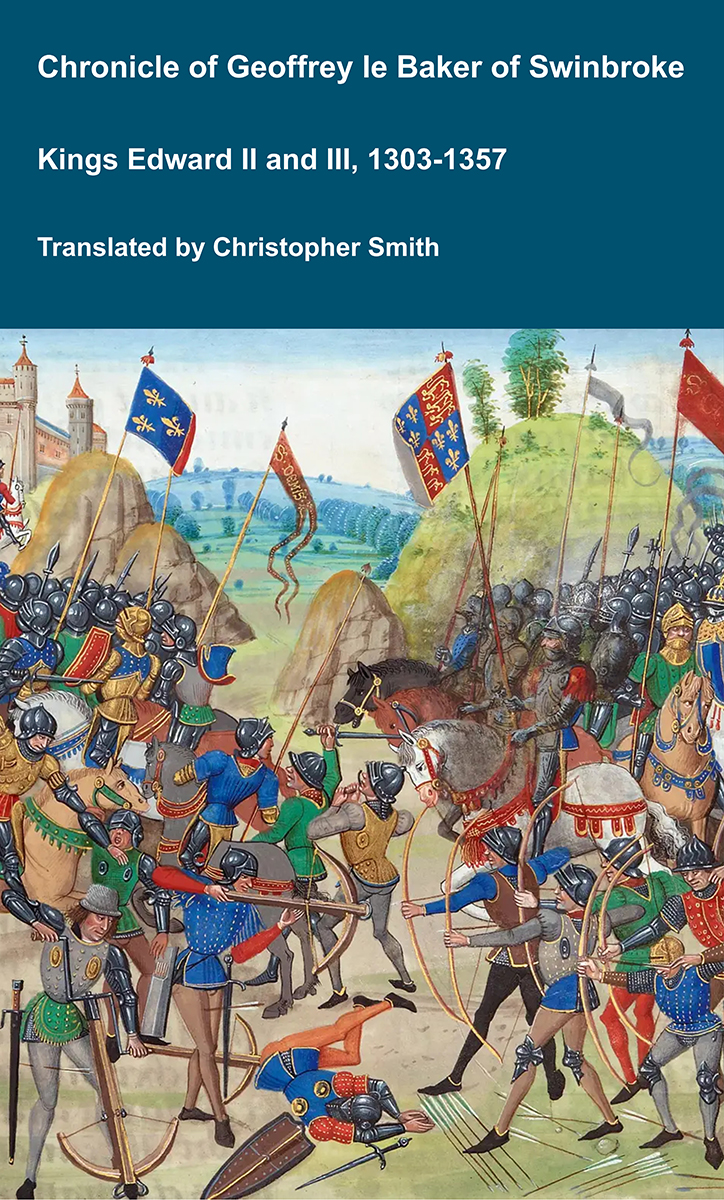
Chronicle of Geoffrey le Baker of Swinbroke
Baker was a secular clerk from Swinbroke, now Swinbrook, an Oxfordshire village two miles east of Burford. His Chronicle describes the events of the period 1303-1356: Gaveston, Bannockburn, Boroughbridge, the murder of King Edward II, the Scottish Wars, Sluys, Crécy, the Black Death, Winchelsea and Poitiers. To quote Herbert Bruce 'it possesses a vigorous and characteristic style, and its value for particular events between 1303 and 1356 has been recognised by its editor and by subsequent writers'. The book provides remarkable detail about the events it describes. Baker's text has been augmented with hundreds of notes, including extracts from other contemporary chronicles, such as the Annales Londonienses, Annales Paulini, Murimuth, Lanercost, Avesbury, Guisborough and Froissart to enrich the reader's understanding. The translation takes as its source the 'Chronicon Galfridi le Baker de Swynebroke' published in 1889, edited by Edward Maunde Thompson.
Available at Amazon in eBook and Paperback format.
Paternal Family Tree: Anjou aka Plantagenet
Maternal Family Tree: Aoife ni Diarmait Macmurrough Countess Pembroke and Buckingham 1145-1188
1281 Marriage of King John of Scotland and Isabella Warenne
1297 Battle of Stirling Bridge
Around December 1206 Hugh Bigod 3rd Earl Norfolk [aged 24] and [his mother] Maud Marshal Countess Norfolk and Surrey [aged 12] were married. She the daughter of [his grandfather] William Marshal 1st Earl Pembroke [aged 60] and [his grandmother] Isabel Clare Countess Pembroke [aged 34]. He the son of Roger Bigod 2nd Earl Norfolk [aged 62] and Ida Tosny Countess Norfolk [aged 50]. They were third cousins.
On 13th October 1225 [his father] William Warenne 5th Earl of Surrey and [his mother] Maud Marshal Countess Norfolk and Surrey [aged 31] were married. She the daughter of [his grandfather] William Marshal 1st Earl Pembroke and [his grandmother] Isabel Clare Countess Pembroke. He the son of Hamelin Warenne Earl of Surrey and Isabella Warenne Countess Boulogne 4th Countess of Surrey. They were half second cousin once removed.
In 1231 John Warenne 6th Earl of Surrey was born to [his father] William Warenne 5th Earl of Surrey and [his mother] Maud Marshal Countess Norfolk and Surrey [aged 37].
On 27th May 1240 [his father] William Warenne 5th Earl of Surrey died. His son John [aged 9] succeeded 6th Earl Surrey and inherited his estates including Conisbrough Castle [Map].
Before 7th May 1243 [his brother-in-law] Hugh D'Aubigny 5th Earl Lincoln 5th Earl of Arundel and [his sister] Isabel Plantagenet Countess Lincoln and Arundel [aged 15] were married. She the daughter of [his father] William Warenne 5th Earl of Surrey and [his mother] Maud Marshal Countess Norfolk and Surrey [aged 49]. He the son of William D'Aubigny 3rd Earl Lincoln 3rd Earl of Arundel and Mabel Gernon Countess Lincoln and Arundel. They were fourth cousin once removed. He a great x 3 grandson of King Henry I "Beauclerc" England.
In 1247 [his brother-in-law] William de Valence 1st Earl Pembroke and Joan Munchensi Countess Pembroke [aged 17] were married. He the son of [his father-in-law] Hugh X of Lusignan V Count La Marche [aged 64] and Isabella of Angoulême Queen Consort England.
In 1247 John Warenne 6th Earl of Surrey [aged 16] and Alice Lusignan Countess of Surrey [aged 23] were married. She by marriage Countess Surrey. She the daughter of Hugh X of Lusignan V Count La Marche [aged 64] and Isabella of Angoulême Queen Consort England. He the son of William Warenne 5th Earl of Surrey and Maud Marshal Countess Norfolk and Surrey [aged 53]. They were fifth cousins.
In 1247 [his brother-in-law] William de Valence 1st Earl Pembroke was created 1st Earl Pembroke. Joan Munchensi Countess Pembroke [aged 17] by marriage Countess Pembroke.
On 27th March 1248 [his mother] Maud Marshal Countess Norfolk and Surrey [aged 54] died.
The History of William Marshal was commissioned by his son shortly after William’s death in 1219 to celebrate the Marshal’s remarkable life; it is an authentic, contemporary voice. The manuscript was discovered in 1861 by French historian Paul Meyer. Meyer published the manuscript in its original Anglo-French in 1891 in two books. This book is a line by line translation of the first of Meyer’s books; lines 1-10152. Book 1 of the History begins in 1139 and ends in 1194. It describes the events of the Anarchy, the role of William’s father John, John’s marriages, William’s childhood, his role as a hostage at the siege of Newbury, his injury and imprisonment in Poitou where he met Eleanor of Aquitaine and his life as a knight errant. It continues with the accusation against him of an improper relationship with Margaret, wife of Henry the Young King, his exile, and return, the death of Henry the Young King, the rebellion of Richard, the future King Richard I, war with France, the death of King Henry II, and the capture of King Richard, and the rebellion of John, the future King John. It ends with the release of King Richard and the death of John Marshal.
Available at Amazon in eBook and Paperback format.
On 5th June 1249 [his father-in-law] Hugh X of Lusignan V Count La Marche [aged 66] died. His son [his brother-in-law] Hugh [aged 28] succeeded XI Seigneur of Lusignan, VI Count La Marche. Yolande Capet Countess Lusignan, La Marche and Angoulême [aged 30] by marriage Seigneur of Lusignan, Countess La Marche.
On 6th April 1250 [his brother-in-law] Hugh XI of Lusignan VI Count of La Marche II Count Angoulême [aged 29] died. His son Hugh [aged 15] succeeded XII Seigneur of Lusignan, VII Count La Marche, III Count Angoulême.
On 5th December 1250 [his brother-in-law] Bishop Aymer de Valence [aged 28] died at Paris [Map].
On 9th February 1256 [his wife] Alice Lusignan Countess of Surrey [aged 32] died.
On 14th May 1264 the army of Simon de Montfort 6th Earl of Leicester 1st Earl Chester [aged 56] including Gilbert "Red Earl" Clare 7th Earl Gloucester 6th Earl Hertford [aged 20], Henry Hastings [aged 29] and Nicholas Segrave 1st Baron Segrave [aged 26] defeated the army of [his former brother-in-law] King Henry III of England [aged 56] during the Battle of Lewes at Lewes [Map].
King Henry III of England, his son, the future, King Edward I of England [aged 24], Humphrey Bohun 2nd Earl Hereford 1st Earl Essex [aged 60], Richard of Cornwall 1st Earl Cornwall [aged 55], John "Red" Comyn 1st Lord Baddenoch [aged 44], Philip Marmion 5th Baron Marmion [aged 30] and John Giffard 1st Baron Giffard Brimpsfield [aged 32] were captured. John Warenne 6th Earl of Surrey [aged 33], John Balliol [aged 56], Robert Bruce 5th Lord Annandale [aged 49], Roger Leybourne [aged 49] and William de Valence 1st Earl Pembroke fought for the King. Guy Lusignan was killed. Fulk IV Fitzwarin [aged 44] drowned. Bishop Walter de Cantelupe [aged 73] was present and blessed the Montfort army before the battle.
On 15th May 1266 Henry "Almain" Cornwall [aged 30] and John Warenne 6th Earl of Surrey [aged 35] fought for the King at Chesterfield, Derbyshire [Map] during the Battle of Chesterfield. Henry Hastings [aged 31], John Clinton, Roger Mandeville, John Eyvil, Baldwin Wake [aged 28] all fought on the rebel side. The rebel Robert Ferrers 6th Earl of Derby [aged 27] was captured.
In 1270 [his half-brother] Roger Bigod 4th Earl Norfolk [aged 61] died. His nephew Roger [aged 25] succeeded 5th Earl Norfolk.
On 19th June 1270 Alan Zouche [aged 67] and his son Roger Zouche [aged 27] were attacked at during a trial between him and John Warenne 6th Earl of Surrey [aged 39]. Alan was seriously injured and left on the spot, his son escaped. On 4th August 1270 John Warenne 6th Earl of Surrey agreed to pay substantial compensation to the injured. Alan died eight days later.
Before 25th March 1273 [his former son-in-law] Henry Percy 7th Baron Percy Topcliffe and Eleanor Warenne Baroness Percy Topcliffe were married. She by marriage Baroness Percy of Topcliffe. She the daughter of John Warenne 6th Earl of Surrey [aged 42] and Alice Lusignan Countess of Surrey.
On 2nd August 1274 King Edward I of England [aged 35] and Eleanor of Castile Queen Consort England [aged 33] arrived at Dover, Kent [Map] after an absence of four years. They travelled to London via Tonbridge Castle [Map], home of Gilbert "Red Earl" Clare 7th Earl Gloucester 6th Earl Hertford [aged 30] and Reigate Castle, Surrey [Map], home of John Warenne 6th Earl of Surrey [aged 43].
On 9th February 1281 [his son-in-law] King John Balliol I of Scotland [aged 32] and Isabella Warenne were married. She the daughter of John Warenne 6th Earl of Surrey [aged 50] and Alice Lusignan Countess of Surrey. They were fourth cousins. He a great x 5 grandson of King Henry I "Beauclerc" England.
In 1282 [his sister] Isabel Plantagenet Countess Lincoln and Arundel [aged 54] died.
On 15th December 1286 [his son] William Warenne was killed in a tournament.
On 27th April 1296 Battle of Dunbar was fought between John Warenne 6th Earl of Surrey [aged 65] and [his son-in-law] King John Balliol I of Scotland [aged 47], his son in law. John Strathbogie 9th Earl Atholl [aged 30] and John Comyn 3rd Earl Buchan were captured.
Patrick de Graham Lord of Kincardine was killed.
William of Worcester's Chronicle of England
William of Worcester, born around 1415, and died around 1482 was secretary to John Fastolf, the renowned soldier of the Hundred Years War, during which time he collected documents, letters, and wrote a record of events. Following their return to England in 1440 William was witness to major events. Twice in his chronicle he uses the first person: 1. when writing about the murder of Thomas, 7th Baron Scales, in 1460, he writes '… and I saw him lying naked in the cemetery near the porch of the church of St. Mary Overie in Southwark …' and 2. describing King Edward IV's entry into London in 1461 he writes '… proclaimed that all the people themselves were to recognize and acknowledge Edward as king. I was present and heard this, and immediately went down with them into the city'. William’s Chronicle is rich in detail. It is the source of much information about the Wars of the Roses, including the term 'Diabolical Marriage' to describe the marriage of Queen Elizabeth Woodville’s brother John’s marriage to Katherine, Dowager Duchess of Norfolk, he aged twenty, she sixty-five or more, and the story about a paper crown being placed in mockery on the severed head of Richard, 3rd Duke of York.
Available at Amazon in eBook and Paperback format.
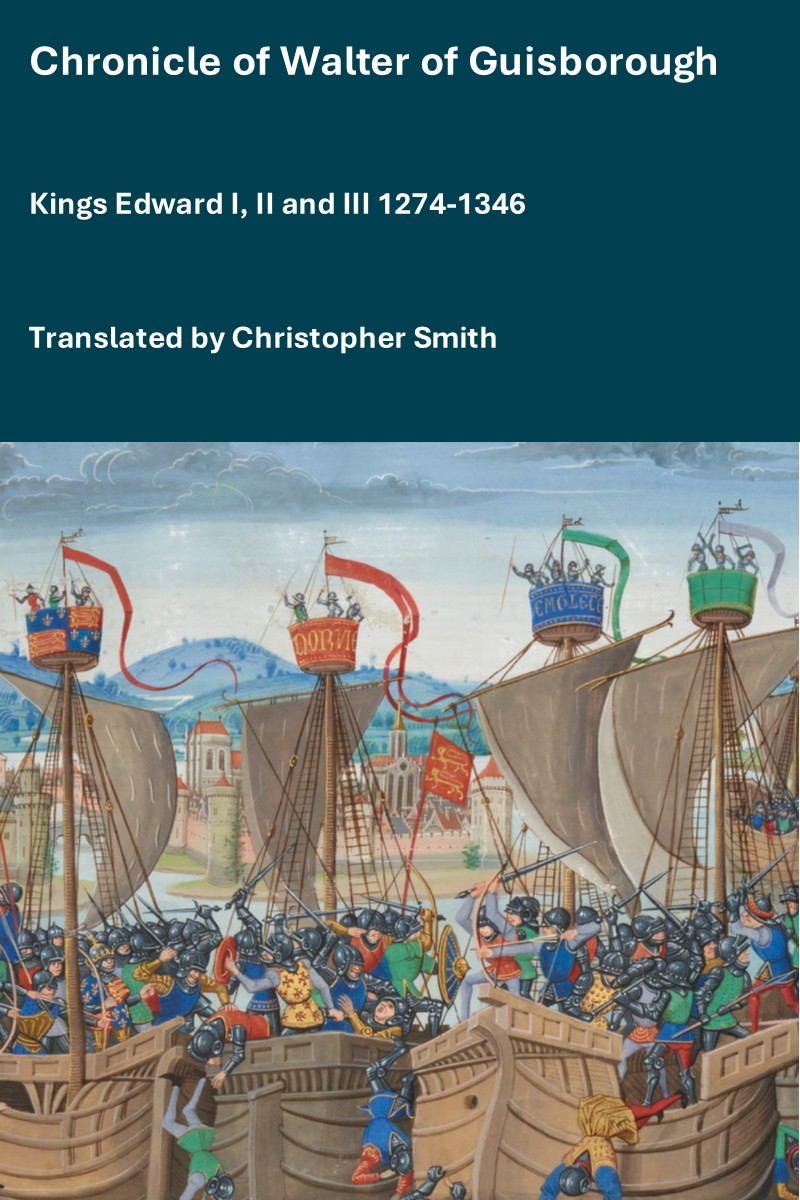 Chronicle of Walter of Guisborough. When this was reported to our king, he immediately dispatched a strong force under the command of the Earl of Warenne [aged 65]: one thousand mounted knights and ten thousand foot soldiers. The Bishop of Durham [aged 51] also sent one hundred armoured men from his own army. They besieged the castle for a few days, and both sides exchanged volleys of missiles and engaged in skirmishes. The new occupants of the castle, now alarmed, requested a truce of three days so that they might send for their king, under the condition that if he did not arrive or assist them, they would surrender the castle. This was granted, and messengers were sent. Then, on the third day, which was a Friday [27th April 1296], three weeks after the capture of Berwick, a large army arrived, sent by the King of Scots: fifteen hundred cavalry and forty thousand foot soldiers, descending the slope of the hill opposite Dunbar, arranged for battle in their squadrons. When the new defenders within the castle saw this force, they rejoiced at the sight and immediately raised their banners on the battlements, shouting insults at our troops, calling them 'tailed dogs' and other abusive names, and threatening them with death and the cutting off of their 'tails.'
Then the Earl of Warenne, having assigned the sons of the nobles who were with him, along with some armed men, to maintain the siege of the castle and prevent the enemy from escaping, boldly advanced with the rest of the army toward the enemy. As our army descended into the valley and spread out in every direction, so as to better and more efficiently approach the Scots, the Scots mistakenly believed that our forces were in retreat and turning their backs in flight. They shouted loudly for their destruction, blowing their horns and howling with such ferocity that the terrifying sound seemed to penetrate like the horns of hell resounding from the abyss. But finally, as our men climbed up out of the deep valley and rushed to engage, the Scots were quickly thrown into confusion. The lines on both sides were drawn, and without delay they clashed fiercely, charging with lances and swords. And, as it pleased the Most High, almost at the first blows, the Scots turned and fled, and our men pursued them, cutting them down and slaughtering them over a distance of seven or eight leagues, nearly as far as the forest of Selkirk. About ten thousand Scots fell in the rout. Among them was a most valiant knight, Patrick de Graham by name, a man considered first among the wise of that kingdom and noblest among the powerful. Unwilling to diminish the glory of his reputation, he did not turn his face in flight, but fought bravely until the end, and was finally killed there. Once the spoils were gathered and our men had returned to the siege lines around the castle, the enemy's banners, which earlier had been raised proudly, were now lowered. They had been thrown into confusion and fear upon seeing their comrades flee and fall in battle.
Quod cum esset regi nostro nunciatum, confestim robur exercitus misit ibidem cum comite de Warenna, mille scilicet armatos equites, et peditum decem millia. De exercitu etiam Dunolmensis episcopi centum armati mittebantur. Qui cum obsedissent castrum, paucis tamen diebus, et mutuis se telis et insultibus visitassent, novi castrenses attoniti, rogaverunt ut concesso triduo liceret eis regem suum expetere, sub qua conditione se dare deberent et castrum reddere. Quo concesso, et missis nunciis, ecce die tertio, qui erat dies Veneris, a captura de Berewyk in tres ebdomadas, venit exercitus multus a rege Scotorum missus, mille quingenti equitantium et XL millia peditum, per clivum montis descendens ex opposito de Dunbar, præparatus ad bellum per turmas suas. Quod cum vidissent novi castrenses, et ex visione tali jam læti effecti, mox eorum vexilla in propugnaculis castri erexerunt, clamantes ad nostros et eos probrose vocantes canes caudatos et talia quæque, insuper comminantes in mortem et caudarum abscisionem.
Tunc comes de Warenna, assignatis pueris magnatum qui cum eo erant cum quibusdam armatis ad obsidionem castri continuandam ne hostes exirent, ipse cum exercitu residuo animose processit ad hostes. Cumque noster exercitus in vallem descendendo et transeundo circumquaque se diffunderet, ut sic facilius meliusque properaret mutuo congressui, credebant Scoti nostros in hoc fugam inire et terga vertere, et conclamabant in mortem eorum, insufflantes cornibus et resonantes ululatibus in tantum quod terribilis sonitus cornuum inferni quasi profunda penetravit. Sed tandem ascendentibus nostris ex valle profunda, et ad congrediendum festinantibus, confestim et ipsi conloss by the ticuerunt, directisque hinc et inde aciebus, absque ulla dilatione mutuo congressi sunt, lanceis et gladiis vicissim occurrentes, et, ut placuit Altissimo, mox quasi in primis ictibus terga verterunt Scoti, et insequebantur nostri cædentes et trucidantes quasi spatio VII leucarum vel octo, fere usque ad Forestam de Selekyrk, cecideruntque ex eis circiter decem millia. Unus autem ex eis miles strenuissimus, nomine Patricius de Graham, inter sapientiores regni illius quasi primus et inter potentiores nobilissimus, cum gloriam suæ laudis minuere nollet, faciem non avertit, sed viriliter agens usque ad mortem, in fine tandem corruit interfectus ibidem. Collectis demum spoliis, et revertentibus nostris ad obsidionem castrensium, ecce deponebantur vexilla quæ contra ruinam eorum prius elevabantur in altum. Confusi enim fuerant et conterriti cum suos et terga vertere et partem corruisse vidissent.
On 11th September 1297 the combined forces of Andrew Moray and William Wallace defeated the forces of John Warenne 6th Earl of Surrey [aged 66] near Stirling Bridge. After around half the English had crossed the narrow bridge the Scots attacked subjecting the English to a significant defeat.
Scalacronica. 11th September 1297. And the following winter, the said William Wallace burnt all Northumberland. The Earl of Warenne [aged 66], who was Keeper of Scotland for the King of England, being in the south1, turned towards Scotland; where at the bridge of Stirling he was defeated by William Wallace, who, being at hand in order of battle2, allowed so many of the English as he pleased to cross over the said bridge, and, at the right moment3, attacked them, caused the bridge to be broken, where many of the English perished, with Hugh de Cressingham, the King's Treasurer; and it was said that the Scots caused him to be flayed, and in token of hatred made girths of his skin. The Earl of Warenne took flight to Berwick. William Wallace, to whom the Scots adhered, immediately after this discomfiture, followed4 the said Earl of Warenne in great force, and skirting Berwick, arrived on Hutton Moor in order of battle; but perceiving the English arrayed to oppose him, he came no nearer to Berwick, but retired and bivouacked in Duns Park5.
Note 1. Warenne, or Surrey, which was his principal title, had been recalled on 18th August for service with King Edward on the Continent, and Sir Brian Fitz Alan was appointed Keeper of Scotland in his place. But Sir Brian having raised a difficulty about his salary (£1128 8s.), the Prince of Wales wrote on 7th Sept., 1298, requiring Surrey to remain at his post. (See Stevenson's Documents illustrative of the History of Scotland, ii. 230.)
Note 2. En batailA soun point. i.e., in force or in order of battle; used in both senses.
Note 3. A soun point. i.e.
Note 4. Suyst, misprinted fuyst in Maitland Club Ed.
Note 5. Not Duns Park on Whitadder, but in a place which then bore that name a little to the north of Berwick.
On 22nd July 1298 King Edward I of England [aged 59] defeated the Scottish army led by William Wallace during the 22nd July 1298 Battle of Falkirk at Falkirk [Map] using archers to firstly attack the Scottish shiltrons with the heavy cavalry with infantry completing the defeat.
John de Graham [aged 31] and John Stewart of Bonkyll [aged 52] were killed.
The English were described in the Falkirk Roll that lists 111 men with their armorials including:
Guy Beauchamp 10th Earl Warwick [aged 26].
Walter Beauchamp [aged 55].
Roger Bigod 5th Earl Norfolk [aged 53].
Humphrey Bohun 3rd Earl Hereford 2nd Earl Essex [aged 49].
Robert Clifford 1st Baron Clifford [aged 24].
Hugh "Elder" Despencer 1st Earl Winchester [aged 37].
William Ferrers 1st Baron Ferrers of Groby [aged 26].
Thomas Berkeley 6th and 1st Baron Berkeley [aged 52].
Maurice Berkeley 7th and 2nd Baron Berkeley [aged 27].
Henry Grey 1st Baron Grey of Codnor [aged 43].
Reginald Grey 1st Baron Grey of Wilton [aged 58].
John Grey 2nd Baron Grey of Wilton [aged 30].
John Mohun 1st Baron Dunster [aged 29].
Simon Montagu 1st Baron Montagu [aged 48].
William Ros 1st Baron Ros Helmsley [aged 43].
John Segrave 2nd Baron Segrave [aged 42].
Nicholas Segrave [aged 42].
Robert de Vere 6th Earl of Oxford [aged 41].
Alan Zouche 1st Baron Zouche Ashby [aged 30].
Thomas Plantagenet 2nd Earl of Leicester, 2nd Earl Lancaster, Earl of Salisbury and Lincoln [aged 20].
Henry Plantagenet 3rd Earl of Leicester 3rd Earl Lancaster [aged 17].
John Warenne 6th Earl of Surrey [aged 67].
[his grandson] Henry Percy 9th and 1st Baron Percy [aged 25].
Hugh Courtenay 1st or 9th Earl Devon [aged 21].
Richard Fitzalan 1st or 8th Earl of Arundel [aged 31].
Henry Beaumont Earl Buchan [aged 19].
John II Duke Brittany [aged 59].
Philip Darcy [aged 40].
Robert Fitzroger.
Robert Fitzwalter 1st Baron Fitzwalter [aged 51], or possiby a Roger Fitzwalter?.
Aymer de Valence 2nd Earl Pembroke [aged 23].
John Wake 1st Baron Wake of Liddell [aged 30], and.
Henry Lacy 4th Earl Lincoln, Earl Salisbury [aged 47].
William Scrope [aged 53] was knighted.
John Moels 1st Baron Moels [aged 29] fought.
John Lovell 1st Baron Lovel [aged 44] fought.
Before 9th March 1301 seven Earls and 96 Barons signed a letter to the Pope refuting the Pope's claim that Scotland was subject to the Pope's feudal overlordship. The letter was never sent. Those who signed include: John Warenne 6th Earl of Surrey [aged 70], Thomas Plantagenet 2nd Earl of Leicester, 2nd Earl Lancaster, Earl of Salisbury and Lincoln [aged 23], Ralph Monthermer 1st Earl of Gloucester and Hertford [aged 31], Humphrey Bohun 4th Earl Hereford 3rd Earl Essex [aged 25], Roger Bigod 5th Earl Norfolk [aged 56], Richard Fitzalan 1st or 8th Earl of Arundel [aged 34], Guy Beauchamp 10th Earl Warwick [aged 29], Aymer de Valence 2nd Earl Pembroke [aged 26], William Leybourne 1st Baron Leybourne [aged 59], Henry Plantagenet 3rd Earl of Leicester 3rd Earl Lancaster [aged 20], William Latimer 1st Baron Latimer of Corby [aged 58], Edmund Hastings, John Hastings 2nd Baron Hastings 14th Baron Abergavenny [aged 14], Edmund Mortimer 2nd Baron Mortimer of Wigmore [aged 50], Fulk Fitzwarin 2nd Baron Fitzwarin [aged 16], [his grandson] Henry Percy 9th and 1st Baron Percy [aged 27], Robert Fitzwalter 1st Baron Fitzwalter [aged 54], John Beauchamp 1st Baron Beauchamp Somerset [aged 26], William de Braose 2nd Baron de Braose 10th Baron Bramber [aged 41], John Botetort 1st Baron Botetort [aged 36], Reginald Grey 1st Baron Grey of Wilton [aged 61], John Moels 1st Baron Moels [aged 32], Thomas Berkeley 6th and 1st Baron Berkeley [aged 55], Robert de Vere 5th Earl of Oxford, John Strange 1st Baron Strange Knockin [aged 48], Thomas Multon 1st Baron Multon [aged 25], Robert Clifford 1st Baron Clifford [aged 26], Walter Beauchamp [aged 58], Alan Zouche 1st Baron Zouche Ashby [aged 33], John Segrave 2nd Baron Segrave [aged 45], William Ferrers 1st Baron Ferrers of Groby [aged 29], Simon Montagu 1st Baron Montagu [aged 51], Piers Mauley, Ralph Neville 1st Baron Neville of Raby [aged 38], John Mohun 1st Baron Dunster [aged 32], Roger Scales 1st Baron Scales, Thomas Furnival 1st Baron Furnivall [aged 41], Hugh Bardolf 1st Baron Bardolf [aged 41], Gilbert Talbot 1st Baron Talbot [aged 24], William Deincourt 2nd Baron Deincourt, Edmund Stafford 1st Baron Stafford [aged 28], Walter Fauconberg 1st Baron Fauconberg [aged 81].
Chronicle of Walter of Guisborough. In the same year died Sir Robert de Brus [aged 60] the fifth, soon after Easter [4th March 1304], while he was on the road towards Annandale, and he was buried in the monastery of Holm [Map].1 In the same year died John, Earl of Warenne [aged 73], an old man, and was buried at Lewes after Christmas. In the same year died that valiant knight Sir William Latimer [aged 61], on the vigil of Saint Nicholas [5th December 1304], who had exercised his knighthood in many lands, and he was buried at Empingham.2
Eodem anno obiit dominus Robertus de Brus quintus, cito post Pascha, cum esset in via versus Vallem Anandiæ, sepultusque est in monasterio de Holme. Eodem anno obiit comes de Warenna Johannes, homo senex, sepultusque est apud Lews post Natale Domini. Eodem anno obiit strenuus ille miles dominus Willelmus Latimer in vigilia Sancti Nicholai, qui suam militiam in multis terris exercuerat, sepultusque est apud Hempingham.
Note 1. Holme Cultram Abbey, Cumberland [Map].
Note 2. Empingham, Rutlandshire.
On 29th September 1304 John Warenne 6th Earl of Surrey [aged 73] died at Kennington, Kent. He was buried at Lewes Priory [Map]. His grandson John [aged 18] succeeded 7th Earl Surrey and inherited his estates including Conisbrough Castle [Map].
[his daughter] Eleanor Warenne Baroness Percy Topcliffe was born to John Warenne 6th Earl of Surrey and Alice Lusignan Countess of Surrey. She married before 25th March 1273 Henry Percy 7th Baron Percy Topcliffe, son of William Percy 6th Baron Percy Topcliffe, and had issue.
[his daughter] Isabella Warenne was born to John Warenne 6th Earl of Surrey and Alice Lusignan Countess of Surrey. She married 9th February 1281 her fourth cousin King John Balliol I of Scotland and had issue.
[his son] William Warenne was born to John Warenne 6th Earl of Surrey and Alice Lusignan Countess of Surrey. He married his fifth cousin Joan Vere, daughter of Robert de Vere 5th Earl of Oxford and Alice Sanford Countess of Oxford, and had issue.
Kings Franks: Great x 12 Grand Son of Charles "Charlemagne aka Great" King of the Franks King Lombardy Holy Roman Emperor
Kings France: Great x 6 Grand Son of Hugh I King of the Franks
Kings Duke Aquitaine: Great x 10 Grand Son of Ranulf I Duke Aquitaine
Philippa Lancaster Queen Consort Denmark [1]
Joan Beaufort Queen Consort Scotland [1]
King Richard III of England [2]
Anne Neville Queen Consort England [3]
King Henry VII of England and Ireland [1]
Queen Anne Boleyn of England [2]
Catherine Parr Queen Consort England [4]
Queen Catherine Howard of England [1]
Jane Grey I Queen England and Ireland [4]
George Wharton [28]
President George Washington [2]
Brigadier-General Charles Fitz-Clarence [112]
Queen Elizabeth II of the United Kingdom [452]
Queen Consort Camilla Shand [138]
Diana Spencer Princess Wales [1250]
Great x 4 Grandfather: Geoffrey "Ferréol" Anjou 2nd Count Gâtinais 
Great x 3 Grandfather: Fulk "Réchin" Anjou 4th Count Anjou
Great x 4 Grandmother: Ermengarde Blanche Ingelger Duchess Burgundy
Great x 2 Grandfather: Fulk "Young" King Jerusalem
Great x 4 Grandfather: Simon Montfort
Great x 3 Grandmother: Bertrade Montfort Queen Consort France
Great x 4 Grandmother: Agnès of Normandy 
Great x 1 Grandfather: Geoffrey Plantagenet Duke Normandy
Great x 4 Grandfather: Jean de la Flèche de Baugency
Great x 3 Grandfather: Elias I Count Maine
Great x 4 Grandmother: Paula Maine
Great x 2 Grandmother: Ermengarde of Maine Countess of Anjou
Great x 4 Grandfather: Gervais II Lord Chateau Du Loir
Great x 3 Grandmother: Matilda Chateau Du Loir Countess Maine
GrandFather: Hamelin Warenne Earl of Surrey
Great x 1 Grandmother: Mistress Unknown
Father: William Warenne 5th Earl of Surrey
Great x 4 Grandfather: Ralph Warenne 
Great x 3 Grandfather: William Warenne 1st Earl of Surrey
Great x 2 Grandfather: William Warenne 2nd Earl of Surrey
Great x 4 Grandfather: Gerbod The Fleming
Great x 3 Grandmother: Gundred Countess of Surrey
Great x 1 Grandfather: William Warenne 3rd Earl of Surrey
Great x 4 Grandfather: Henry I King of the Franks 
Great x 3 Grandfather: Hugh "Great" Capet
Great x 4 Grandmother: Anne of Kiev Queen Consort Francia
Great x 2 Grandmother: Elizabeth Capet Countess Leicester, Meulan and Surrey
Great x 4 Grandfather: Herbert Vermandois IV Count Vermandois
Great x 3 Grandmother: Adelaide I Countess Vermandois
Great x 4 Grandmother: Adela Valois Countess Blois and Vermandois 
GrandMother: Isabella Warenne Countess Boulogne 4th Countess of Surrey
Great x 4 Grandfather: Roger "The Great" Montgomery 1st Earl of Shrewsbury
Great x 3 Grandfather: Robert II Belleme 2nd Count Ponthieu 3rd Earl of Shrewsbury
Great x 4 Grandmother: Mabel de Bellême
Great x 2 Grandfather: William "Talvas" Montgomery III Count Ponthieu
Great x 4 Grandfather: Guy aka Wido I Count of Ponthieu 
Great x 3 Grandmother: Agnes Ponthieu Countess Ponthieu and Shrewsbury
Great x 1 Grandmother: Adela Montgomery Countess of Salisbury and Surrey
Great x 4 Grandfather: Henry "Gallant" Burgundy
Great x 3 Grandfather: Odo "Red" I Duke Burgundy
Great x 2 Grandmother: Helie Burgundy Countess Ponthieu
Great x 4 Grandfather: William I Count Burgundy 
Great x 3 Grandmother: Sybilla Ivrea Duchess Burgundy
Great x 4 Grandmother: Ettiennette Countess Burgundy
John Warenne 6th Earl of Surrey
Great x 2 Grandfather: Gilbert Giffard 
Great x 1 Grandfather: John Fitzgilbert
GrandFather: William Marshal 1st Earl Pembroke
Great x 3 Grandfather: Edward of Salisbury 1st Baron Trowbridge 1st Baron Chitterne
Great x 2 Grandfather: Walter of Salisbury 2nd Baron Chitterne
Great x 1 Grandmother: Sybil of Salisbury
Great x 2 Grandmother: Sybilla Chaworth Baroness Chitterne 
Mother: Maud Marshal Countess Norfolk and Surrey
Great x 4 Grandfather: Richard de Clare
Great x 3 Grandfather: Gilbert de Clare
Great x 4 Grandmother: Rohese Giffard 
Great x 2 Grandfather: Gilbert de Clare 1st Earl Pembroke
Great x 4 Grandfather: Hugh Clermont Count of Clermont-en-Beauvaisis
Great x 3 Grandmother: Adeliza Clermont
Great x 1 Grandfather: Richard "Strongbow" Clare 2nd Earl Pembroke
Great x 4 Grandfather: Roger "Bearded" Beaumont 
Great x 3 Grandfather: Robert Beaumont 1st Earl of Leicester Count Meulan
Great x 4 Grandmother: Adeline of Meulan
Great x 2 Grandmother: Isabel Beaumont Countess Pembroke
Great x 4 Grandfather: Hugh "Great" Capet
Great x 3 Grandmother: Elizabeth Capet Countess Leicester, Meulan and Surrey
Great x 4 Grandmother: Adelaide I Countess Vermandois
GrandMother: Isabel Clare Countess Pembroke
Great x 2 Grandfather: Diarmait Macmurrough
Great x 1 Grandmother: Aoife ni Diarmait Macmurrough Countess Pembroke and Buckingham