

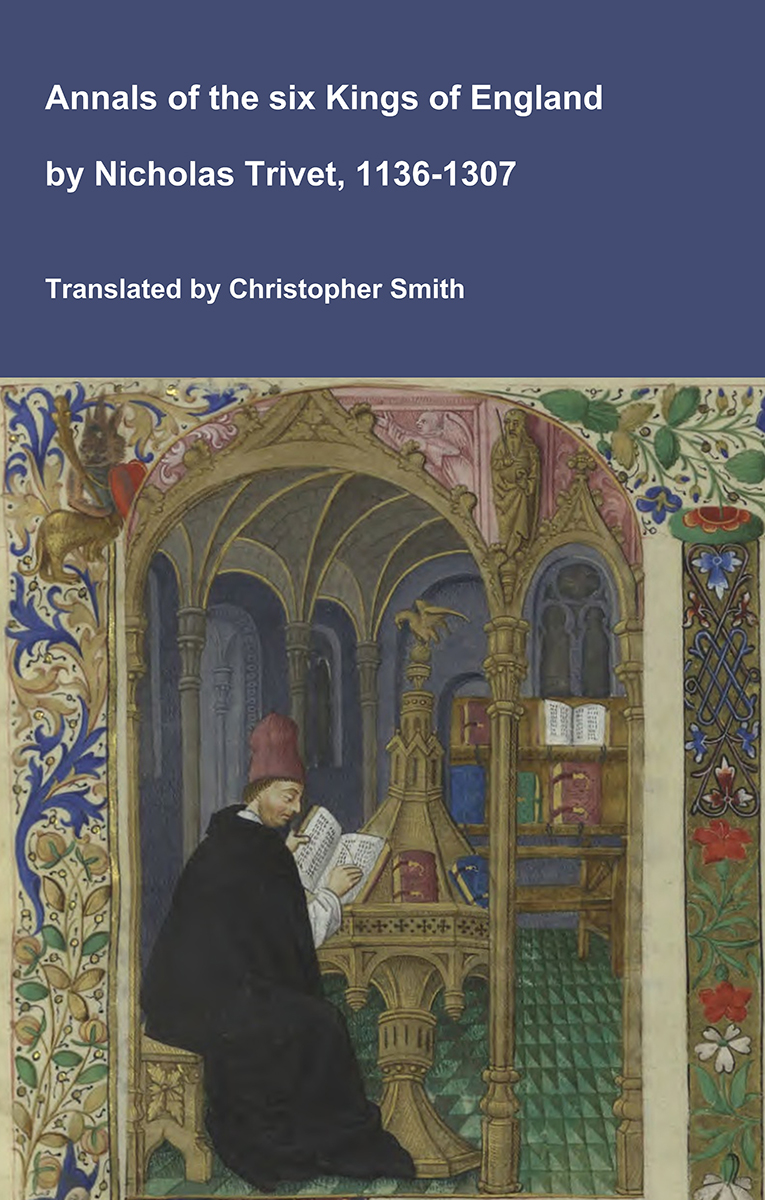
Annals of the six Kings of England by Nicholas Trivet
Translation of the Annals of the Six Kings of England by that traces the rise and rule of the Angevin aka Plantagenet dynasty from the mid-12th to early 14th century. Written by the Dominican scholar Nicholas Trivet, the work offers a vivid account of English history from the reign of King Stephen through to the death of King Edward I, blending political narrative with moral reflection. Covering the reigns of six monarchs—from Stephen to Edward I—the chronicle explores royal authority, rebellion, war, and the shifting balance between crown, church, and nobility. Trivet provides detailed insight into defining moments such as baronial conflicts, Anglo-French rivalry, and the consolidation of royal power under Edward I, whose reign he describes with particular immediacy. The Annals combines careful year-by-year reporting with thoughtful interpretation, presenting history not merely as a sequence of events but as a moral and political lesson. Ideal for readers interested in medieval history, kingship, and the origins of the English state, this chronicle remains a valuable and accessible window into the turbulent world of the Plantagenet kings.
Available at Amazon in eBook and Paperback format.
Around 1328 John Wycliffe was born.
Archaeologia Volume 22 Section XVI. How the Duke sent for John Wiclyffe (age 49) to consult with hym, & how he was maide to come to his answeare.
[19th February 1377] In the meane tyme the duke ceased not (as yt ys sayed) with his felowes to imagyne how he myghte maike the churche subject, & by what meanes he myght submytt the realme unto hym, whereby he myght the frelier bring that to passe that he had long conceaved in hys mynde, for he saw that yt wolde be harde for hym to obteyne hys purpose, the churche standynge in her full state, & very daungerous to attempt publikely to doo those thynges that he had conceaved in hys mynde, the lawes & customes of London beynge in force; wherfor he labored fyrste to overthrow, as well the libertyes of the churche as of the citye, for the whiche he called unto hym a certain false devine, or as I may better name hym, a fyghter agaynste God, whoe, many yeares before, in all hys acts in the scholes had barked agaynste the churche, for that he was justly depryved by the Archbishopp of Canterburye from a certeyne benefyce that he uniustly was incumbent upon, within the cytye of Oxforde, & many new opynions he invented without any grounde but suche which vaynly occupied the eares of the hearers, & myght invite the simple people (desirous alwayes to heare new thyngs, as there manner ys) to hear hym. Thys felow was called John, but unworthely, for that he had caste away the grace that God had geaven hym, avertynge hym selffe from the trueth, which ys God, & convertynge unto fables. Amongst other thynges whiche he spake, not to be rehersed, he denyed the bishopp to have authorytye to excommunicate any man, & yf yt sholde be graunted that the bishopp colde excommunicate any person, then he affirmed that any prieste myght absolve such a one as well as the pope. He sayed further, that neither the kynge nor the seculer lorde coldegyve any thynge perpetually to any person of his churche. That (as he affirmed) in the tyme of William Rufus yt was practysed in Englande, for whom, as for other kynges of the realme (notwithstandynge he took away the church goodes) the churche of England praieth, which yf she doe lawfully, then she dothe well in prayeynge for the bishopp, & to say she doth yt unlawfully were absurde. Furthermore, he affyrmed that the temporal lordes (yf they had need) myght lawefully taike the goods of such religious persons to releave there necessityes. When he hadd taughte these & many worse then these, not only openly in the scholes in Oxforde, but also had preached them publikly in London, that there he myght ether gett the favoure of the duke, & of others whom he had found prone to heare hys opynion, which thyngs he had long sought for, that ys to say that he myght fynde certayne of the nobilitye of thys realme, or rather more ryghtly devills, whoe wolde imbrace hys folyshe toyes, & wolde encorage hym what they colde to maike dull the sworde of Peter, & least he sholde be publikly punyshed they sholde defende hym with the seculer arm, by whom beynge supported, he muche more boldly communicated the matter of excommunication with them, in so muche that he drew into the pytt of errour, not only lordes, but also certeyne simple cytyzens of London, for he was not only eloquent but also a most perfect hypocryte & dyssembler, directynge all hys doyngs to one ende, that ys to witt to spreade hys worde, hys fame, & opynion amongst men. He feined hym selffe to contemne temporall goods as unstable & fraile for the love of eternal ritches, & therfor hys conversation was with those religious that had possessions; & that he myght the more delude the people's mynds, he adioyned hym selffe unto the beggynge freires, approvynge there povertye & extollynge there perfection, that he myght deceave the vulgar sorte. He was furnyshed with many arguments, but with no knowledge from God, & florished to maike hys opinions seeme probable, & abundantly inveighed the eares of the unheartened hearers with the composition of wordes which he spytefully enoughe cast furthe, & vaynly fed the wyndes without frute.
Archaeologia Volume 22 Section XVI. Of the discord raised in St Paule hys churche in London, betwene the Cleargie & the Duke, & Syr Henry Percye & the Londoners, by John Wiclyffe (age 49).
Thys sonne, therfor, of perdition, John Wiclyffe, was to appeare before the bishopps the Thursday before the feast of St. Peter his chaire [23rd February 1377],x there to be convented for marvellous wordes that he had spoken, Sathan, the adversarye of the whoole churche, as ys beleaved, teachynge hym; whoe after the nynth houre, the duke & Syr Henry Percye, & divyers other assystynge hym, whoe by there powre were able to trouble the weake people, & also beynge as a meane betwene them, that yf any thynge sholde fall from the table of the ritche bishopps, that ys to say plate, although it were soyled in the fall, they wolde gather yt upp & wolde chew yt by there backbytynge, beholde the abominable hoste, John aforenamed, was brought furthe with greate pompe, nether yet was sufficient yt for hym to have onely the common sergeants, unlesse Syr Henrye Percye the chiefe Marshall of Englande did goe before hym; in the waye he was animated by his companions not to feare the congregation of the bishopps, whoe in respect of hym were unlearned; nether yet the concourse of the people, seynge that he was walled in on every syde with so many knightes. His body was now broughte into St. Paule's churche with an incredible pryde, where such a multitude of people was gathered togeather to heare hym, that yt was harde for the noble men & knyghtes (the people lettynge them) to passe through, and even by & by with this occasion they were persuaded craftely to pull backe with there handes there scholer, that he myght escape deathe entended hym by manye bishopps. The devill founde a way, that fyrste a dissension beynge mayde betwene the noble men & bishopp, hys answeare myght be differed. Truly when the people beynge gathered togeather, stayed to geave place unto the noble men, Syr Henry Percye, abusynge hys authorytye, miserably pricked forwardes the people in the churche, whiche the Bishopp of London seyng, prohibited hym to exercyse suche authoritye in the churche, saynge that yf he had knowne he wolde have used hym selffe so there, he sholde not have come into the churche yf he coulde have letted hym, whiche the duke hearynge was offended, & protested that he wolde exercyse suche authorytye whether he wolde or not. When they were come into our Ladyes chappell, the duke & barons, with the archbishopp & bishopps, syttynge downe, the foresayed John also was sent in by Syr Henrye Percye to sytt downe, for because, sayed he, he haythe much to answeare he haith neade of a better seate. On the other syde, the byshopp of London denyed the sayme, affyrmynge yt to be agaynst reason that he sholde sytt there, & also contrary to the law for hym to sytt, whoe there was cited to answere before hys ordinarye; & therfor the tyme of hys answearynge, or so longe as any thynge sholde be deposed agynste hym, or hys cause sholde be handled, he ought to stande. Here upon very contumelyous wordes did ryse betwene Syr Henrye Percye & the bishopp, & the whoole multitude began to be troubled. And then the duke began to reprehende the bishopp, & the bishopp to turne then on the duke agayne. The duke was ashamed that he colde not in this stryfe prevaile,y & then began with frowarde threatenynges to deale with the bishopp, swearyng that he wolde pull downe both the pryde of hym & of all the bishopps in Englande, & added, thou trustest (sayed he) in thy parents, whoe can profytt the nothynge, for they shall have enough to doo to defend themselves, for hys parents, that ys to say hys father & hys mother, were of nobylitye, the Earle & the Countes of Devonshire. The bishopp on the other syde sayed, in defendynge the trueth I truste not in my parents, nor in the lyfe of any man, but in God in whom I ought to trust. Then the duke whysperynge in his eare sayed he had rather draw hym furth of the churche by the heare then suffer such thynges. The Londoners hearynge these words, angerlye with a lowd voyce cried out, swearynge they wolde not suffer there Bishopp to be injured, & that they wold soner loose there lyfe then there bishopp sholde be dishonered in the churche, or pulled out with such vyolence. There fury was the more encreased, for that the same day before none in the parlyament at Westminster, the duke being president, &c. it was requested in the kyngs name, that from that day forward there should be no more Mayre of London accordynge to the auncyent custome, but a captayne, and that the Marshall of England, as well in the cytye as in other places myght arrest such as offended, with many other thynges, which were manyfestly agaynst the lybertyes of the cytye, and portended daungers and hurt to the same, which being once hard, John Philpott, a cytezyn of specyall name, arose, and affyrmed that such thyngs were never sene, and that the mayor & comons wold suffer no such arrest, and so before none the counsell brake up. The duke and the byshops revylyng one another, the people wonderfully enraged and trobled, the enemy of mankynde, as I sayd before, procuryng this counsell, and by these occasyons that false varlet & mynyster of the devill persuaded, lest he should be confounded in his inventions, for he saw that in all thyngs he wold be profytable unto hym, & therefore was careful lest such a defender of his part should perysh ether secretly or so lightly.
Note x. The date here assigned to this remarkable transaction is doubted by Lowth, because the Pope's Bull, which he supposes to have been the cause of Wicliffe's citation to St. Paul's, bears as late a date as the 22d of May 1377. He therefore concludes, that the tumult could not have happened many days before the death of Edward the Third, which occurred on the 21st of June. Lewis, in his Life of Wicliffe (p. 50), supposes the meeting at St. Paul's not to have taken place till the February of the succeeding year, after the accession of Richard the Second, in which he is followed by Mr. Baber, in the memoirs prefixed to his edition of Wicliffe's New Testament, p. xvii. This, however, is completely at variance not only with the relation in the text, but also with that of Walsingham, the Continuator of Murimuth, and the other contemporary or early authorities. Mr. Godwin (Life of Chaucer, ii. p. 251) defends the earlier date, suggesting that the citation to St. Paul's was the immediate and personal act of the English prelacy, and that it was the citation of Wicliffe to Lambeth in the following year, which was the result of the Pope's interference, the English Bishops having found themselves too weak in the contest, and having, on that account, invited the interposition of the sovereign Pontiff. This appears to be the true solution, agreeing with the statement in the text, that it was upon the suggestion of the bishops, that Archbishop Sudbury had been unwillingly moved to issue the citation. It is true, indeed, that the mandate (preserved in Wilkin's Concilia, iii. p. 123), which the Archbishop and the Bishop of London, in consequence of the authority vested in them by the Pope's Bull, issued to the Chancellor of Oxford on the 5th of January following, required Wicliffe's presence at St. Paul's on the thirtieth juridical day from that date. But as we have no account from the contemporary writers that any second meeting in St. Paul's actually took place, it may be reasonably concluded that Lambeth was afterwards substituted, as a less likely scene for the renewal of popular commotion, though the result proved otherwise. The opinion here expressed may be strengthened by remarking that not only Fox, but his able antagonist Harpsfeld, who, though a zealous papist, was furnished with materials for his Ecclesiastical History by Archbishop Parker (in whose mild custody he was a prisoner) understood the tumult at St. Paul's to have preceded and been the cause of the Pope's interference, and that the proceeding at Lambeth was the consequence of it. Hist. Wicleffiana, p. 683.
Note y. y Fox, in quoting the Chronicle of St. Alban's, then belonging to Archbishop Parker, from which (as is stated in the introductory Letter) the Chronicle above printed is conceived to have been a translation, says, "to use the words of mine author, 'Erubuit Dux quod non potuit prevalere litigio,' i. e. that the Duke blushed because he could not overpasse the Bishop in brawling and railing." Acts & Mon. i. p. 558, edit. 1641. It clearly appears from this and other passages, that Fox had the use of the Latin original, translating it into language which suited his purpose, though not departing from the facts. Fuller, in his Church History, has dramatized this dialogue between the duke and the bishop, in his usual quaint style.
Thomas Walsingham [~1422]. July 1381. On this day furthermore, John Ball (age 43), a priest, having been captured by the men of Coventry, and the day before brought to Saint Albans and into the presence of the King, was found guilty of having grievously offended His Majesty, heard and confessed the most shameful crimes, and was condemned by the same Robert to dragging, hanging, beheading, disemboweling, and quartering; his death was postponed until Monday, through the intervention of Lord William (age 39), the Bishop of London, who, concerned about the salvation of his soul, obtained for him this time for repentance. Here, for twenty years and more, always preaching in various places what he knew to be pleasing to the common people, he detracted both ecclesiastical persons and secular lords, seeking the goodwill of the common people more than merit with God. Indeed, he taught that tithes should not be given to the curate unless the giver was wealthier than the vicar or rector who would receive them. He also taught that tithes and offerings should be withheld from curates if it was evident that the parishioner or subject was of a better life than their curate. He also taught that no one was fit for the kingdom of God who was not born in wedlock. He taught also the perverse doctrines of the perfidious John Wycliffe (age 53), and the opinions he held, and false insanities, and many things that would be too long to recount; because of which, forbidden by the Bishops in whose parishes he presumed to preach, from henceforth he was not allowed to preach in churches, and took to the streets and alleys, or to the fields, to preach. Nor was he lacking listeners from among the common people, whom he always tried to attract to his sermons through slanders of the prelates and pleasing words. Finally excommunicated, when he did not desist, he was imprisoned, where he predicted that he would be freed by twenty thousand friends. This later happened during the aforementioned turmoil of the kingdom, when the commons broke all prisons and compelled the imprisoned to leave. And having been freed in this manner, he followed them, inciting them to commit many evils, and preaching that it must indeed be done. And that his doctrine might infect more people, at Blackheath [Map], where two hundred thousand common people were gathered together, he began a sermon like this:—
"Whan Adam dalf, and Eve span,
"Wo was thanne a gentilman?"
Hoc die præterea, Johannem Balle, presbyterum, captum a viris Coventrensibus, et pridie ductum ad Sanctum Albanum et Regis præsentiam, cujus majestatem convictus est læsisse enormiter, auditum et confessum turpissima scelera, tractioni, suspendio, decollationi, exentrationi, et quarterizationi, ut usu vulgari loguar, idem Robertus adjudicavit; cujus mors dilationem accepit usque in diem Lunæ, interventu Domini Willelmi, Londoniensis Episcopi, qui, circa salutem sollicitus suæ animæ, illud ei spatium pœnitentise impetravit. Hic per viginti annos, et amplius, semper prædicans in diversis locis en quæ scivit vulgo placentia, detrahens tam personis ecclesiasticis quam dominis ssecularibus, benevolentiam magis communis populi quam meritum penes Deum captabat. Docuit nempe plebem decimas non esse dandag curato, nisi is qui daturus esset foret ditior quam vicarius qui acciperet, sive rector. Docuit etiam decimas et oblationes subtrahendas curatis, si constaret subjectum aut parochianum melioris vite fore quam curatum suum. Docuit etiam neminem aptum regno Dei, qui hon in matrimonio natus fuisset. Docuit et perversa dogmata perfidi Johannis Wiclyf, et opiniones quas tenuit, et insanias falsas, et plura que longum foret recitare: propter quæ, prohibitus ab Episcopis in, quorum parochiis hæc præsumpsit, ne in ecclesiis de cætero prædicaret, concessit in plateas et vicos, vel in campos, ad prædicandum. Nec defuerunt ei de communibus auditores, quos semper studuit per detractiones prælatorum, et placentia verba, allicere ad sermonem. Postremo excommunicatus, cum nec desisteret, carceri mancipatur, ubi prædixit se deliberandum per viginti millis amicorum. Quod postea evenit in turbatione regni præfata, cum communes omnes carceres confregerunt, et incarceratos abire compulerunt. Cumque taliter deliberatus fuisset, eos secutus est, instigans ad plura mala perpetranda, et prædicans ita omnino fore faciendum. Et ut sua doctrina plures inficeret, ad le Blakheth, ubi ducenta millia hominum communium fuere simul congregata, hujuscemodi sermonem est exorsus:—
"Whan Adam dalf, and Eve span,
"Wo was thanne a gentilman?"
Chronicle of Adam of Usk [~1352-1430]. 1382. According to the saying of Solomon: "Woe to thee, O land, when thy king is a child,"1 in the time of the youth of the same Richard many misfortunes, both caused thereby and happening therefrom, ceased not to harass the kingdom of England, as has been before said and as will hereinafter more fully appear, even to the great disorder of the state and to the last undoing of king Richard (age 14) himself and of those who too fondly clung to him. Amongst all other misfortunes, nay, amongst the most wicked of all wicked things, even errors and heresies in the catholic faith, England, and above all London and Bristol2, stood corrupted, being infected by the seeds which one master John Wycliffe (age 54) sowed, polluting as it were the faith with the tares of his baleful teaching. And the followers of this master John, like Mahomet, by preaching things pleasing to the powerful and the rich, namely, that the withholding of tithes and even of offerings and the reaving of temporal goods from the clergy were praiseworthy, and, to the young, that self-indulgence was a virtue, most wickedly did sow the seed of murder, snares, strife, variance, and discords, which last unto this day, and which, I fear, will last even to the undoing of the kingdom. Whence, in many parts of the land, and above all in London and in Bristol, they, like the Jews at Mount Horeb on account of the molten calf (Exodus xxxij.), turning against each other, righteously had to grieve for three-and-twenty thousand of their fellows who suffered a miserable3. The people of England, wrangling about the old faith and the new, are every day, as it were, on the very point of bringing down upon their own heads rebellion and ruin. And I fear that in the end it will happen as once it did, when many citizens of London true to the faith rose against the duke of Lancaster to slay him, because he favoured the said master John, so that, hurrying from his table into a boat hastily provided, he fled across Thames and hardly escaped with his life4. Such errors and heresies grew in the city of London to so great a height (seeing that from such cause spring strife and variance), that, when such as were accused thereof came to answer before their ordinaries, the people were wont to run together in thousands, some accusing, others defending, them, with clamour and strife, as if they were just rushing at each other's throats5. So great, too, grew their malice, that, at the time of the second parliament of king Henry the fifth, hereinafter written, these Lollards, flocking to London from all parts of the land, thought to have utterly destroyed the clergy there at that time assembled6. But my lord of Canterbury (age 40), forewarned of their evil design, found fitting remedies, as will hereinafter be told.
Note 1. Eccles. x. 16.
Note 2. Adam of Usk, as a native of Monmouthshire, would naturally take an interest in what went on in the neighbouring city of Bristol. John Purvey, Wycliffe's follower and part-translator of the Bible, preached there; and it is not improbable that Wycliffe himself also did so, as, in 1875, he was presented by Edward III to the prebend of Aust, in the collegiate church of Westbury-on-Trym.—Seyer, Memoirs of Bristol, ij. 164.
Note 3. The round number of 23,000 may be intended to represent the total of sufferers down to the time when the chronicle was finished, that is, towards the close of the reign of Henry V.
Note 4. In February, 1377, when Wycliffe appeared in St. Paul's to answer the charges brought against him. A quarrel arising between the duke of Lancaster (age 41), who was present as a supporter of Wycliffe, and William Courtenay, bishop of London, the duke made use of violent language, which roused the anger of the Londoners, who attacked the Savoy and would have done the duke mischief, had he not escaped by boat on the Thames.— Walsingham, Hist. i. 8325; Archeolog. xxij. 256; Chronicon Anglie, 13828-1388 (Rolls series), 119, 397. A.D. 1882. p. 4.
Note 5. Compare the passage in Walsingham: "Insuper nec illud esse silendum estimo, cum episcopi predicti cum isto schismatico in capella archiepiscopi apud Lambhith convenissent, non dico cives tantum Londonienses, sed viles ipsius civitatis, se impudenter ingerere presumpserunt in eandem capellam, et verba facere pro eodem, et istud negotium impedire."—Hist, Angl. i. 356, ij. 65.
Note 6. The MS. reads "Henrici quarti," but this is a clerical blunder, The gathering in St. Giles's-fields, under sir John Oldcastle, is referred to. But Adam is not accurate: the actual date of the rising was in January, while Henry the fifth's second parliament, which was held at Leicester, did not meet till April, 1414. See below, p. 300.


On 31st December 1384 John Wycliffe (age 56) died at Lutterworth, Lincolnshire having suffered a stroke three days before