

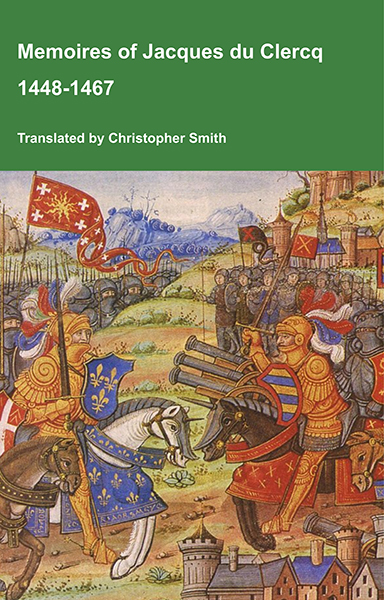
This is a translation of the 'Memoires of Jacques du Clercq', published in 1823 in two volumes, edited by Frederic, Baron de Reissenberg. In his introduction Reissenberg writes: 'Jacques du Clercq tells us that he was born in 1424, and that he was a licentiate in law and a counsellor to Philip the Good, Duke of Burgundy, in the castellany of Douai, Lille, and Orchies. It appears that he established his residence at Arras. In 1446, he married the daughter of Baldwin de la Lacherie, a gentleman who lived in Lille. We read in the fifth book of his Memoirs that his father, also named Jacques du Clercq, had married a lady of the Le Camelin family, from Compiègne. His ancestors, always attached to the counts of Flanders, had constantly served them, whether in their councils or in their armies.' The Memoires cover a period of nineteen years beginning in in 1448, ending in in 1467. It appears that the author had intended to extend the Memoirs beyond that date; no doubt illness or death prevented him from carrying out this plan. As Reissenberg writes the 'merit of this work lies in the simplicity of its narrative, in its tone of good faith, and in a certain air of frankness which naturally wins the reader’s confidence.' Du Clercq ranges from events of national and international importance, including events of the Wars of the Roses in England, to simple, everyday local events such as marriages, robberies, murders, trials and deaths, including that of his own father in Book 5; one of his last entries.
Available at Amazon in eBook and Paperback format.
Paternal Family Tree: Hastings
Before 20th March 1319 [his father] John Hastings 2nd Baron Hastings 14th Baron Abergavenny [aged 32] and [his mother] Juliana Leybourne Countess Huntingdon [aged 16] were married. She by marriage Baroness Hastings.
On 20th March 1319 Laurence Hastings 1st Earl Pembroke was born to [his father] John Hastings 2nd Baron Hastings 14th Baron Abergavenny [aged 32] and [his mother] Juliana Leybourne Countess Huntingdon [aged 16] at Allesbury, Warwickshire.
On 20th January 1325 [his father] John Hastings 2nd Baron Hastings 14th Baron Abergavenny [aged 38] died. His son Laurence [aged 5] succeeded 3rd Baron Hastings, 14th Baron Abergavenny Feudal Creation.
After 20th January 1325 [his step-father] Thomas Blount 1st Baron Blount [aged 62] and [his mother] Juliana Leybourne Countess Huntingdon [aged 22] were married. The difference in their ages was 40 years.
Around 1326 [his brother-in-law] Ralph Stafford 1st Earl Stafford [aged 24] and [his sister] Katherine Hastings Baroness Stafford [aged 22] were married. She by marriage Baroness Stafford. She the daughter of [his father] John Hastings 2nd Baron Hastings 14th Baron Abergavenny and [his mother] Juliana Leybourne Countess Huntingdon [aged 23]. They were fifth cousins.
On 31st May 1328 the Mortimer family leveraged their new status at a lavish ceremony that celebrated the marriages of two of Roger Mortimer's [aged 41] daughters at Hereford [Map].
Edward Plantagenet [aged 8] and Beatrice Mortimer [aged 6] were married. She the daughter of Roger Mortimer 1st Earl March and Joan Geneville Baroness Mortimer 2nd Baroness Geneville [aged 42]. He the son of Thomas of Brotherton 1st Earl Norfolk [aged 27] and Alice Hales Countess Norfolk. They were half third cousin once removed. He a grandson of King Edward I of England. She a great x 4 granddaughter of King John of England.
Laurence Hastings 1st Earl Pembroke [aged 9] and Agnes Mortimer Countess of Pembroke [aged 11] were married. She the daughter of Roger Mortimer 1st Earl March and Joan Geneville Baroness Mortimer 2nd Baroness Geneville. He the son of John Hastings 2nd Baron Hastings 14th Baron Abergavenny and Juliana Leybourne Countess Huntingdon [aged 25]. They were third cousin once removed. She a great x 4 granddaughter of King John of England.
King Edward III of England [aged 15] and his mother Isabella of France Queen Consort England [aged 33] attended as well as Roger Mortimer 1st Earl March.
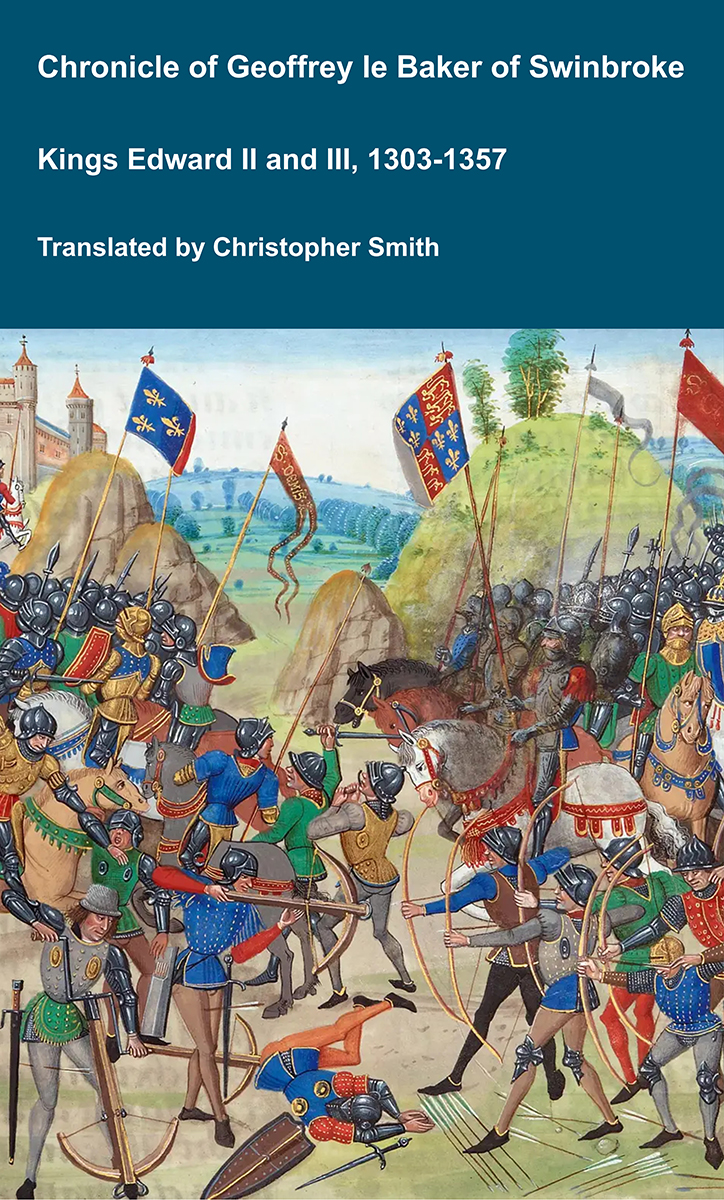 Chronicle of Geoffrey le Baker of Swinbroke. The King of England, after the aforementioned betrothal of his sister, shortly after the Feast of the Holy Trinity [31st May 1328], proceeded to Hereford, where solemn weddings were held for the daughters of Roger de Mortimer and certain noblemen,1 namely, the son of the Earl Marshal [aged 27] and the heir of Lord [his father] John of Hastings. There were also grand tournaments held there, in which the king's mother took part.
Rex Anglie, post predictam sue sororis desponsacionem, cito post festum sancte Trinitatis, se transtulit versus Herefordiam, ubi fuerunt solemnes nupcie inter filias Rogeri de Mortuo mari et quosdam nobiles, videlicet filium comitis Marescalli et heredem domini Iohannis de Hastinghes. Fuerunt eciam ibidem hastiludia solemnia, quibus interfuit mater regis.
Note 1. His daughter [his sister-in-law] Beatrix [aged 6] was married to Edward [aged 8], son of Thomas of Brotherton; and [his wife] Agnes [aged 11] to Laurence [aged 9], son of John, Lord Hastings, and afterwards earl of Pembroke. He had in all seven daughters, each of whom was married into some powerful family.
After 13th August 1328 [his step-father] William Clinton 1st Earl Huntingdon [aged 24] and [his mother] Juliana Leybourne Countess Huntingdon [aged 25] were married.
On 6th July 1336 [his sister] Katherine Hastings Baroness Stafford [aged 32] died at Stafford, Staffordshire [Map].
On 16th March 1337 [his step-father] William Clinton 1st Earl Huntingdon [aged 33] was created 1st Earl Huntingdon. [his mother] Juliana Leybourne Countess Huntingdon [aged 34] by marriage Countess Huntingdon.
On 12th October 1339 Laurence Hastings 1st Earl Pembroke [aged 20] was created 1st Earl Pembroke. [his wife] Agnes Mortimer Countess of Pembroke [aged 22] by marriage Countess Pembroke.
Bourgeois de Valenciennes. It happened a long time after the matters spoken of above, about the feast of Saint John the Baptist in the year 1344, that King Edward of England sent forces into Gascony, where the duke of Normandy was waging war and had gained towns and castles. He sent there the Earl of Derby1, the Earl of Pembroke2, and my lord Walter of Mauny, with many others. These took and won the castle of Bergerac and more than forty towns and fortresses, and they pressed the French so hard that they defeated them. There were taken prisoner the Count of L’Isle, the Count of Valentinois, the Viscount of Murendon, the Viscount of Monder, the Viscount of Villemur, the Viscount of Bouquentin, my lord Charles of Poitiers, my lord Roger, brother of the Count of Comminges, and many other counts, viscounts, and some three hundred knights. The others were slain or drowned in a river called the Viane. This battle took place in the year 13453.
Il avint une grànt espasse de tamps après ces choses dessus dittes, environ le Saint-Jehan-Baptiste, l'an mil IIIc et XLIIII, que le roy Édowart d'Engleterr e envoia en Gascongne où le duch de Normendie guerrioit et avoit gaigniet villes et chasteaulx, et y envoia le conte d'Erby, le conte de Pennebourc et monseigneur Gaultier de Mausny et pluseurs aultres, lesquels prinrent et gaignèrent le chastel de' Bergerac et bien XL que yilles que forteresses, et s'approchèrent dos François telement qu'ils les desconfireut; et y fut prins le conte de Lille, le conte de Valentinois, le visconte de Murendon, le visconte de Monder, le visconte de Villemur, le visconte de Bouquentin, monseigneur Charles de Poitiers, monseigneur Rogier, frère au conte de Cominges, et pluseursaultres contes et viscontes, et chevaliers bien IIIc. Et les aultres furent mors et noyés en une rivière qu'on nomme Viane et fut ceste bataille l'an mil IIP et XLIIII.
Note 1. Henry of Grosmont [aged 35], 1310-1361, Earl of Derby, subsequently 1st Duke of Lancaster, first cousin of King Edward III.
Note 2. Laurence Hastings [aged 26], 1319-1348, created Earl of Pembroke in 1339. He was a great-grandson of the last Earl of Pembroke of the previous creation Aymer de Valence who died in 1324.
Note 3. The original text has 1344. The Battle of Bergerac was fought in August 1345. Froissart, Book 3, Chapters 210-211: "At sunrise the English, who had been ordered to make the assault by water in their ships, were fully prepared. The captains among them were the Earl of Pembroke and the Earl of Hereford. With them were many young knights and squires who had come there of their own eager will, to advance themselves in arms. In that fleet there was a great number of archers. They advanced swiftly and came up to a great barrier that stood before the palisade, which was soon broken down and cast to the ground. The men of Bergerac and the commonalty of the town perceived that in no way could they endure against that assault. They began to lose heart and went to the Count of L’Isle and to the knights who were there, and said to them: 'My lords, consider what you wish to do. We are in danger of being utterly lost. If this town is taken, we shall lose our goods and our lives as well. It would be better for us to surrender it to the Earl of Derby than to suffer greater harm.' Then the Count of L’Isle answered and said: 'Come, let us go where you say the danger lies, for we will not surrender it in this manner.' Thereupon the knights and squires of Gascony who were there came forward toward the palisades and set themselves to the defense with great courage. The archers, who were in their barges, shot so thickly and so straight that scarcely anyone could appear without putting himself in danger of being slain or grievously wounded. Within the town, together with the Gascons, there were some two hundred Genoese crossbowmen, who did them great service; for they were well shielded against the shooting of the English and sorely troubled the English archers throughout that day. There were many wounded on both sides. At length the English, who were in their ships, pressed the attack so vigorously that they broke down a great section of the palisade. When those of Bergerac saw the peril, they came forward and asked for a truce, that they might take counsel concerning their surrender. It was granted to them for the remainder of the day and the following night until sunrise, on condition that they should not strengthen themselves in any way. Thus each side withdrew to its lodgings. That night the barons of Gascony who were there held a great council, to determine how they might conduct themselves. When they had taken counsel, they had their horses saddled and their goods loaded, mounted, and departed about midnight. They rode toward the town of La Réole, which is not far from there. The gates were opened to them; they entered within and lodged and quartered themselves throughout the town."
On 25th June 1347 a English fleet commanded by William Bohun 1st Earl of Northampton [aged 37] and Laurence Hastings 1st Earl Pembroke [aged 28] defeated a French fleet that was intending to re-supply the besiege Calais precipitating the surrender of Calais two months later.
Annals of the six Kings of England by Nicholas Trivet
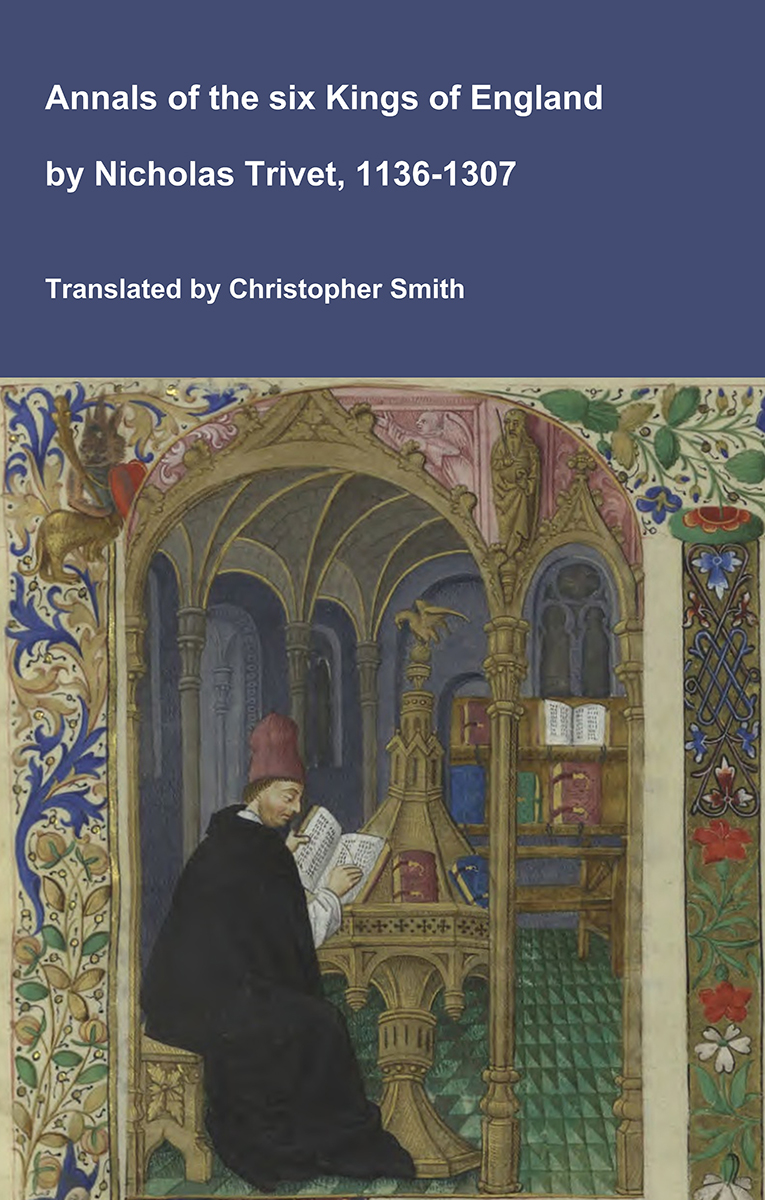
Translation of the Annals of the Six Kings of England by that traces the rise and rule of the Angevin aka Plantagenet dynasty from the mid-12th to early 14th century. Written by the Dominican scholar Nicholas Trivet, the work offers a vivid account of English history from the reign of King Stephen through to the death of King Edward I, blending political narrative with moral reflection. Covering the reigns of six monarchs—from Stephen to Edward I—the chronicle explores royal authority, rebellion, war, and the shifting balance between crown, church, and nobility. Trivet provides detailed insight into defining moments such as baronial conflicts, Anglo-French rivalry, and the consolidation of royal power under Edward I, whose reign he describes with particular immediacy. The Annals combines careful year-by-year reporting with thoughtful interpretation, presenting history not merely as a sequence of events but as a moral and political lesson. Ideal for readers interested in medieval history, kingship, and the origins of the English state, this chronicle remains a valuable and accessible window into the turbulent world of the Plantagenet kings.
Available at Amazon in eBook and Paperback format.
Deeds of King Edward III by Robert of Avesbury. Very dear sir, you should know that on the day [25th June 1347] after Saint John's Day the wind, which had been from the west, turned toward the east at the hour of tierce. Because of this the earls of Northampton [aged 37] and Pembroke [aged 28], and the lords Morley, Talbot, and Bradeston, together with the two admirals and a great number of archers from their retinues and from the commons, boarded their ships and sailed toward Boulogne and Crotoy in order to observe the enemies who had arranged to provision Calais. Thus, they encountered, on this side of Crotoy about the hour of vespers, the said enemies, who were counted within sight of our men as forty-four vessels: hulks, galleys, and victualling ships loaded with various supplies. Some of those enemies who were at the rear threw their provisions into the sea and swam toward England, while others made for the port of Crotoy. The ten galleys abandoned their boats and their cargo and put out to the high sea. One hulk and twelve victualling ships which were ahead were so vigorously pursued that they ran as close to the shore as they could, and all the men leapt into the sea and drowned so completely that not a single person remained alive in their vessels. But on the following night, at daybreak, two boats came out of the town into the open sea, and they were quickly noticed by a mariner named William Roke together with a man called Stephen Hikeman. One of the boats returned to the town with great difficulty, but the other was driven ashore. In that boat was captured a great master who was the commander of the Genoese galleys and the leader of the Genoese who are inside the town, and with him seventeen others of the same company and about forty letters. But the said commander, before he was taken, tied with an axe a letter which carried an important message and threw it into the sea. That letter and the axe were found on the shore when the sea had receded, of which you will find a copy enclosed within this. And what I have already sent you concerning this matter before this hour, know that it is true, for I heard it from a knight who was within the ships."
"Tres chier sire, voilletz savoir qe lendemain de seint; Johan le vent, qestoit vers le west, se tourna vers lorient a houre de tiercz, si qe lez countes de Northamtone et Penbrok et les seignurs de Morleye, Talbot, Bradston, et lez IJ amirals, od graunt foison darchiers de lor retenances et des comunes, qe entrerent noz niefs et siglerent vers Buloigne et Croteye, pur visiter lez enemys qount ordeigne de vitaller Caleys, si qils encountrerent decea Croteye environ heure de vespre lez dits enemys, qe fusrent acountez deinz la veue de noz gentz XLIIIJ vesseaux: des fluynes, galeyes, et vitaillers, chargetz des diverses vitailles. Dez queux enemys ascuns qestoient a derere dischargeront lor vitailles par meer et nagierent devers Engleterre, ascuns devers le porte de Oroteye. Lez X galeyes qe fusront gueperount lour bateux et lour charge, se mistrent al haut meer. Et un fluyne et XIJ vitaillers od lor vitailles qe fasront devaunt fusrent si fortement pursuiz qils se mistrent si pres de terre come ils poount, et saillerent trestoutz en meer et neierent si purement qe une soul persone ne remient en vie deinz lor vesseaux. Mais la nuyt suant, en laube de jour, al haut meer isserent hors de la ville IJ bateaux, qe fusrent bien tost aparceux par un mariner gest appelle William Roke, od une Hikeman Stephene, si ge lun batel retourna en la ville od graunt paine et lautre estoit chace a terre. En quele bateux estoit pris un grant maistre, qestoit patroun des galeyes de Gene et maistre de Geneuoys qe sount dedeinz la ville, et ovesqe luy XVIJ de mesmes lez persones et bien XL lettres. Mais le dit patroun, devaunt qil estoit pris, la a une hache une lettre ge portoit graunt charge, et le getta en meer; geles lettre et hache estoient treovetz a la retret de la meer, de qi vous troueretz a cople enclose dedeinz ceste. Et qoi jeo vous aay maunde devaunt ceste heure touchant ceste matiere, sachietz qe ceo est verite; car jeo lay oye dun chivaler ge fust dedeintz lez niefs."
On 29th August 1347 [his son] John Hastings 2nd Earl Pembroke was born to Laurence Hastings 1st Earl Pembroke [aged 28] and [his wife] Agnes Mortimer Countess of Pembroke [aged 30] at Sutton Valence, Maidstone. He married (1) his half fourth cousin Margaret Plantagenet Countess of Pembroke, daughter of King Edward III of England and Philippa of Hainaut Queen Consort England (2) July 1368 his half fourth cousin Anne Manny Countess Pembroke, daughter of Walter Manny 1st Baron Manny and Margaret Plantagenet 1st Duchess of Norfolk, and had issue.
On 20th August 1348 Laurence Hastings 1st Earl Pembroke [aged 29] died at Abergavenny Castle [Map]. He was buried at Abergavenny Priory [Map]. His son John succeeded 2nd Earl Pembroke, 4th Baron Hastings, 15th Baron Abergavenny Feudal Creation.
In 1368 [his former wife] Agnes Mortimer Countess of Pembroke [aged 51] died.
Chronicle of Geoffrey le Baker of Swinbroke. In the nineteenth year of the king's reign, Henry, Earl of Derby,1 later created Duke of Lancaster, and the Earls of Devon and Pembroke, as well as Lord Ralph Stafford; not yet Earl of Stafford but still a baron, and Lord Walter de Mauny, were sent to Gascony. There, having conquered walled towns and castles, they won many glorious battles with great bravery. The town of Aiguillon,2 which they captured by assault, was placed under the guardianship of Ralph of Stafford. Afterward, they moved against other towns, such as Bergerac, which due to its strength was called "the chamber of the French," and also Saint-Jean, La Réole, and many other large, strong, and well-fortified places, which they captured through great effort and perilous assaults. In these campaigns, the Duke of Lancaster fought in underground tunnels, which were being dug to undermine the towers and walls, and suffered fierce attacks from the valiant defenders, fighting hand-to-hand against the besieged. And, something unheard of before, he knighted both Gascon and English soldiers in those very tunnels. Indeed, by conquering towns, cities, castles, and fortresses numbering two hundred and fifty, he marched across a large part of Gascony and advanced as far as Toulouse. There, he invited the ladies of Toulouse and noble maidens, through letters, to dine with him, his fellow nobles, and Lord Bernard de Libreto,3 a loyal Gascon. But, with God's protection, he did no harm to the city or its inhabitants, except for instilling in them unbearable terror, as those who had been besieged later told me. The terror was such that even mendicant friars took up arms, and the Prior of the Carmelite order of the Blessed Virgin Mary in Toulouse, bearing a silver banner with a golden image of the Virgin, led the citizens of his quarter from the walls. He raised his banner in defence,4 and by this display, he stirred pious devotion in the duke and many in the army, though some mocked him as well.
Anno Domini MCCCXLV, regis XIX, Henricus comes Derbie, postea dux Lancastrie creatus, et comes Devonie et comes Pembrochie et dominus Radulfus, nondum comes Staffordie set baro, et dominus Walterus de Magne Vasconiam destinantur; ubi, conquisitis villis muratis et castris, multa gloriosa certamina fortiter vicerunt. Villam Daguiloun per insultum adquisitam deputabant custodie Radulphi Staffordie. Postea diverterunt se ad alias villas, ut Brigerak, vocatam pre sua fortitudine 'cameram Francorum,' et ad villam sancti Iohannis et de la Ruele et alias multas grandes et fortes et bene munitas, quas magnis laboribus et insultibus periculosis adquisierunt. Ibi dux Lancastrie, militans in fossatis subterraneis que pro diruendis turribus et muris effodiebantur, graves a virilibus defensoribus insultus paciebatur, et manualiter contra obsessos dimicavit, et, quod antea fuit inauditum, in eiisdem fossatis milites tam Vascones quam Anglicos effecit. Quippe villas, civitates, castra et fortalicia ducentas l. conquirendo, magnam partem Vasconie et usque Tolosam transequitavit, ubi dominas Tolosanas et virgines nobiles per suas literas ad convivandum secum et suis comitibus et domino Bernardo de Libreto, Aquitannico fideli, invitavit. Set, civitatem Deo conservante, nihil eius incolis malefecit, nisi quod terrorem intollerabilem, ut obsessi mihi retulerunt, eiis intulit; ita quod, religiosis mendicis ad arma compulsis, prior Carmelitarum beate Marie Tolose, sub vexillo argenteo ymaginem auream beate Virginis habente, de quarterio sui incolatus civibus prefectus, ostendens suum vexillum ad muros, per armorum errancias descriptum ducem ad devocionem piam et quam plures de exercitu, atque nonnullos ad derisionem, provocavit.
Note 1. Henry of Grosmont succeeded as earl of Lancaster, 22nd September 1345, and was created duke on the 6th March 1352. Hugh Courtenay succeeded as earl of Devon in 1341; died in 1377. Laurence de Hastings was created earl of Pembroke, 12th October 1339; died in 1348. Ralph de Stafford succeeded as baron Stafford in 1308, and was created earl on the 5th March 1351; died in 1372.
Baker is very confused as to the capture of the different places. Bergerac was first taken on the 24th August 1345, Aiguillon, early in December, La Réole, in January 1346. The Saint-Jean-d'Angely was not taken till September 1346. Derby did not go near Toulouse, although it is not impossible that some incursion was made thither. Baker says that he had his information from persons who were besieged there; but he was quite capable of confusing events, and he is most probably referring to the expedition of 1349.
Note 2. Aiguillon, is located at the confluence of Rivers Lot and Garonne. Bergerac is on the River Dordogne. La Réole and Saint-Jean-d'Angely are both on the Garonne downstream of Aiguillon.
Note 3. Bernard, sire d'Albret; died 1358.
Note 4. This seems to mean: by the procession of his banner, on which the picture of the Virgin stood for his armorial device.
Kings Wessex: Great x 8 Grand Son of King Edmund "Ironside" I of England
Kings Gwynedd: Great x 12 Grand Son of Maredudd ab Owain King Deheubarth King Powys King Gwynedd
Kings Seisyllwg: Great x 14 Grand Son of Hywel "Dda aka Good" King Seisyllwg King Deheubarth
Kings Powys: Great x 12 Grand Son of Maredudd ab Owain King Deheubarth King Powys King Gwynedd
Kings England: Great x 7 Grand Son of King Henry I "Beauclerc" England
Kings Scotland: Great x 7 Grand Son of King Duncan I of Scotland
Kings Franks: Great x 16 Grand Son of Charles "Charlemagne aka Great" King of the Franks King Lombardy Holy Roman Emperor
Kings France: Great x 9 Grand Son of Hugh I King of the Franks
Kings Duke Aquitaine: Great x 13 Grand Son of Ranulf I Duke Aquitaine
Great x 4 Grandfather: William Hastings 
Great x 3 Grandfather: William Hastings
Great x 4 Grandmother: Margaret Banaster
Great x 2 Grandfather: Henry Hastings
Great x 4 Grandfather: Roger Bigod 2nd Earl Norfolk 
Great x 3 Grandmother: Margery Bigod
Great x 4 Grandmother: Ida Tosny Countess Norfolk 
Great x 1 Grandfather: Henry Hastings 4 x Great Grand Son of King Henry I "Beauclerc" England
Great x 4 Grandfather: Henry Dunkeld 3rd Earl Huntingdon 1st Earl of Northumbria 
Great x 3 Grandfather: David Dunkeld 8th Earl Huntingdon
Great x 4 Grandmother: Ada Warenne Countess Huntingdon and Northumbria 
Great x 2 Grandmother: Ada Dunkeld 3 x Great Grand Daughter of King Henry I "Beauclerc" England
Great x 4 Grandfather: Hugh de Kevelioc Gernon 5th Earl Chester Great Grand Son of King Henry I "Beauclerc" England
Great x 3 Grandmother: Matilda Gernon Countess Huntingdon 2 x Great Grand Daughter of King Henry I "Beauclerc" England
Great x 4 Grandmother: Bertrade Montfort Countess Chester
GrandFather: John Hastings 13th Baron Abergavenny 1st Baron Hastings 5 x Great Grand Son of King Henry I "Beauclerc" England
Great x 4 Grandfather: William Cantilupe Baron 
Great x 3 Grandfather: William Cantilupe
Great x 2 Grandfather: William Cantilupe
Great x 1 Grandmother: Joan Cantilupe
Great x 4 Grandfather: Reginald de Braose 8th Baron Abergavenny 6th Baron Bramber 
Great x 3 Grandfather: William de Braose 9th Baron Abergavenny 7th Baron Bramber
Great x 4 Grandmother: Graecia Briwere
Great x 2 Grandmother: Eva de Braose
Great x 4 Grandfather: William Marshal 1st Earl Pembroke 
Great x 3 Grandmother: Eva Marshal
Great x 4 Grandmother: Isabel Clare Countess Pembroke 
Father: John Hastings 2nd Baron Hastings 14th Baron Abergavenny 6 x Great Grand Son of King Henry I "Beauclerc" England
Great x 4 Grandfather: Hugh Lusignan 
Great x 3 Grandfather: Hugh IX of Lusignan IV Count of La Marche
Great x 2 Grandfather: Hugh X of Lusignan V Count La Marche
Great x 1 Grandfather: William de Valence 1st Earl Pembroke
Great x 4 Grandfather: William "Taillefer" Angoulême VI Count Angoulême
Great x 3 Grandfather: Aymer Angoulême I Count Angoulême
Great x 2 Grandmother: Isabella of Angoulême Queen Consort England
Great x 4 Grandfather: Peter Courtenay 
Great x 3 Grandmother: Alice Courtenay Countess Angoulême
Great x 4 Grandmother: Elizabeth Courtenay 
GrandMother: Isabel Valence Baroness Bergavenny Baroness Hastings
Great x 2 Grandfather: Warin Munchensi
Great x 1 Grandmother: Joan Munchensi Countess Pembroke
Laurence Hastings 1st Earl Pembroke 7 x Great Grand Son of King Henry I "Beauclerc" England
Great x 2 Grandfather: Roger Leybourne
Great x 1 Grandfather: William Leybourne 1st Baron Leybourne
GrandFather: Thomas Leybourne
Great x 3 Grandfather: Simon de Sandwich
Great x 2 Grandfather: Henry de Sandwich
Great x 1 Grandmother: Juliana de Sandwich
Great x 2 Grandmother: Joan d'Auberville
Mother: Juliana Leybourne Countess Huntingdon
GrandMother: Alice Tosny