

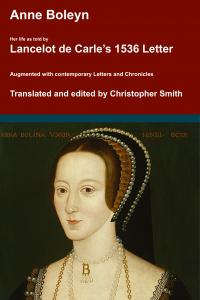
Anne Boleyn. Her Life as told by Lancelot de Carle's 1536 Letter.
In 1536, two weeks after the execution of Anne Boleyn, her brother George and four others, Lancelot du Carle, wrote an extraordinary letter that described Anne's life, and her trial and execution, to which he was a witness. This book presents a new translation of that letter, with additional material from other contemporary sources such as Letters, Hall's and Wriothesley's Chronicles, the pamphlets of Wynkyn the Worde, the Memorial of George Constantyne, the Portuguese Letter and the Baga de Secrets, all of which are provided in Appendices.
Available at Amazon in eBook and Paperback format.
Margaret Halliday Lady Hungerford was born to [her father] William Halliday.
In 1620 Edward Hungerford [aged 24] and Margaret Halliday Lady Hungerford were married.
On 14th February 1624 [her father] William Halliday [aged 59] died. He was buried at St Lawrence Jewry.

In 1631 Cornelius Janssens aka Johnson [aged 37]. Portrait of Margaret Halliday Lady Hungerford.
In 1648 [her husband] Edward Hungerford [aged 52] died without issue.

Samuel Pepys' Diary. 26th April 1669. After dinner comes one Colonel Macnachan, one that I see often at Court, a Scotchman, but know him not; only he brings me a letter from my Lord Middleton [aged 61], who, he says, is in great distress for £500 to relieve my Lord Morton with, but upon, what account I know not; and he would have me advance it without order upon his pay for Tangier, which I was astonished at, but had the grace to deny him with an excuse. And so he went away, leaving me a little troubled that I was thus driven, on a sudden, to do any thing herein; but Creed, coming just now to see me, he approves of what I have done. And then to talk of general matters, and, by and by, Sheres being gone, my wife, and he, and I out, and I set him down at Temple Bar, and myself and wife went down the Temple [Map] upon seeming business, only to put him off, and just at the Temple [Map] gate I spied Deb. with another gentlewoman, and Deb. winked on me and smiled, but undiscovered, and I was glad to see her. So my wife and I to the 'Change [Map], about things for her; and here, at Mrs. Burnett's shop, I am told by Betty, who was all undressed, of a great fire happened in Durham-Yard last night, burning the house of one Lady Hungerford, who was to come to town to it this night; and so the house is burned, new furnished, by carelessness of the girl sent to take off a candle from a bunch of candles, which she did by burning it off, and left the rest, as is supposed, on fire. The King [aged 38] and Court were here, it seems, and stopped the fire by blowing up of the next house. The King and Court went out of town to Newmarket, Suffolk this morning betimes, for a week.
In 1672 Margaret Halliday Lady Hungerford died without issue.
Proceedings of the Somerset Archaeological and Natural History Society Volume 3 Pages 114-124. The Chantry Chapel, Dedicated To St. Anne.
This is on the north side of the principal chapel, mea suring twenty feet by fifteen. It was probably built by Sir Thomas Hungerford, the purchaser of Farleigh, for private use, in what was then the parish church. After the suppression of chantries, it seems to have answered the purpose of a mausoleum. About a.d. 1650, it was embellished, and the vault underneath was enlarged, by Margaret (Halliday), lady of Sir [her former husband] Edward Hungerford, K.B. The walls were painted with coats of arms and figures of the floor was inlaid with black and white marble, in lozenge; and gilded iron gates, with arms and crests, were placed between the two chapels. The stained glass now in the windows has been added recently.
Proceedings of the Somerset Archaeological and Natural History Society Volume 3 Pages 114-124. No. 6. Sir [her former husband] Edward Hungerford, K.B., and Margaret (Halliday) his wife. — This is the latest of the Hungerford monuments at Farleigh. The Sir Edward buried here was a Colonel in the army of the Commonwealth, and commanded at the siege of Wardour Castle [Map], when it was defended by Blanche, Lady Arundel. He died a.d. 1648. His Lady was daughter of William Halliday, Alderman of London, and brought to the Hungerfords the Manors of Corsham, Iford, Stanton St. Quintin, etc. She founded an Almshouse at Corsham, and died 1672.
This fine monument is of black and white marble; the upper slab is in a single piece, eight feet long by five wide. Against the chantry chapel wall, on the east side, opposite the foot of the monument, is a small circular copper plate, formerly the cover of a leaden urn in the vault below, and relating to the Knight whose figure lies on the monument.