

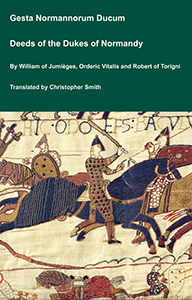
The Deeds of the Dukes of Normandy
The Gesta Normannorum Ducum [The Deeds of the Dukes of Normandy] is a landmark medieval chronicle tracing the rise and fall of the Norman dynasty from its early roots through the pivotal events surrounding the Norman Conquest of England. Originally penned in Latin by the monk William of Jumièges shortly before 1060 and later expanded at the behest of William the Conqueror, the work chronicles the deeds, politics, battles, and leadership of the Norman dukes, especially William’s own claim to the English throne. The narrative combines earlier historical sources with firsthand information and oral testimony to present an authoritative account of Normandy’s transformation from a Viking settlement into one of medieval Europe’s most powerful realms. William’s history emphasizes the legitimacy, military prowess, and governance of the Norman line, framing their expansion, including the conquest of England, as both divinely sanctioned and noble in purpose. Later chroniclers such as Orderic Vitalis and Robert of Torigni continued the history, extending the coverage into the 12th century, providing broader context on ducal rule and its impact. Today this classic work remains a foundational source for understanding Norman identity, medieval statesmanship, and the historical forces that reshaped England and Western Europe between 800AD and 1100AD.
Available at Amazon in eBook and Paperback format.
Around 1600 Martin Noell was born.
In 1662 Martin Noell (age 62) was knighted.
Samuel Pepys' Diary. 5th September 1662. So to my office, and there till 9 at night, and so to my lodgings to bed. I this day heard that Mr. Martin Noell (age 62) is knighted by the King (age 32), which I much wonder at; but yet he is certainly a very useful man.

Samuel Pepys' Diary. 27th February 1664. At noon with Mr. Coventry (age 36) to the African House, and to my Lord Peterborough's (age 42) business again, and then to dinner, where, before dinner, we had the best oysters I have seen this year, and I think as good in all respects as ever I eat in my life. I eat a great many. Great, good company at dinner, among others Sir Martin Noell (age 64), who told us the dispute between him, as farmer of the Additional Duty, and the East India Company, whether callicos be linnen or no; which he says it is, having been ever esteemed so: they say it is made of cotton woole, and grows upon trees, not like flax or hempe. But it was carried against the Company, though they stand out against the verdict.
On 29th September 1665 Martin Noell (age 65) died of plague.
Samuel Pepys' Diary. 29th September 1665. But at last I did, and so left my tallies there against another day, and so walked to Yowell [Map], and there did spend a peece upon them, having a whole house full, and much mirth by a sister of the mistresse of the house, an old mayde lately married to a lieutenant of a company that quarters there, and much pleasant discourse we had and, dinner being done, we to horse again and come to Greenwich, Kent [Map] before night, and so to my lodging, and there being a little weary sat down and fell to order some of my pocket papers, and then comes Captain Cocke (age 48), and after a great deal of discourse with him seriously upon the disorders of our state through lack of men to mind the public business and to understand it, we broke up, sitting up talking very late. We spoke a little of my late business propounded of taking profit for my money laid out for these goods, but he finds I rise in my demand, he offering me still £500 certain. So we did give it over, and I to bed. I hear for certain this night upon the road that Sir Martin Noell (age 65) is this day dead of the plague in London, where he hath lain sick of it these eight days.
Samuel Pepys' Diary. 8th October 1665. This day I hear the Pope is dead; [a false report] and one said, that the newes is, that the King of France (age 27) is stabbed, but that the former is very true, which will do great things sure, as to the troubling of that part of the world, the King of Spayne (deceased)1 being so lately dead. And one thing more, Sir Martin Noell's (deceased) lady is dead with griefe for the death of her husband and nothing else, as they say, in the world; but it seems nobody can make anything of his estate, whether he be dead worth anything or no, he having dealt in so many things, publique and private, as nobody can understand whereabouts his estate is, which is the fate of these great dealers at everything. So after my business being done I home to my lodging and to bed,
Note 1. Philip IV., King of Spain, who succeeded to the throne in 1621, died in 1665. He was succeeded by his son Charles II (age 3).


