

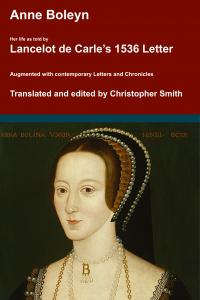
Anne Boleyn. Her Life as told by Lancelot de Carle's 1536 Letter.
In 1536, two weeks after the execution of Anne Boleyn, her brother George and four others, Lancelot du Carle, wrote an extraordinary letter that described Anne's life, and her trial and execution, to which he was a witness. This book presents a new translation of that letter, with additional material from other contemporary sources such as Letters, Hall's and Wriothesley's Chronicles, the pamphlets of Wynkyn the Worde, the Memorial of George Constantyne, the Portuguese Letter and the Baga de Secrets, all of which are provided in Appendices.
Available at Amazon in eBook and Paperback format.
In 1630 Mary Gifford was born to [her father] Thomas Gifford.
On 14th November 1644 John Shelley of Mitchelgrove 1st Baronet died. His son [her future husband] Charles succeeded 2nd Baronet Shelley of Mitchelgrove in Sussex.
Before 1662 [her future husband] Charles Shelley 2nd Baronet and Elizabeth Weston were married. She the daughter of Benjamin Weston and Elizabeth Sheldon Countess Anglesey [aged 53].
Samuel Pepys' Diary. 19th February 1664. After dinner I to the office, where we should have met upon business extraordinary, but business not coming we broke up, and I thither again and took my wife; and taking a coach, went to visit my Ladys Jemimah and Paulina Montagu, and Mrs. Elizabeth Pickering [aged 22], whom we find at their father's new house1 in Lincolne's Inn Fields; but the house all in dirt. They received us well enough; but I did not endeavour to carry myself over familiarly with them; and so after a little stay, there coming in presently after us my Lady Aberguenny [aged 34] and other ladies, we back again by coach, and visited, my wife did, my she cozen Scott, who is very ill still, and thence to Jaggard's again, where a very good supper and great store of plate; and above all after supper Mrs. Jaggard did at my entreaty play on the Vyall, but so well as I did not think any woman in England could and but few Maisters, I must confess it did mightily surprise me, though I knew heretofore that she could play, but little thought so well.
Note 1. The Earl of Sandwich had just moved to a house in Lincoln's Inn Fields. Elizabeth Dickering, who afterwards married John Creed, was niece to Lord Sandwich [aged 38].


Before 21st April 1665 George Neville [aged 50] and Mary Gifford [aged 35] were married.
On 21st April 1665 [her son] George Neville 1st Baron Abergavenny was born to [her husband] George Neville [aged 50] and Mary Gifford [aged 35]. He married before 26th March 1695 Honora Belasyse Baroness Bergavenny, daughter of John Belasyse 1st Baron Belasyse and Anne Paulett Baroness Belasyse.
On 2nd June 1666 [her husband] George Neville [aged 51] died.
After 2nd June 1666 Charles Shelley 2nd Baronet and Mary Gifford [aged 36] were married. His son John Shelley 3rd Baronet [aged 4] subsequently married her daughter Winifred Neville Lady Shelley.
In 1681 [her husband] Charles Shelley 2nd Baronet died. His son [her future son-in-law] John [aged 19] succeeded 3rd Baronet Shelley of Mitchelgrove in Sussex.
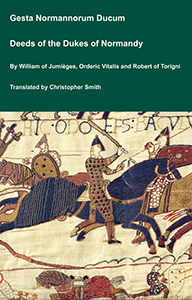
The Deeds of the Dukes of Normandy
The Gesta Normannorum Ducum [The Deeds of the Dukes of Normandy] is a landmark medieval chronicle tracing the rise and fall of the Norman dynasty from its early roots through the pivotal events surrounding the Norman Conquest of England. Originally penned in Latin by the monk William of Jumièges shortly before 1060 and later expanded at the behest of William the Conqueror, the work chronicles the deeds, politics, battles, and leadership of the Norman dukes, especially William’s own claim to the English throne. The narrative combines earlier historical sources with firsthand information and oral testimony to present an authoritative account of Normandy’s transformation from a Viking settlement into one of medieval Europe’s most powerful realms. William’s history emphasizes the legitimacy, military prowess, and governance of the Norman line, framing their expansion, including the conquest of England, as both divinely sanctioned and noble in purpose. Later chroniclers such as Orderic Vitalis and Robert of Torigni continued the history, extending the coverage into the 12th century, providing broader context on ducal rule and its impact. Today this classic work remains a foundational source for understanding Norman identity, medieval statesmanship, and the historical forces that reshaped England and Western Europe between 800AD and 1100AD.
Available at Amazon in eBook and Paperback format.
Before 15th June 1685 [her son-in-law] John Shelley 3rd Baronet [aged 23] and [her daughter] Winifred Neville Lady Shelley were married. She by marriage Lady Shelley of Mitchelgrove in Sussex. His father [her former husband] Charles Shelley 2nd Baronet and her mother Mary Gifford [aged 55] were married meaning her step-father became her father-in-law.
Before 24th May 1687 [her daughter] Winifred Neville Lady Shelley died.
Before 26th March 1695 [her son] George Neville 1st Baron Abergavenny [aged 29] and [her daughter-in-law] Honora Belasyse Baroness Bergavenny were married. She by marriage Baroness Abergavenny.
On 26th March 1695 [her son] George Neville 1st Baron Abergavenny [aged 29] died. Baron Abergavenny extinct..
Before 14th November 1699, the date she was buried, Mary Gifford [aged 69] died.
Cansisk's Monumental Inscriptions Volume 1 Old St Pancras Churchyard. Churchyard St Pancras Old Church [Map]. The Right Hon. Mary [deceased], Lady Dowager Abergavenny, buried Nov. 14, 1699.
[her daughter] Winifred Neville Lady Shelley was born to George Neville and Mary Gifford. She married before 15th June 1685 John Shelley 3rd Baronet, son of Charles Shelley 2nd Baronet and Elizabeth Weston, and had issue.