

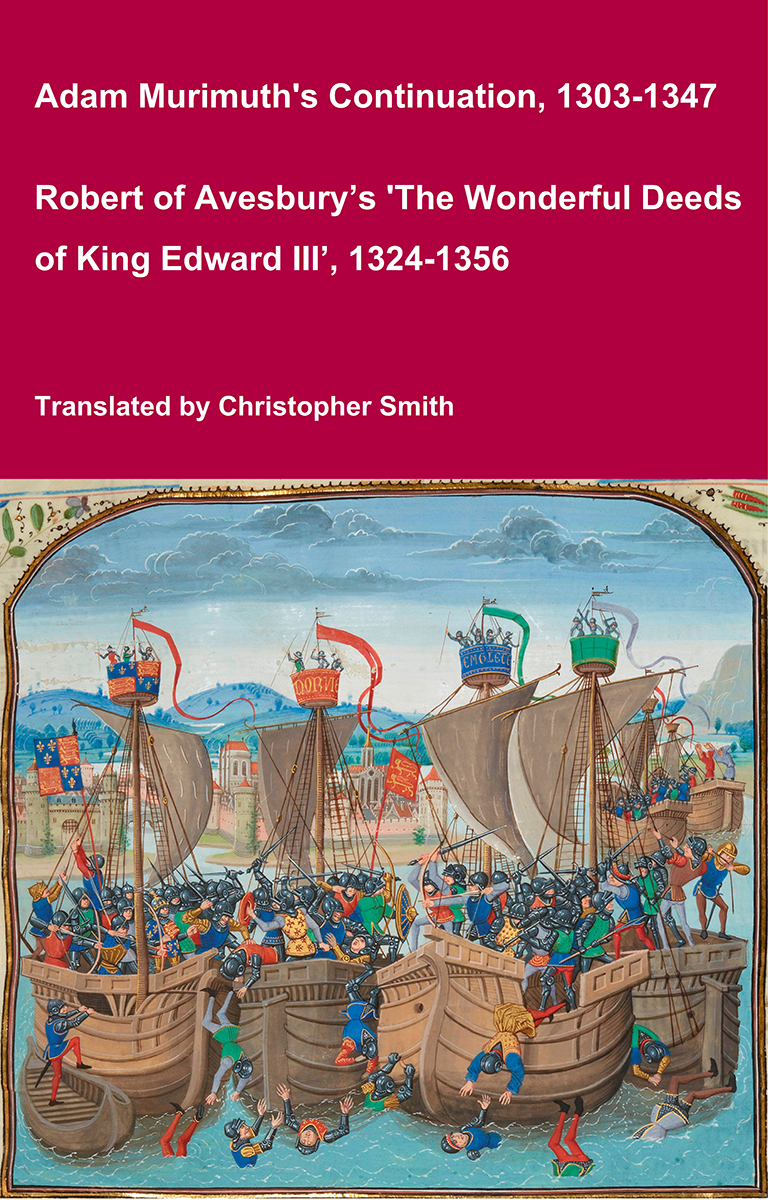
Adam Murimuth's Continuation and Robert of Avesbury’s 'The Wonderful Deeds of King Edward III'
This volume brings together two of the most important contemporary chronicles for the reign of Edward III and the opening phases of the Hundred Years’ War. Written in Latin by English clerical observers, these texts provide a vivid and authoritative window into the political, diplomatic, and military history of fourteenth-century England and its continental ambitions. Adam Murimuth Continuatio's Chronicarum continues an earlier chronicle into the mid-fourteenth century, offering concise but valuable notices on royal policy, foreign relations, and ecclesiastical affairs. Its annalistic structure makes it especially useful for establishing chronology and tracing the development of events year by year. Complementing it, Robert of Avesbury’s De gestis mirabilibus regis Edwardi tertii is a rich documentary chronicle preserving letters, treaties, and official records alongside narrative passages. It is an indispensable source for understanding Edward III’s claim to the French crown, the conduct of war, and the mechanisms of medieval diplomacy. Together, these works offer scholars, students, and enthusiasts a reliable and unembellished account of a transformative period in English and European history. Essential for anyone interested in medieval chronicles, the Hundred Years’ War, or the reign of Edward III.
Available at Amazon in eBook and Paperback format.
On 24th September 1869 Maud Cunnington née Pegge was born.
In 1889 Benjamin Howard Cunnington (age 28) and Maud Cunnington née Pegge (age 19) were married.
Wiltshire Archaeological Magazine 1907 V35 Pages 1-20. Notes on the Opening of a Bronze Age Barrow at Manton [Manton Barrow aka Preshute G1a [Map]], near Marlborough By Mrs M E Cunnington (age 37).


Wiltshire Archaeological Magazine 1910 V36 Pages 311-317. Notes On Barrows [King's Play Hill Long Barrow [Map], King's Play Hill Round Barrow 1 [Map], King's Play Hill Round Barrow 2 [Map]] On King's Play Down, Heddington.1 By Maud E. Cunnington (age 40).
Note 1. The three barrows here described were opened by Mr. B. H. Cunnington and myself in August, 1907, by kind permission of Captain Spicer, of Spye Park and of his tenant, Mr. Peak-Garland.
Wiltshire Archaeological Magazine 1910 V36 Pages 300-310. The Discovery Of A Chamber In The Long Barrow At Lanhill [Lanhill Long Barrow aka Hubba's Low [Map]], Near Chippenham. By Maud E. Cunnington (age 40).
Wiltshire Archaeological Magazine 1913 V38 Pages 1-11. June 1913. The Re-Erection of Two Fallen Stones [Longstones Cove aka Devil's Quoits [Map]], and Discovery of an Interment with Drinking Cup, At Avebury.1 By Mrs. M. E. Cunnington (age 43).
Wiltshire Archaeological Magazine 1913 V38 Pages 379-414. June 1914. List Of The Long Barrows Of Wiltshire. By Mrs. M. E. Cunnington (age 44).
[Referred to in the previous List of Prehistoric Antiquities, pp. 153—378, as "Appendix, Long Barrows."]
Wiltshire Archaeological Magazine 1925 V43 Pages 48-58. Figsbury Rings [Map]. An Account Of Excavations In 19241. By Mrs. M. E. Cunnington (age 55).
Wiltshire Archaeological Magazine 1930 V45 Pages 300-335. The "Sanctuary" [Map] On Overton Hill, Near Avebury. By M. E. Cunnington (age 60). Being an account of excavations carried out by Mr. and Mrs. B. H, Cunnington in 1930.
Abbot John Whethamstede’s Chronicle of the Abbey of St Albans
Abbot John Whethamstede's Register aka Chronicle of his second term at the Abbey of St Albans, 1451-1461, is a remarkable text that describes his first-hand experience of the beginning of the Wars of the Roses including the First and Second Battles of St Albans, 1455 and 1461, respectively, their cause, and their consequences, not least on the Abbey itself. His text also includes Loveday, Blore Heath, Northampton, the Act of Accord, Wakefield, and Towton, and ends with the Coronation of King Edward IV. In addition to the events of the Wars of the Roses, Abbot John, or his scribes who wrote the Chronicle, include details in the life of the Abbey such as charters, letters, land exchanges, visits by legates, and disputes, which provide a rich insight into the day-to-day life of the Abbey, and the challenges faced by its Abbot.
Available at Amazon in eBook and Paperback format.
In 1950 [her husband] Benjamin Howard Cunnington (age 89) died.
On 28th February 1951 Maud Cunnington née Pegge (age 81) died.

Longstones Cove aka Devil's Quoits [Map], aka Adam and Eve, Longstone Cove, Devil's Coits, describe two large upright sarsen stones in a field to the south-west of the Avebury Henge. One of the stones fell and was re-erected in 1911. During the course of its re-erection husband and wife Benjamin and Maud Cunnington discovered a crouched skeleton with beaker ware at its foot. When re-erected the larger stone, known as Adam, was rotated by around 45 degress clockwise from its original position.
Antiquity 2022 Volume 96.2: References. Cunnington, M. 1929. Woodhenge. Devizes: privately published.